TITAN · 08
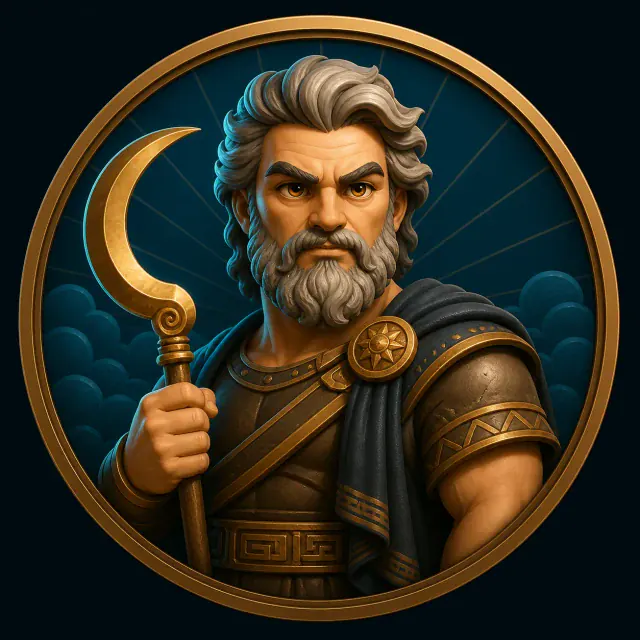
Illustrated portrait of Cronus

Portrait from the MythBranch atlas
Interpretive illustration, not an ancient likeness

Greek mythology research profile · cited sources

Cronus

Saturn · Titan ruler before Zeus

Cronus is the youngest Titan, the son who answers Gaia's call, overthrows Uranus, and then repeats the older ruler's fear by swallowing his own children. Rhea saves Zeus, who forces the siblings' return and defeats the Titans. Greek Cronus and Roman Saturn become deeply entangled in later art, where the sickle, agriculture, time, melancholy, and child-devouring produce one of mythology's most disturbing visual traditions.

Names · attributes · ancient evidence

Cronus: identity and historical contexts.

Cronus's sickle first appears as Gaia's tool for separating sky from earth. Once ruler, he learns that a child will overthrow him and answers by ingesting each newborn. The image is the inverse of parenthood: instead of allowing descendants into the world, he returns them to a closed paternal body. Zeus's escape depends on Rhea, Gaia, deception, and a stone wrapped like an infant.

Cronus is not originally Chronos, personified Time, although Greek and Roman thinkers, poets, and artists increasingly linked the similar names. Roman Saturn has a major agricultural festival, civic history, and story of a Golden Age that cannot be treated as a simple translation of every Greek Cronus passage. Goya's Saturn is a modern reception shaped by war, aging, and the Black Paintings, not an illustration of one fixed ancient scene.

01Kronos · Cronus02Ankylomētēs · Crooked-counselled03Neōtatos Titanōn · Youngest Titan04Saturnus · Saturn05Pater temporis · Father Time, later reception
01

Two generations, one repeated strategy

Uranus hides children in Gaia; Cronus swallows children into himself. Both rulers try to cancel succession by denying descendants independent space. Cronus therefore occupies a moral hinge: his courageous answer to Gaia does not prevent him from reproducing the structure he overthrew when power becomes his own.
02

Why Saturn's images dominate

European artists generally use the Roman name and inherit associations with melancholy, agriculture, planetary influence, old age, and time. Rubens and Goya both paint cannibalism, but their works are not interchangeable covers. Each page record names its maker, medium, institution, and interpretive context so a famous image does not become generic mythology wallpaper.

Texts · chronology · variant traditions

Selected ancient narratives involving Cronus.

Cronus's three central episodes form a deliberate succession pattern rather than a disconnected set of violent anecdotes.

01

First divine succession

Cronus answers Gaia

Gaia, burdened by children whom Uranus hides within her, makes an adamant sickle and asks the Titans to punish their father. Only Cronus speaks. He ambushes Uranus and strikes, separating sky from earth and releasing the possibility of a new generation. The act also produces avenging and monstrous descendants from its aftermath.

Hesiodic tradition: Theogony ↗
02

Titan kingship

The children are swallowed

Cronus marries Rhea and swallows Hestia, Demeter, Hera, Hades, and Poseidon as each is born because Gaia and Uranus have foretold defeat by a child. Rhea's grief turns her toward the same older advisers. The ruler who once freed siblings now transforms his own body into a prison.

Hesiodic tradition: Theogony ↗
03

Rise of Zeus

The stone and the Titan war

Rhea hides Zeus in Crete and gives Cronus a swaddled stone. Zeus grows, makes Cronus disgorge the siblings, frees powerful captives, and wages war. After defeat, Cronus's later fate varies: imprisonment in Tartarus in some accounts, release or blessed rule in others, especially traditions connected with the Isles of the Blessed and Roman Saturn.

Hesiodic tradition: Theogony ↗Pseudo-Apollodorus: Library of Greek Mythology ↗

Genealogical records and atlas relationships

Genealogical evidence and variant traditions.

Cronus and Rhea stand between primordial generation and the first Olympian siblings. The atlas emphasizes this dynastic bridge while omitting several later traditions about Cronus's additional children or final abode.

Genealogy note

Hesiod names Hestia, Demeter, Hera, Hades, Poseidon, and Zeus as children of Cronus and Rhea. The chart's order is visual rather than a claim about exact birth order in every source.

Open the interactive branch ↗

Text · stage · screen · scholarship

Selected works concerning Cronus in later reception.

Each selected work treats this figure as its subject, title presence, principal voice, or central dramatic agent. Incidental appearances are excluded. The bibliography also avoids assigning the same representative title to multiple profiles except where a shared primary text is indispensable.

  1. late 8th–7th c. BCETheogony: The Reign of CronusCosmogonic poem
  2. early 5th c. CESaturnalia, Book ILearned dialogue
  3. 1820–23SaturnBlack Painting
01

Selected bibliography

Ancient succession

01 works
02

Selected bibliography

Roman antiquarian reception

01 works
03

Selected bibliography

Visual reception

01 works

When modern book covers or publicity images are shown, they appear at small scale for identification and criticism; copyright remains with the named rights holders. Public-domain context images are explicitly labeled.

Sources and documentation

Primary texts, scholarship, and catalogue records.

Dates follow conventional scholarly ranges. Cover thumbnails identify modern editions; they do not represent the original material form of an ancient text. Links lead to university archives, publishers, and museum catalogues.

Ancient source

2
  1. 01TheogonyHesiodic tradition
    Verified text or catalogue record
    Theogony↗

    Hesiodic tradition · late 8th–7th c. BCE

    Cronus's attack on Uranus, swallowed children, deception, and defeat.
    Edition or recordGreek text and translation · Perseus Digital Library
  2. 02Library of Greek MythologyPseudo-Apollodorus
    Verified text or catalogue record
    Library of Greek Mythology↗

    Pseudo-Apollodorus · 1st–2nd c. CE

    Later narrative synthesis of the Titan succession and war.
    Edition or recordGreek text and translation · Perseus Digital Library

Academic study

1
  1. 01Cronus and Saturn in Classical TraditionClassical reception scholarship trail
    Verified text or catalogue record
    Cronus and Saturn in Classical Tradition↗

    Classical reception scholarship trail · Modern research

    Research path for the later fusion with time, agriculture, astrology, and melancholy.
    Edition or recordJSTOR indexed scholarship

Museum research

1
  1. 01SaturnMuseo Nacional del Prado
    Verified text or catalogue record
    Saturn↗

    Museo Nacional del Prado · 1820–23

    Authoritative object, technique, provenance, and Black Paintings context.
    Edition or recordPrado collection record P000763

Family questions

Questions about Cronus's family.

Who are Cronus's parents?

Cronus is a son of Gaia and Uranus and the youngest of the twelve Titans in Hesiod.

Why did Cronus swallow his children?

He feared a prophecy that a child would overthrow him, repeating the succession he had enacted against Uranus.

Is Cronus the same as Saturn or Father Time?

Roman Saturn became Cronus's closest equivalent. The association with personified Time is influential but develops through later interpretation and wordplay, not a simple original identity.