OLYMPIAN · 17
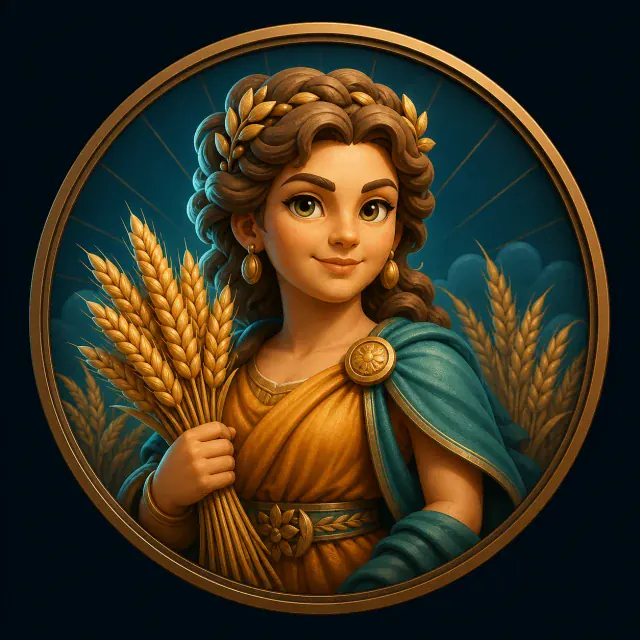
Illustrated portrait of Demeter

Portrait from the MythBranch atlas
Interpretive illustration, not an ancient likeness

Greek mythology research profile · cited sources

Demeter

Ceres · Grain, maternal power, famine & renewal

Demeter is goddess of grain, agriculture, and the sacred knowledge that sustains settled life. Her most important surviving poem is also one of mythology's strongest accounts of maternal power: when Persephone disappears, Demeter searches, rejects divine normality, stops growth, and compels a settlement among Zeus and Hades. At Eleusis, her story anchored mysteries promising initiates a changed relation to death.

Names · attributes · ancient evidence

Demeter: identity and historical contexts.

Demeter's name likely contains a maternal element, while the first part remains debated. She is not a generic goddess of all nature; grain, cultivated land, seasonal work, women's ritual, law, and the human techniques of subsistence define much of her field. Torches recall the search for Persephone, wheat and poppies mark fertility, and the Eleusinian pair of mother and daughter becomes one of the ancient Mediterranean's most enduring sacred relationships.

The common classroom formula ‘Persephone causes the seasons’ is incomplete. The Homeric Hymn describes Demeter's deliberate famine and a negotiated partial return, not an automatic natural mechanism. Details of the Eleusinian Mysteries were secret, and later writers provide fragments rather than a complete ritual script. Responsible discussion distinguishes public myth, archaeological evidence, and speculative reconstruction.

01Chloē · Green shoot02Thesmophoros · Bringer of sacred law03Sito · Grain04Karpophoros · Fruit-bearer05Erinys · Wrathful Demeter
01

Agriculture is a relationship of dependence

Immortals do not need bread, but humans and the honors humans offer gods depend on harvest. Demeter's withdrawal therefore turns grief into leverage over Zeus's whole order. The hymn recognizes care work and food production as foundations of sovereignty rather than a domestic background to male politics.


02

Eleusis promises without explaining everything

The hymn links Demeter to the foundation of rites and says the initiated are blessed, but surviving sources avoid disclosing central ritual experiences. Archaeology identifies processional routes, buildings, offerings, and long institutional history. A serious page can explain the framework while refusing modern claims to reveal the secret in one sentence.

Texts · chronology · variant traditions

Selected ancient narratives involving Demeter.

Demeter's myths join intimate grief to agricultural survival and the creation of sacred communities.

01

Homeric Hymn to Demeter

Demeter hears Persephone vanish

Persephone cries out as Hades carries her below. Demeter hears but does not know the captor, wanders for nine days with torches, and refuses nectar, ambrosia, and bathing. Hecate and Helios eventually help reveal what happened and Zeus's role in the marriage arrangement.

Anonymous: Homeric Hymn to Demeter ↗
02

Mortal disguise

Demeter lives at Eleusis

Disguised as an old woman, Demeter enters the household of Celeus and Metaneira and nurses Demophon. She tries to make him immortal through fire and ambrosia, but the frightened mother interrupts. Demeter reveals herself and commands that a temple and rites be established.

Anonymous: Homeric Hymn to Demeter ↗
03

Divine crisis

The earth stops growing

Demeter remains in her temple and prevents seed from sprouting. Famine threatens humanity and the gods' sacrifices. Zeus sends messengers and finally Hermes to Hades. Persephone returns, but because she has eaten pomegranate seed she must spend part of the year below.

Anonymous: Homeric Hymn to Demeter ↗

Genealogical records and atlas relationships

Genealogical evidence and variant traditions.

The atlas shows Demeter as a daughter of Cronus and Rhea and Persephone as her daughter. The central mother–daughter line remains more important to this profile than a comprehensive list of Demeter's local children and partners.

Unions drawn in this atlas

00

No line of this type is drawn in the current atlas.

Children drawn in this atlas

01
Genealogy note

Zeus is Persephone's father in the Homeric Hymn. Other traditions connect Demeter with Iasion, Poseidon, Plutus, Arion, and Despoina; local Arcadian stories differ sharply from the Eleusinian hymn.

Open the interactive branch ↗

Text · stage · screen · scholarship

Selected works concerning Demeter in later reception.

Each selected work treats this figure as its subject, title presence, principal voice, or central dramatic agent. Incidental appearances are excluded. The bibliography also avoids assigning the same representative title to multiple profiles except where a shared primary text is indispensable.

  1. 7th–6th c. BCEHomeric Hymn to DemeterNarrative hymn
  2. 2022Olympians: Demeter and Persephone — The Hidden SeedGraphic novel
  3. 1999DemeterPoem in The World's Wife
01

Selected bibliography

Ancient hymn & ritual

01 works
02

Selected bibliography

Graphic biography

01 works
03

Selected bibliography

Modern poetry

01 works

When modern book covers or publicity images are shown, they appear at small scale for identification and criticism; copyright remains with the named rights holders. Public-domain context images are explicitly labeled.

Sources and documentation

Primary texts, scholarship, and catalogue records.

Dates follow conventional scholarly ranges. Cover thumbnails identify modern editions; they do not represent the original material form of an ancient text. Links lead to university archives, publishers, and museum catalogues.

Ancient source

2
  1. 01Homeric Hymn to DemeterAnonymous
    Verified text or catalogue record
    Homeric Hymn to Demeter↗

    Anonymous · 7th–6th c. BCE

    The principal literary source for search, famine, Eleusis, settlement, and return.
    Edition or recordHarvard Center for Hellenic Studies translation
  2. 02Description of GreecePausanias
    Verified text or catalogue record
    Description of Greece↗

    Pausanias · 2nd c. CE

    Cult places, local images, Triptolemus, and variants around Demeter.
    Edition or recordGreek text and translation · Perseus Digital Library

Academic study

1
  1. 01Eleusis and the Eleusinian MysteriesArchaeological scholarship trail
    Verified text or catalogue record
    Eleusis and the Eleusinian Mysteries↗

    Archaeological scholarship trail · Modern research

    Historical framework for sanctuary, festival, initiation, and limits of evidence.
    Edition or recordEncyclopaedia Britannica research overview

Museum research

1
  1. 01Great Eleusinian ReliefThe Metropolitan Museum of Art
    Verified text or catalogue record
    Great Eleusinian Relief↗

    The Metropolitan Museum of Art · Museum record

    Curatorial analysis of Demeter, Persephone, Triptolemus, copy, and reconstruction.
    Edition or recordMet Collection object 14.130.9

Family questions

Questions about Demeter's family.

Who are Demeter's parents?

Demeter is a daughter of Cronus and Rhea and one of Zeus's first-generation Olympian siblings.

Who is Demeter's daughter?

Persephone, also called Kore, is Demeter's daughter by Zeus in the Homeric Hymn.

Did Demeter cause winter?

The hymn describes Demeter stopping the growth of crops during her conflict with Zeus and Hades. Later seasonal explanations condense a narrative that also concerns divine authority and ritual.