DEITY · 16
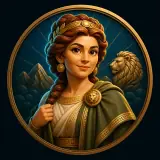
Illustrated portrait of Hades

Portrait from the MythBranch atlas
Interpretive illustration, not an ancient likeness

Greek mythology research profile · cited sources

Hades

Pluto / Dis · Sovereign of the dead and hidden wealth

Hades is the son of Cronus and Rhea who receives rule of the underworld after the Titan war. He is sovereign of the dead, not the personification of death and not normally one of the resident Twelve Olympians. His feared name often doubles as the realm itself. The abduction and marriage of Persephone dominate his mythology, while later Pluto emphasizes the wealth hidden beneath the earth.

Names · attributes · ancient evidence

Hades: identity and historical contexts.

Hades means ‘the unseen one’ in traditional interpretation, and euphemisms such as Plouton, Wealthy One, redirect attention toward mineral and agricultural riches below ground. He maintains boundaries: the dead enter, few return, and exceptional crossings require divine permission or heroic force. Thanatos personifies death, Hermes guides souls, judges assess them in later accounts, and Hades rules the realm; collapsing these offices produces a misleading Greek Satan.

Ancient worshippers did honor Hades and underworld powers, but literary and ritual caution around naming him differs from the public festival visibility of many Olympians. The Persephone story must also be told with genre and power visible: the Homeric Hymn centers Demeter's grief and Persephone's experience, while later art and romance can soften abduction into courtship. Modern adaptations often make Hades witty, rebellious, or entrepreneurial; those are transformations, not ancient consensus.

01Aidoneus · The unseen02Plouton · Wealthy one03Polydegmōn · Receiver of many04Klymenos · Renowned05Zeus Katachthonios · Zeus below
01

A realm and its ruler share one name

When a translation says someone goes ‘to Hades,’ context decides whether the phrase means the god, his house, or the entire underworld. The overlap is ancient and productive, but a family tree needs a person-node. This page therefore distinguishes sovereign relationships from geographic descriptions while showing why the language keeps them close.

02

Wealth grows from the same ground that holds the dead

Plouton links underground riches, seed burial, agricultural return, and the accumulation of countless souls. The association does not make Hades a cheerful harvest god. It reveals a chthonic logic in which fertility and death occupy the same earth, especially beside Demeter and Persephone at Eleusis.

Texts · chronology · variant traditions

Selected ancient narratives involving Hades.

Hades appears most clearly where a boundary is crossed—by force, bargain, song, ritual, or the seasonal movement of Persephone.

02

Homeric Hymn to Demeter

Persephone is taken

With Zeus's knowledge, Hades seizes Persephone as she gathers flowers and carries her below. Demeter searches, withdraws fertility, and forces a settlement. Persephone returns but the pomegranate binds her to part of each year in the underworld, where she reigns beside Hades.

Anonymous: Homeric Hymn to Demeter ↗
03

Orphic and later poetic tradition

Orpheus sings before the rulers below

Orpheus descends to recover Eurydice and moves the underworld powers with song. Hades and Persephone allow return under a condition that fails when Orpheus looks back. Versions differ in which ruler responds and why, but the story makes artistic persuasion briefly alter the law of death.

Ovid: Metamorphoses ↗
04

Twelfth Labor

Heracles brings Cerberus upward

Heracles descends and asks or forces permission to take Cerberus, often under the condition that he use no weapons. He masters the hound, displays it in the upper world, and returns it. Hades's realm can be entered by exceptional heroes, but its guardian and order are restored.

Pseudo-Apollodorus: Library of Greek Mythology ↗

Genealogical records and atlas relationships

Genealogical evidence and variant traditions.

The atlas places Hades among the children of Cronus and Rhea and connects him selectively with Persephone. Ancient tradition gives the royal pair a more complex ritual and narrative identity than one union line can show.

Unions drawn in this atlas

01

Children drawn in this atlas

00

No line of this type is drawn in the current atlas.

Genealogy note

Hades and Persephone are the central underworld couple. Some later sources name children such as Macaria or Melinoe with varying parentage; those lines are not consistent enough to present as one undisputed family.

Open the interactive branch ↗

Text · stage · screen · scholarship

Selected works concerning Hades in later reception.

Each selected work treats this figure as its subject, title presence, principal voice, or central dramatic agent. Incidental appearances are excluded. The bibliography also avoids assigning the same representative title to multiple profiles except where a shared primary text is indispensable.

  1. 2020HadesNarrative action game
  2. 2010 / Broadway 2019HadestownFolk opera / musical
  3. 1607L'Orfeo: Pluto's JudgmentOpera
01

Selected bibliography

Games & stage

02 works
02

Selected bibliography

Opera & poetry

01 works

When modern book covers or publicity images are shown, they appear at small scale for identification and criticism; copyright remains with the named rights holders. Public-domain context images are explicitly labeled.

Sources and documentation

Primary texts, scholarship, and catalogue records.

Dates follow conventional scholarly ranges. Cover thumbnails identify modern editions; they do not represent the original material form of an ancient text. Links lead to university archives, publishers, and museum catalogues.

Ancient source

4
  1. 01Iliad, Book 15Homeric tradition
    Verified text or catalogue record
    Iliad, Book 15↗

    Homeric tradition · late 8th–early 7th c. BCE

    Poseidon's account of the three brothers' allotted domains.
    Edition or recordOpen translation · Harvard Center for Hellenic Studies
  2. 02Homeric Hymn to DemeterAnonymous
    Verified text or catalogue record
    Homeric Hymn to Demeter↗

    Anonymous · 7th–6th c. BCE

    The central evidence for abduction, Demeter's search, famine, settlement, and Persephone's divided year.
    Edition or recordHarvard Center for Hellenic Studies translation
  3. 03Library of Greek MythologyPseudo-Apollodorus
    Verified text or catalogue record
    Library of Greek Mythology↗

    Pseudo-Apollodorus · 1st–2nd c. CE

    Realm division, heroic descents, Cerberus, and family variants.
    Edition or recordGreek text and translation · Perseus Digital Library
  4. 04MetamorphosesOvid
    Verified text or catalogue record
    Metamorphoses↗

    Ovid · c. 8 CE

    Roman transformations of Persephone, Orpheus, and underworld narrative.
    Edition or recordLatin text and English translation · Perseus

Museum research

1
  1. 01Hydria: Abduction of PersephoneThe Metropolitan Museum of Art
    Verified text or catalogue record
    Hydria: Abduction of Persephone↗

    The Metropolitan Museum of Art · c. 340–330 BCE

    Public-domain object and curatorial interpretation of Hades's chariot scene.
    Edition or recordMet Collection object 07.128.1

Family questions

Questions about Hades's family.

Who are Hades's parents?

Hades is a son of Cronus and Rhea and brother of Zeus, Poseidon, Hera, Demeter, and Hestia.

Is Hades one of the Twelve Olympians?

He belongs to the Olympian divine generation but is usually excluded from lists of twelve resident Olympians because he rules below.

Is Hades the god of death?

Hades rules the dead and underworld. Thanatos personifies death itself, while Hermes and other figures have different roles in the soul's passage.