TITAN · 13
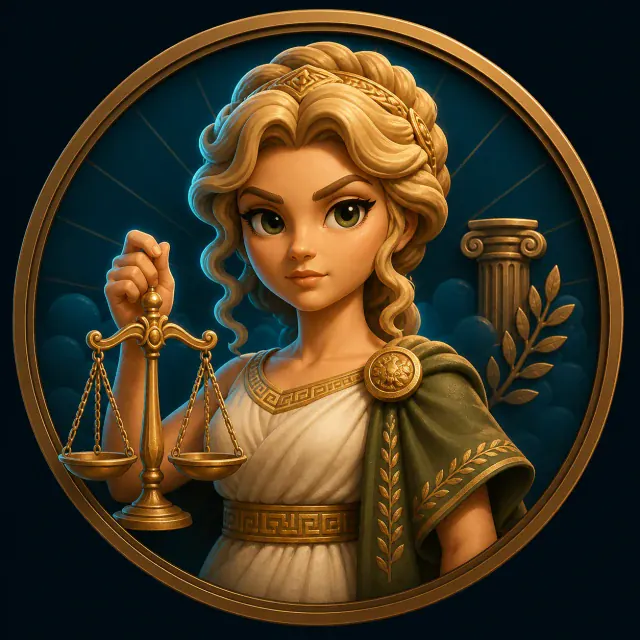
Illustrated portrait of Themis

Portrait from the MythBranch atlas
Interpretive illustration, not an ancient likeness

Greek mythology research profile · cited sources

Themis

Justitia · Custom, right order, and lawful process

Themis is the Titan goddess of themis: established order, custom, rightful procedure, divine ordinance, and the structure that lets assemblies and relationships function. She is daughter of Gaia and Uranus, adviser and partner of Zeus, and mother in Hesiod of the Hours and Fates. Modern courthouses often confuse her with blindfolded Lady Justice, but ancient Themis is older, prophetic, relational, and not defined by one universal set of scales.

Names · attributes · ancient evidence

Themis: identity and historical contexts.

The Greek word themis can mean what is laid down or fitting within divine and social order. In Homer, Themis can summon or dismiss assemblies; in Hesiod, her union with Zeus generates Eunomia, Dike, and Eirene—good order, justice, and peace—as well as the Fates in one major genealogy. Prophetic tradition also places Themis before Apollo at Delphi, linking lawful order with knowledge about what must come.

Themis, Dike, Roman Justitia, and modern Lady Justice overlap in later visual culture but are not identical. Blindfold, scales, and sword developed through long allegorical traditions, often far removed from ancient depictions. Catalogue identification must distinguish objects that name Themis from general personifications of Justice and from Roman or later civic figures. Courthouse statues are therefore not treated automatically as evidence for Greek Themis.

01Themis · Established order02Euboulos · Good counsellor03Ichnaia · Tracker04Agoraia · Of assembly05Themistes · Giver of ordinances
01

Advice is part of sovereignty

Zeus's rule is not pictured as solitary command. Themis convenes assemblies, organizes feasts, and represents procedures through which divine order becomes repeatable. Her Titan birth also means Olympian law depends on knowledge inherited from an older generation rather than appearing fully new after victory.


02

Justice is her daughter and later double

Hesiod makes Dike a daughter of Zeus and Themis. Later art and legal symbolism frequently merge mother, daughter, and Roman Justitia. That fusion has historical significance, but it should not be projected backward as proof that ancient Themis was always blindfolded and holding the exact modern attributes.

Texts · chronology · variant traditions

Selected ancient narratives involving Themis.

Her major evidence appears not in adventures but wherever power must become legitimate, assembled, inherited, or warned.

01

Hesiod · Theogony

Themis and Zeus generate civic goods

After Metis, Zeus marries bright Themis. She bears the Hours—Eunomia, Dike, and flourishing Eirene—and the Fates in Hesiod's account. The genealogy makes good order, justice, peace, and allotted destiny children of sovereign power joined with established right.

Hesiodic tradition: Theogony ↗
02

Prophetic succession

Themis holds the Delphic seat

Aeschylus's Eumenides opens with the Pythia naming Earth as first prophet, then Themis, Phoebe, and Apollo. Other traditions arrange the Delphic succession differently, but Themis repeatedly carries primordial knowledge forward into Olympian prophecy.

Aeschylus: Eumenides ↗Pausanias: Description of Greece ↗
03

Homeric epic

Themis summons divine assembly

In epic, Themis can call the gods together, receive Zeus, or participate in the ordered hospitality of Olympus. These brief actions are easy to overlook because they lack combat, yet they show the infrastructure of divine community: someone must make gathering, speech, precedence, and feast intelligible.

Homeric tradition: Iliad ↗

Genealogical records and atlas relationships

Genealogical evidence and variant traditions.

The atlas shows Themis among the Titans but does not draw her union with Zeus or children. That omission keeps the full graph readable; the profile states the important Hours-and-Fates genealogy explicitly.

Unions drawn in this atlas

00

No line of this type is drawn in the current atlas.

Children drawn in this atlas

00

No line of this type is drawn in the current atlas.

Genealogy note

Hesiod makes Themis mother of the Hours and Fates by Zeus. Other traditions assign the Fates different parentage, demonstrating why one line should not be presented as universal.

Open the interactive branch ↗

Text · stage · screen · scholarship

Selected works concerning Themis in later reception.

Each selected work treats this figure as its subject, title presence, principal voice, or central dramatic agent. Incidental appearances are excluded. The bibliography also avoids assigning the same representative title to multiple profiles except where a shared primary text is indispensable.

  1. 458 BCEEumenides: The Prophetic SuccessionTragedy
  2. 5th c. BCEPrometheus Bound: Themis as Prophetic MotherTragedy
  3. 1912Themis: A Study of the Social Origins of Greek ReligionClassical study
01

Selected bibliography

Ancient drama

02 works
02

Selected bibliography

Reference & scholarship

01 works

When modern book covers or publicity images are shown, they appear at small scale for identification and criticism; copyright remains with the named rights holders. Public-domain context images are explicitly labeled.

Sources and documentation

Primary texts, scholarship, and catalogue records.

Dates follow conventional scholarly ranges. Cover thumbnails identify modern editions; they do not represent the original material form of an ancient text. Links lead to university archives, publishers, and museum catalogues.

Ancient source

4
  1. 01TheogonyHesiodic tradition
    Verified text or catalogue record
    Theogony↗

    Hesiodic tradition · late 8th–7th c. BCE

    Titan parentage, union with Zeus, and children Hours and Fates.
    Edition or recordGreek text and translation · Perseus Digital Library
  2. 02EumenidesAeschylus
    Verified text or catalogue record
    Eumenides↗

    Aeschylus · 458 BCE

    Delphic prophetic succession and the movement from vengeance to civic process.
    Edition or recordGreek text and translation · Perseus Digital Library
  3. 03IliadHomeric tradition
    Verified text or catalogue record
    Iliad↗

    Homeric tradition · late 8th–early 7th c. BCE

    Themis as convener and participant in divine order.
    Edition or recordOpen translation · Harvard Center for Hellenic Studies
  4. 04Description of GreecePausanias
    Verified text or catalogue record
    Description of Greece↗

    Pausanias · 2nd c. CE

    Sanctuaries, cult images, and local prophetic traditions.
    Edition or recordGreek text and translation · Perseus Digital Library

Museum research

1
  1. 01Themis collection authorityThe British Museum
    Verified text or catalogue record
    Themis collection authority↗

    The British Museum · Collection research

    Curated biography and linked objects with changing Justice iconography.
    Edition or recordBritish Museum Collection Online

Family questions

Questions about Themis's family.

Who are Themis's parents?

Themis is a Titan daughter of Gaia and Uranus.

Who are Themis's children?

Hesiod makes her mother by Zeus of the Hours—Good Order, Justice, and Peace—and of the Fates.

Is Themis Lady Justice?

Themis contributes to the later visual tradition of Justice, but blindfolded Lady Justice also draws on Dike, Roman Justitia, and medieval and early modern allegory.