TITAN · 14
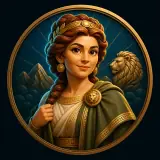
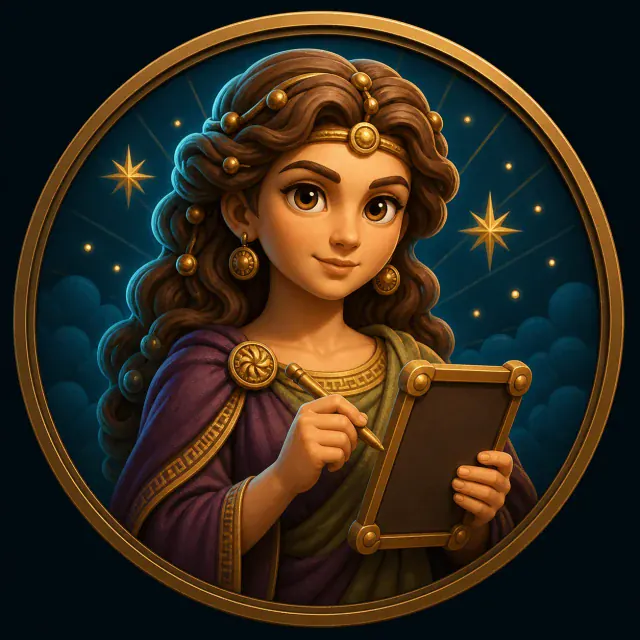
Illustrated portrait of Mnemosyne

Portrait from the MythBranch atlas
Interpretive illustration, not an ancient likeness

Greek mythology research profile · cited sources

Mnemosyne

Moneta · Memory as mother of artistic voice

Mnemosyne is the Titan goddess of memory, daughter of Gaia and Uranus and mother of the nine Muses by Zeus. Her genealogy associates poetic and historical knowledge with trained remembrance. Although she rarely acts as the protagonist of an extended narrative, invocations of the Muses presuppose her domain. Later poetry, psychology, museum practice, and Aby Warburg's Mnemosyne Atlas use her name in theories of cultural memory.

Names · attributes · ancient evidence

Mnemosyne: identity and historical contexts.

Mnēmosynē is both the ordinary capacity of memory and a divine Titan. Hesiod says Zeus lay with her for nine nights, after which she bore nine daughters who delight in song and relieve sorrow. The sequence connects ordered multiplicity—nine nights, nine Muses—with the preservation and performance of knowledge. In oral poetry, memory is not passive storage; it is a practiced power that makes vast inherited narratives available in the present.

Roman Moneta is only an approximate equivalent and has her own history, including Juno Moneta and the linguistic path toward ‘money.’ Orphic and mystery-related evidence gives Memory an eschatological role: initiates may be instructed to avoid Forgetfulness and drink from the lake of Mnemosyne. Modern ‘collective memory’ theories borrow the name but should not be retrojected as a complete ancient psychology.

01Mnēmosynē · Memory02Mētēr Mousōn · Mother of Muses03Titanis04Polyēchos · Rich in echoes05Moneta · Roman reception
01

The Muses are not inspiration without archive

Poets call on the Muses because divine daughters of Memory can know names, sequences, and distant events beyond one human life. Their authority is genealogical: song comes from remembered order. Mnemosyne therefore occupies the infrastructure of epic even when she is not named in every performance.
02

The name Mnemosyne in Warburg's atlas

Aby Warburg's late Mnemosyne Atlas assembled image reproductions on black panels to trace gestures and forms across time. The project does not retell the goddess's myths; it adopts her name for a method concerned with cultural memory and relations among images.

Texts · chronology · variant traditions

Selected ancient narratives involving Mnemosyne.

Mnemosyne's surviving profile joins divine genealogy, oral performance, and the high stakes of remembering after death.

01

Hesiod · Theogony

Nine nights and nine Muses

Zeus visits Mnemosyne for nine consecutive nights away from the other gods. She later bears nine like-minded daughters who delight in feasts and song. Hesiod names each Muse and links their gifts with the capacity of kings and poets to speak persuasively and relieve grief.

Hesiodic tradition: Theogony ↗
02

Epic performance

The poet asks the Muses to remember

Epic invocations ask the Muse to sing, tell, or recall events that no mortal performer directly witnessed. The request relies on Mnemosyne's descendants as a collective intelligence spanning divine councils, battlefields, voyages, and genealogies. Memory becomes the condition of authoritative narration rather than a private mental faculty.

Homeric tradition: Iliad ↗
03

Orphic gold tablets

The initiate chooses Memory

Several inscribed tablets buried with the dead instruct the soul to avoid a spring associated with Forgetfulness and seek the water of Mnemosyne, declaring a special identity to guardians. The texts vary and belong to particular ritual contexts, but they make remembered knowledge a means of navigating death.

Multiple initiatory contexts: Orphic Gold Tablets ↗

Genealogical records and atlas relationships

Genealogical evidence and variant traditions.

The atlas shows Mnemosyne among the Titans but not her union with Zeus or the nine Muses. The profile restores that foundational line because it explains her significance more fully than an isolated domain label.

Unions drawn in this atlas

00

No line of this type is drawn in the current atlas.

Children drawn in this atlas

00

No line of this type is drawn in the current atlas.

Genealogy note

Hesiod makes Mnemosyne mother of Calliope, Clio, Erato, Euterpe, Melpomene, Polyhymnia, Terpsichore, Thalia, and Urania by Zeus. Lists and functions become more standardized over time.

Open the interactive branch ↗

Text · stage · screen · scholarship

Selected works concerning Mnemosyne in later reception.

Each selected work treats this figure as its subject, title presence, principal voice, or central dramatic agent. Incidental appearances are excluded. The bibliography also avoids assigning the same representative title to multiple profiles except where a shared primary text is indispensable.

  1. 1803–06 versionsMnemosyneLyric poem
  2. 1924–29Mnemosyne AtlasImage atlas
  3. 5th c. BCE–Roman eraThe Orphic Gold TabletsInscribed funerary tablets
01

Selected bibliography

Poetry & cultural memory

02 works
02

Selected bibliography

Ancient ritual text

01 works

When modern book covers or publicity images are shown, they appear at small scale for identification and criticism; copyright remains with the named rights holders. Public-domain context images are explicitly labeled.

Sources and documentation

Primary texts, scholarship, and catalogue records.

Dates follow conventional scholarly ranges. Cover thumbnails identify modern editions; they do not represent the original material form of an ancient text. Links lead to university archives, publishers, and museum catalogues.

Ancient source

3
  1. 01TheogonyHesiodic tradition
    Verified text or catalogue record
    Theogony↗

    Hesiodic tradition · late 8th–7th c. BCE

    Titan parentage, union with Zeus, birth and naming of the Muses.
    Edition or recordGreek text and translation · Perseus Digital Library
  2. 02IliadHomeric tradition
    Verified text or catalogue record
    Iliad↗

    Homeric tradition · late 8th–early 7th c. BCE

    Epic invocation and the memory claims of Muse-enabled performance.
    Edition or recordOpen translation · Harvard Center for Hellenic Studies
  3. 03Orphic Gold TabletsMultiple initiatory contexts
    Verified text or catalogue record
    Orphic Gold Tablets↗

    Multiple initiatory contexts · 5th c. BCE–Roman era

    A museum record for a Greek gold tablet whose inscription guides its owner through the underworld.
    Edition or recordBritish Museum Collection Online

Academic study

1
  1. 01The Mnemosyne AtlasWarburg Institute research
    Verified text or catalogue record
    The Mnemosyne Atlas↗

    Warburg Institute research · Modern scholarship

    Digital reconstruction and scholarly apparatus for Warburg's image panels.
    Edition or recordCornell University / Warburg Institute

Museum research

1
  1. 01Mnemosyne collection authorityThe British Museum
    Verified text or catalogue record
    Mnemosyne collection authority↗

    The British Museum · Collection research

    Museum biography and linked prints, frontispieces, and allegorical reception.
    Edition or recordBritish Museum Collection Online

Family questions

Questions about Mnemosyne's family.

Who are Mnemosyne's parents?

Mnemosyne is a Titan daughter of Gaia and Uranus.

Who are Mnemosyne's children?

With Zeus she is mother of the nine Muses in Hesiod's Theogony.

What is Mnemosyne the goddess of?

She personifies memory, especially the divine capacity behind song, genealogy, knowledge, and later traditions of remembrance after death.