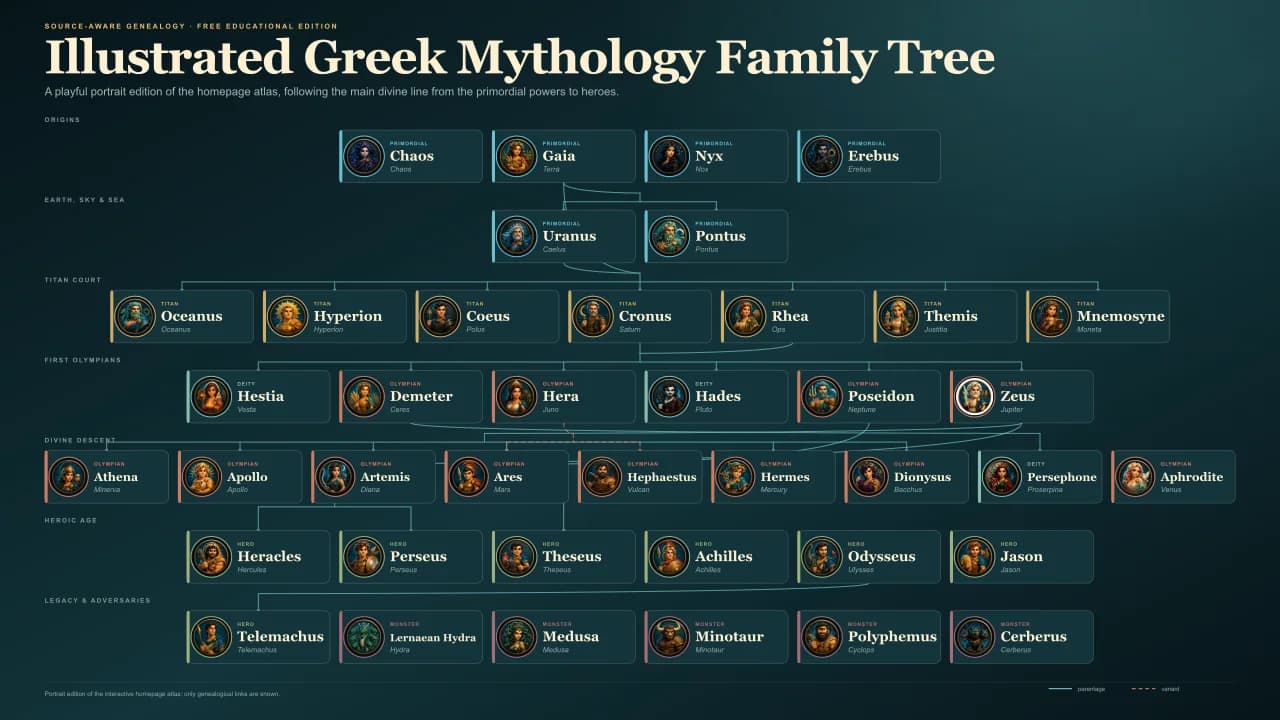
The short answer: choose MythBranch for a global interactive atlas, documented profiles, printable charts, and open JSON-LD; choose Mythoskolis for a focused, ego-centered genealogy with an advanced variant view; and choose Theoi for dense static charts connected to a large quotation-rich mythology encyclopedia.
If you need to create your own chart rather than explore an existing one, Canva is the easiest visual canvas and Lucidchart is the stronger structured diagramming workspace. Neither supplies reliable mythology data. For research, use Perseus or Scaife to read ancient texts, ToposText to connect people and passages with places, museum catalogues to inspect material evidence, and Wikidata when you need open identifiers or linked data.
Editor's answer
There is no single best tool—there is a best research stack
MythBranch
Explore the main genealogy visually, move into figure-level family trees, compare selected variants, download publication-ready charts, or inspect the public evidence graph.
Open MythBranch →Mythoskolis
Center one figure at a time, then read parents, siblings, consorts, children, alternatives, uncertain relations, and source excerpts without loading one enormous chart.
Open Mythoskolis ↗Theoi
Move through summary, Hesiodic, Homeric, and detailed divine family charts, with names linking into encyclopedia entries containing quotations from classical literature.
Open Theoi ↗Our conflict of interest: MythBranch wrote and publishes this comparison. We do not assign ourselves a numerical score or claim universal completeness. Our recommendation is based on the criteria below, and our current limitations are stated in the full review.
Transparent method
How we evaluated Greek mythology genealogy tools
We reviewed publicly accessible product pages and documentation on August 23, 2026. No company paid for inclusion or supplied editorial copy. “Tool” is used broadly because readers arrive with three distinct jobs: exploring a prepared genealogy, making a custom diagram, or verifying the evidence behind a relationship.
Genealogical clarity
Can a first-time reader understand parents, consorts, children, generations, and non-genealogical relationships?
Source transparency
Can a claim be traced to an ancient passage, scholarly edition, catalogue record, or clearly described editorial rule?
Variant handling
Does the resource label incompatible traditions, or silently flatten them into one apparently certain line?
Greek–Roman precision
Does it distinguish cultural identification from identity, rather than treating Jupiter as merely a translated label for Zeus?
Interaction and access
Can readers search, recenter, zoom, navigate with keyboard or touch, and reach the important content without a paywall?
Reuse and output
Can teachers, designers, researchers, or developers export a chart, cite a stable record, or reuse structured data?
A mythology family tree is not accurate because it contains the most names. It is accurate when readers can see which source supports each branch—and where another source disagrees.
At a glance
Greek mythology family tree tools compared
| Resource | Best for | Model | Evidence | Output |
|---|---|---|---|---|
| MythBranch | Global interactive overview + open data | Atlas, profiles, evidence graph | Passage-level ledger in progress | Interactive, SVG/PNG, JSON-LD |
| Mythoskolis | Local, person-centered exploration | Ego-centered HoloGraph | Variants and excerpts in advanced mode | Interactive web experience |
| Theoi | Dense divine genealogy charts | Static linked chart series | Encyclopedia quotations and chart notes | Web charts |
| Canva | Designed classroom handouts | Manual visual canvas | User supplied | Custom visual designs |
| Lucidchart | Collaborative custom diagrams | Manual structured diagram | User supplied | Editable diagrams |
| Perseus / Scaife | Checking ancient texts | Digital text library | Editions and translations | Readable, searchable texts |
| ToposText | Myths connected to ancient places | Texts + people + gazetteer | Indexed ancient references | Web and mobile reference |
| British Museum | Object and iconographic evidence | Museum catalogue | Accession-level records | Collection records and images |
| Wikidata | Reusable linked-data identifiers | Collaborative knowledge graph | Statement references vary | CC0 structured data |
The table compares capabilities, not authority in the abstract. A museum object record can be the strongest source for an image but the wrong interface for learning who Zeus's children are. A beautiful chart maker can be excellent software while providing no mythology evidence at all.
Full reviews
Nine useful resources, each with a different job
MythBranch
mythbranch.com ↗MythBranch combines a whole-atlas view with era pages, individual family-tree profiles, downloadable gallery editions, an embeddable widget, and a public knowledge graph. The current evidence release contains 190 controlled entities, 270 assertions, 36 source records, and 13 explicitly labeled variants. Greek and Roman figures can be modeled separately rather than reduced to translation pairs.
- Choose it when
- You want one route from visual orientation to profile-level explanation, source assertions, print assets, and machine-readable data.
- Important limitation
- The knowledge graph is an alpha release. Its registry is broader than its passage-level source ledger, and many indexed figures do not yet have fully reviewed public profiles.
Mythoskolis HoloGraph
mythoskolis.com ↗Mythoskolis takes the opposite visual approach from a giant global tree. Its HoloGraph centers one entity and arranges the nearby parents, consorts, children, and siblings around that focus. The advanced mode adds alternative relations, uncertain ties, sources, and—in documented cases—clickable excerpts. This local neighborhood model is especially readable on dense branches.
- Choose it when
- You want to keep recentering the graph and follow a figure through genealogy, entity sheets, and connected stories.
- Important limitation
- It intentionally does not present one complete global tree, so it is less suited to a poster-like overview of the whole mythic system.
Theoi Greek Gods Family Tree
theoi.com ↗Theoi offers summary charts, a genealogy based on Hesiod's Theogony, Homeric charts, and an eight-part detailed series covering primordial gods, the children of Night, Titans, sea gods, monsters, Olympians, Oceanids, rivers, and nymphs. Names link into an extensive encyclopedia with classical quotations and images of ancient art.
- Choose it when
- You want a broad divine reference chart and quick movement from a name to ancient literary quotations.
- Important limitation
- Theoi states that where ancient authors disagree, its main detailed chart selects the oldest and/or most popular source. That makes the chart legible, but not every disagreement remains simultaneously visible.
Canva
canva.com ↗Canva provides a flexible whiteboard, family-tree templates, connectors, images, typography, collaboration, and design export. It is the simplest option in this list for a teacher or student who already knows which figures and relationships belong in a custom handout.
- Choose it when
- The design is the assignment: a classroom worksheet, presentation graphic, or visually branded chart.
- Important limitation
- Canva does not verify Greek mythology. Every name, relationship, source note, and variant must be researched and entered by the creator.
Lucidchart
lucid.co ↗Lucidchart is useful when the tree must remain editable as a diagram. Its templates, shapes, connectors, images, and collaborative workspace make it easier to reorganize a complicated custom genealogy than a fixed poster editor.
- Choose it when
- A group needs to build, discuss, and revise a custom relationship diagram rather than consume a finished mythology atlas.
- Important limitation
- It supplies diagram logic, not a mythology corpus. Contradictory sources and special relations still require a data model and editorial decisions.
Perseus Digital Library / Scaife Viewer
scaife.perseus.org ↗Perseus is foundational infrastructure for Greco-Roman digital scholarship, and the Scaife Viewer provides a modern reading environment for pre-modern texts in original languages and translation. It is where a serious reader can check what a passage actually says instead of repeating a chart's unsourced claim.
- Choose it when
- You need Homer, Hesiod, tragedy, mythography, Greek or Latin text, translations, and passage-level verification.
- Important limitation
- It is a digital library, not a family-tree interface. Readers must interpret the passage and connect it to a genealogy themselves.
ToposText
topostext.org ↗ToposText joins a large clean-text library with a gazetteer and an index of ancient people and mythological figures. It is unusually valuable when genealogy intersects geography: a local cult, a hero's city, a river god, an island genealogy, or a passage tied to a specific landscape.
- Choose it when
- You want to move between ancient passages, named people, and mapped places in Greek history and mythology.
- Important limitation
- Its organizing problem is text and place, not a visual genealogy, so it supplements rather than replaces a family-tree tool.
British Museum Collection Online
britishmuseum.org ↗Ancient images can preserve identities, attributes, pairings, cult contexts, and narrative scenes that do not function like a literary genealogy. The British Museum's collection search lets readers locate object records by keyword, person, place, object type, or museum number and filter for records with images.
- Choose it when
- You need an accession number, object date, material, findspot, curatorial description, or image-rights context for visual evidence.
- Important limitation
- A catalogue record documents an object. It should not automatically be treated as a comprehensive literary account or a complete family relationship.
Wikidata
wikidata.org ↗Wikidata is a free, collaborative, multilingual knowledge base readable by humans and machines. Statements can carry references and links to external identifiers, and its structured data is released under CC0. That makes it a powerful interoperability layer for matching names across projects.
- Choose it when
- You need stable identifiers, multilingual labels, broad cross-domain links, open reuse, or a starting point for computational work.
- Important limitation
- Coverage and references vary by statement. It is a secondary, community-edited knowledge base, not a curated edition of one ancient tradition.
Decision guide
Choose by the result you need
I want to understand who is related to whom
Start with MythBranch for the broad atlas or Mythoskolis for a person-centered neighborhood. Use Theoi when you want a denser static chart and quotation-rich encyclopedia entries.
I want to create my own Greek gods family tree
Use Canva for visual ease or Lucidchart for a structured editable diagram. Establish the source tradition before drawing: a “Hesiod family tree” is a defensible scope; an unlabeled “complete tree” usually is not.
I need evidence for a disputed parent or child
Read the cited passage in Perseus or Scaife. Search ToposText when places matter. Consult museum catalogues when the evidence is an object or image. Record the source, locator, date, and tradition.
I need data, identifiers, or a printable asset
Use MythBranch's JSON-LD and gallery downloads for the project's modeled relationships; use Wikidata for open cross-domain identifiers. Check the license and provenance of every image and dataset separately.
Our recommendation for most readers
Explore visually first. Verify disputed branches in the ancient text. Export only after the tradition is labeled.
Start with the interactive Greek mythology family tree ↗Quick answers
Greek mythology family tree tools: FAQ
What is the best interactive Greek mythology family tree?
MythBranch is strongest when you want a broad, visually navigable atlas with downloadable charts and open structured data. Mythoskolis is especially strong for recentering on one figure and inspecting a readable local family neighborhood. The better choice depends on whether you want a global overview or an ego-centered view.
Is there a Greek mythology family tree maker or generator?
There is no reliable one-click generator that can resolve contradictory ancient traditions for you. Canva and Lucidchart can build a custom chart, but you must supply and verify the relationships. MythBranch, Mythoskolis, and Theoi provide pre-researched genealogy rather than a blank editing canvas.
Why do Greek mythology family trees disagree?
Greek mythology has no single universal canon. Homer, Hesiod, lyric poets, tragedians, mythographers, local cults, visual art, and Roman authors can preserve different genealogies. A responsible tool names its source or labels the variant instead of silently merging every tradition.
What is the best free Greek gods family tree for a classroom?
Use a simplified printable chart when the teaching goal is orientation, then pair it with a source-based resource for disputed relationships. MythBranch offers classroom and black-and-white downloads; Canva is useful when a teacher needs to redesign the material for a particular lesson.
Can I download Greek mythology family-tree data?
MythBranch publishes a JSON-LD knowledge-graph export alongside downloadable SVG and PNG charts. Wikidata also provides reusable CC0 structured data, but it is a general collaborative knowledge base rather than a mythology-specific editorial model.
Reviewed August 23, 2026. Product capabilities may change. Corrections and documented counterexamples are welcome through MythBranch's research desk.