OLYMPIAN · 15
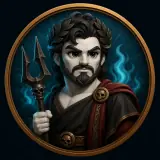
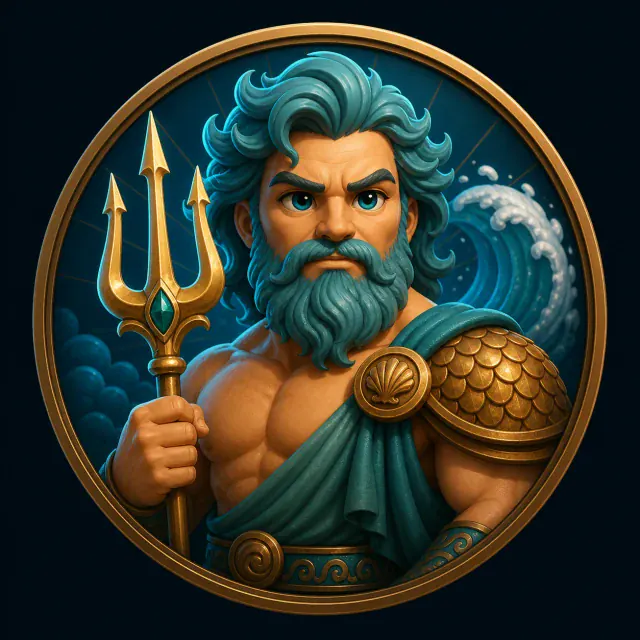
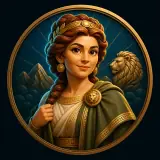
Illustrated portrait of Poseidon

Portrait from the MythBranch atlas
Interpretive illustration, not an ancient likeness

Greek mythology research profile · cited sources

Poseidon

Neptune · Sea, earthquakes, horses & unstable boundaries

Poseidon is brother of Zeus and Hades, Olympian ruler of the sea, sender of earthquakes, and god of horses. His myths are rarely calm maritime decoration: he contests cities, blocks journeys, fathers dangerous and heroic descendants, and exposes how coastlines, walls, springs, and political claims remain unstable. Roman Neptune overlaps with him but developed through a different religious and civic history.

Names · attributes · ancient evidence

Poseidon: identity and historical contexts.

Poseidon's trident marks marine sovereignty and the power to split ground or raise water. The epithet Ennosigaios, Earth-shaker, is central in epic, while Hippios links him to horses and chariot culture. Coastal sanctuaries such as Sounion and the Isthmus placed his worship where travel, trade, contest, and geological exposure met. He is an Olympian sovereign, not the primordial sea itself: Pontus and Oceanus belong to older cosmic layers.

The famous ‘division of the world’ assigns sky to Zeus, sea to Poseidon, and the underworld to Hades while earth and Olympus remain common. Ancient sources do not always present the brothers' relationship or Poseidon's city contests identically. The Artemision bronze is traditionally called Zeus or Poseidon because its missing weapon would decide the identification; the page preserves that museum debate instead of turning uncertainty into a trident by caption.

01Ennosigaios · Earth-shaker02Hippios · Of horses03Asphaleios · Securer04Gaiaochos · Earth-holder05Pelagaios · Of the open sea
01

A god of foundations as well as floods

Earthquake epithets make Poseidon responsible for the ground's failure, yet communities also invoke him for stability. The apparent contradiction is characteristic of Greek divine power: the deity who causes a danger can be the one best placed to restrain it. Walls, harbors, and civic territories therefore belong beside waves and storms.
02

Horses are not a secondary symbol

Poseidon fathers or creates horses in several traditions and receives the epithet Hippios. Myths of Demeter, Medusa, Pegasus, Pelops, and chariot contests link equine speed with water, aristocratic prestige, sexuality, and danger. A page focused only on the trident would miss an entire ritual and narrative field.

Texts · chronology · variant traditions

Selected ancient narratives involving Poseidon.

Poseidon's stories connect cosmic division with civic rivalry, heroic travel, horse mastery, and the consequences of injured honor.

01

After the Titan war

The brothers divide their realms

Zeus, Poseidon, and Hades cast lots for sky, sea, and underworld, while earth and Olympus remain shared. The scene gives Poseidon a sovereign realm but does not make him the creator of water. His older marine relatives and the common earth complicate any modern idea of three completely separate kingdoms.

Homeric tradition: Iliad ↗Pseudo-Apollodorus: Library of Greek Mythology ↗
03

Odyssey · Books 9–13

Odysseus blinds Polyphemus

Odysseus escapes the Cyclops by intelligence and violence, then reveals his name while sailing away. Polyphemus asks his father Poseidon to prevent or delay the hero's return. Poseidon's long anger structures the Odyssey's distance, shipwreck, and final dependence on divine negotiation.

Homeric tradition: Odyssey ↗
04

Before the Trojan War

The walls of Troy and a broken bargain

Poseidon and Apollo serve Laomedon and build or protect Troy's walls in differing accounts. When the king refuses payment, divine resentment produces disaster and later support against the city. The myth links monumental construction with labor, contract, and the danger of cheating gods who made security possible.

Homeric tradition: Iliad ↗Pseudo-Apollodorus: Library of Greek Mythology ↗
05

Heroic genealogy

The contest for Pelops

Pelops receives divine horses or chariot help associated with Poseidon and wins Hippodameia through a race shadowed by sabotage and death. Pindar also preserves a tradition of Poseidon's love for Pelops, replacing the gruesome banquet story with divine intimacy and heroic return.

Pindar: Olympian Ode 1 ↗

Genealogical records and atlas relationships

Genealogical evidence and variant traditions.

The atlas shows Poseidon as a child of Cronus and Rhea and sibling of the first Olympians. It records only selected descendants, although ancient genealogies give him an exceptionally large and varied family.

Unions drawn in this atlas

00

No line of this type is drawn in the current atlas.

Children drawn in this atlas

01
Genealogy note

Amphitrite is Poseidon's principal divine wife, and Triton their best-known son. Other traditions make him father of Polyphemus, Pegasus in one genealogy, Theseus in competing parentage, and numerous regional founders and monsters.

Open the interactive branch ↗

Text · stage · screen · scholarship

Selected works concerning Poseidon in later reception.

Each selected work treats this figure as its subject, title presence, principal voice, or central dramatic agent. Incidental appearances are excluded. The bibliography also avoids assigning the same representative title to multiple profiles except where a shared primary text is indispensable.

  1. AntiquityHomeric Hymn 22: To PoseidonHymn
  2. 2013Olympians: Poseidon — Earth ShakerGraphic novel
  3. 1694Neptune's Triumph for the Return of AlbionMasque / semi-opera project
01

Selected bibliography

Ancient text & cult

01 works
02

Selected bibliography

Graphic biography

01 works
03

Selected bibliography

Stage & music

01 works

When modern book covers or publicity images are shown, they appear at small scale for identification and criticism; copyright remains with the named rights holders. Public-domain context images are explicitly labeled.

Sources and documentation

Primary texts, scholarship, and catalogue records.

Dates follow conventional scholarly ranges. Cover thumbnails identify modern editions; they do not represent the original material form of an ancient text. Links lead to university archives, publishers, and museum catalogues.

Ancient source

5
  1. 01IliadHomeric tradition
    Verified text or catalogue record
    Iliad↗

    Homeric tradition · late 8th–early 7th c. BCE

    Poseidon's domain, Trojan anger, divine politics, and Earth-shaker identity.
    Edition or recordOpen translation · Harvard Center for Hellenic Studies
  2. 02OdysseyHomeric tradition
    Verified text or catalogue record
    Odyssey↗

    Homeric tradition · late 8th–early 7th c. BCE

    The sustained conflict over Polyphemus and Odysseus's return.
    Edition or recordOpen translation · Harvard Center for Hellenic Studies
  3. 03Library of Greek MythologyPseudo-Apollodorus
    Verified text or catalogue record
    Library of Greek Mythology↗

    Pseudo-Apollodorus · 1st–2nd c. CE

    Realm division, civic contests, descendants, and mythographic variants.
    Edition or recordGreek text and translation · Perseus Digital Library
  4. 04Description of GreecePausanias
    Verified text or catalogue record
    Description of Greece↗

    Pausanias · 2nd c. CE

    Sanctuaries, local contests, springs, images, and coastal cult geography.
    Edition or recordGreek text and translation · Perseus Digital Library
  5. 05Olympian Ode 1Pindar
    Verified text or catalogue record
    Olympian Ode 1↗

    Pindar · 476 BCE

    Poseidon, Pelops, chariot victory, and revision of the cannibal banquet tradition.
    Edition or recordGreek text and translation research · Perseus

Family questions

Questions about Poseidon's family.

Who are Poseidon's parents?

Poseidon is a son of Cronus and Rhea and brother of Zeus, Hades, Hera, Demeter, and Hestia.

What is Poseidon the god of?

He rules the sea and is strongly associated with earthquakes, horses, coastal foundations, and the protection or destruction of journeys.

Is Neptune exactly the same as Poseidon?

Neptune is Poseidon's closest Roman equivalent, but Roman religion and later European art developed distinct meanings and institutions around him.