DEITY · 18
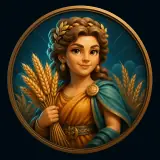
Illustrated portrait of Hestia

Portrait from the MythBranch atlas
Interpretive illustration, not an ancient likeness

Greek mythology research profile · cited sources

Hestia

Vesta · The hearth that makes a household and city coherent

Hestia is the goddess of the hearth, the fixed center of household, sanctuary, and city. She is a daughter of Cronus and Rhea, called first-born and last-born because she was swallowed first and released last. Her limited adventure mythology reflects her function: Hestia stays, receives the first and last portions of sacrifice, and makes shared space possible while other gods travel, fight, marry, and found dynasties.

Names · attributes · ancient evidence

Hestia: identity and historical contexts.

The Greek hestia is both the goddess and the physical hearth. Fire at the center marks residence, cooking, sacrifice, inheritance, and civic continuity. New colonies could carry fire from a mother city's public hearth, turning flame into political kinship. Hestia's refusal of marriage after proposals from Poseidon and Apollo protects this central availability: she belongs to no husband's household because every legitimate household and divine feast requires her.

Roman Vesta shares the sacred hearth but belongs to a distinctive state cult maintained by the Vestal Virgins; those Roman institutions should not be attributed directly to Greek Hestia. Lists of the Twelve Olympians vary, sometimes including Hestia and sometimes Dionysus. The popular story that she voluntarily surrendered a throne to Dionysus is a modern harmonization rather than a securely attested ancient myth.

01Hestia · Hearth02Prōtē kai eschatē · First and last03Bōmia · Of the altar04Prytaneia · Of the civic hearth05Aidōs · Reverent modesty
01

The central goddess has few portraits

A fixed hearth is materially present without requiring a human image. This helps explain why Hestia can be ritually pervasive yet visually and narratively quiet. Modern rankings that measure importance by dramatic myths or recognizable statues systematically underestimate deities embedded in repeated practice.


02

Hestia and Hermes organize space differently

A famous structural reading contrasts Hestia's fixed interior center with Hermes's movement across thresholds and roads. The opposition is illuminating when grounded in ritual and text, but it should not turn two flexible deities into abstract diagrams. Hestia can belong to civic colonization, while Hermes can stand within households.

Texts · chronology · variant traditions

Selected ancient narratives involving Hestia.

Hestia's profile emerges through birth order, refusal, sacrifice, and the political life of the public hearth rather than a hero-style quest.

02

Homeric Hymn to Aphrodite

Hestia refuses Poseidon and Apollo

Poseidon and Apollo seek Hestia, but she swears before Zeus to remain a maiden. Zeus grants her honor in the middle of the house and a rich portion at every temple. The refusal is not social withdrawal; it establishes a role that cannot be absorbed into one marriage alliance.

Anonymous: Homeric Hymn to Aphrodite ↗
03

Hymn and ritual practice

Every feast begins from Hestia

Short Homeric Hymns address Hestia at the house of Apollo in Delphi and alongside Hermes. They ask her to enter, bless, or dwell and state that no feast occurs without a libation to her first and last. The goddess's presence is enacted through order of offering.

Anonymous: Homeric Hymns to Hestia ↗

Genealogical records and atlas relationships

Genealogical evidence and variant traditions.

The atlas shows Hestia among the children of Cronus and Rhea. It draws no partner or descendants because her sworn virginity and fixed ritual role are central to the dominant tradition.

Unions drawn in this atlas

00

No line of this type is drawn in the current atlas.

Children drawn in this atlas

00

No line of this type is drawn in the current atlas.

Genealogy note

Hestia is sister of Demeter, Hera, Hades, Poseidon, and Zeus. Her family importance lies in shared origin and ritual presence, not in producing another divine branch.

Open the interactive branch ↗

Text · stage · screen · scholarship

Selected works concerning Hestia in later reception.

Each selected work treats this figure as its subject, title presence, principal voice, or central dramatic agent. Incidental appearances are excluded. The bibliography also avoids assigning the same representative title to multiple profiles except where a shared primary text is indispensable.

  1. AntiquityHomeric Hymns 24 and 29: To HestiaShort hymns
  2. 1969 English publication contextHestia–Hermes: The Religious Expression of Space and MovementClassical essay
  3. 2015SPQR: The Vestal and the Roman HearthHistorical synthesis
01

Selected bibliography

Ancient hymn & ritual

01 works
02

Selected bibliography

Scholarship & interpretation

02 works
ScholarshipHestia–Hermes: The Religious Expression of Space and MovementJean-Pierre Vernant · 1969 English publication context
Classical essay

Hestia–Hermes: The Religious Expression of Space and Movement

Jean-Pierre Vernant

Vernant's influential essay reads Hestia's fixed center against Hermes's mobility to investigate Greek classifications of space, gender, exchange, and social order. It remains valuable when treated as an argument rather than an ancient doctrine.

Zone BooksOpen record ↗

When modern book covers or publicity images are shown, they appear at small scale for identification and criticism; copyright remains with the named rights holders. Public-domain context images are explicitly labeled.

Sources and documentation

Primary texts, scholarship, and catalogue records.

Dates follow conventional scholarly ranges. Cover thumbnails identify modern editions; they do not represent the original material form of an ancient text. Links lead to university archives, publishers, and museum catalogues.

Ancient source

4
  1. 01TheogonyHesiodic tradition
    Verified text or catalogue record
    Theogony↗

    Hesiodic tradition · late 8th–7th c. BCE

    Hestia among the children swallowed by Cronus.
    Edition or recordGreek text and translation · Perseus Digital Library
  2. 02Library of Greek MythologyPseudo-Apollodorus
    Verified text or catalogue record
    Library of Greek Mythology↗

    Pseudo-Apollodorus · 1st–2nd c. CE

    Birth order, return, and Olympian genealogy.
    Edition or recordGreek text and translation · Perseus Digital Library
  3. 03Homeric Hymn to AphroditeAnonymous
    Verified text or catalogue record
    Homeric Hymn to Aphrodite↗

    Anonymous · 7th–6th c. BCE

    Hestia's refusal of marriage and Zeus's grant of central honor.
    Edition or recordHarvard Center for Hellenic Studies translation
  4. 04Homeric Hymns to HestiaAnonymous
    Verified text or catalogue record
    Homeric Hymns to Hestia↗

    Anonymous · Antiquity

    Direct ritual address and relation to feast, Delphi, house, and Hermes.
    Edition or recordClassical text translation · Theoi library

Museum research

1
  1. 01Hestia Full of BlessingsDumbarton Oaks
    Verified text or catalogue record
    Hestia Full of Blessings↗

    Dumbarton Oaks · 6th c. CE

    Authoritative catalogue record for the named late antique textile.
    Edition or recordDumbarton Oaks Byzantine Collection

Family questions

Questions about Hestia's family.

Who are Hestia's parents?

Hestia is the eldest child of Cronus and Rhea in birth order and the last released from Cronus.

Who are Hestia's brothers and sisters?

Hestia's siblings are Demeter, Hera, Hades, Poseidon, and Zeus. All six are children of Cronus and Rhea in the standard Olympian genealogy.

What is Hestia the goddess of?

She is goddess of the hearth and the domestic, sacrificial, and civic center it creates.

Did Hestia give her Olympian seat to Dionysus?

That tidy reconciliation of competing Twelve Olympian lists is common today but is not securely attested as an ancient narrative.