PRIMORDIAL · 07
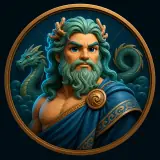
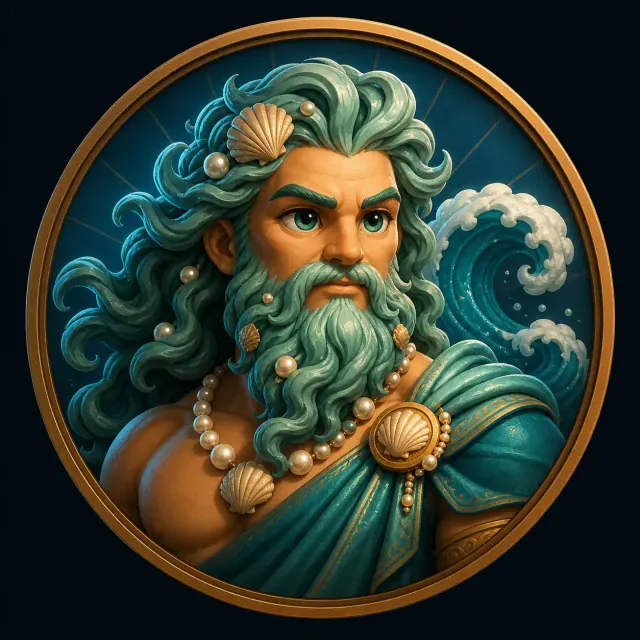
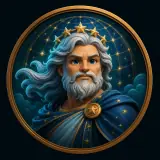
Illustrated portrait of Pontus

Portrait from the MythBranch atlas
Interpretive illustration, not an ancient likeness

Greek mythology research profile · cited sources

Pontus

Pontus · The sea before Poseidon's kingship

Pontus is the primordial Sea produced by Gaia without a partner, distinct from Poseidon, the later Olympian who rules marine waters. With Gaia, Pontus fathers a family of sea powers including Nereus, Thaumas, Phorcys, Ceto, and Eurybia. His significance is genealogical and elemental: the sea exists and generates its characteristic beings before Olympian government divides cosmic rule.

Names · attributes · ancient evidence

Pontus: identity and historical contexts.

Pontos is both an ordinary Greek word for sea and a personified primordial father. Hesiod calls him the ‘fruitless deep with raging swell,’ born from Gaia without love. The phrase does not mean the sea produces nothing; the following genealogy makes Pontus an ancestor of old sea gods, wonders, dangers, and monsters. His children distribute qualities that later summaries often collapse into a generic category of ‘sea deities.’

Pontus is easily confused with Oceanus and Poseidon. Oceanus is the encircling world river and a Titan; Poseidon is an Olympian sovereign associated with sea, earthquakes, and horses; Pontus is the sea as an early elemental being. Ancient and Roman art can label broad male marine heads as Oceanus, Pontus, or a local sea personification, so institutional uncertainty must remain visible.

01Pontos · Sea02Atrygetos · Unharvested03Polyphloisbos · Loud-roaring04Halios · Marine05Pelagos · Open sea
01

Element, ancestor, and ordinary noun

A capital letter creates a neat English figure called Pontus, but Greek poetry moves between personification and common sea language. Genealogy is the strongest signal that the element is being treated as a divine ancestor. Elsewhere translators must judge whether a passage names a being or simply the water crossed by ships.
02

Do not turn every sea face into Pontus

Mosaics and sarcophagi frequently show aged marine heads with flowing hair, horns, claws, or sea creatures. Catalogues debate whether particular examples are Oceanus, Pontus, Neptune, or a general personification. This page lists the museum research trail without claiming certainty where the object itself supplies no inscription.

Texts · chronology · variant traditions

Selected ancient narratives involving Pontus.

Pontus has little adventure biography; his narrative importance lies in generation and the distinction between primal substance and later kingship.

01

Hesiod · Theogony

Gaia produces the sea

Gaia bears Pontus without sexual union after producing Uranus and the mountains. The poem distinguishes the stable earth, covering sky, inland heights, and restless sea as related cosmic regions. Pontus is therefore not created by Poseidon and does not begin when Olympian lots are cast.

Hesiodic tradition: Theogony ↗
02

Primordial genealogy

The old man and the wonders of the sea

Gaia and Pontus produce Nereus, Thaumas, Phorcys, Ceto, and Eurybia. Their descendants include Nereids, Iris, Harpies, Graeae, Gorgons, Echidna, and many monsters. The family moves from gentle truth and rainbow wonder to predation and peril without treating the sea as morally uniform.

Hesiodic tradition: Theogony ↗Pseudo-Apollodorus: Library of Greek Mythology ↗
03

Olympian succession

Poseidon receives the sea

Later myth tells how Zeus, Poseidon, and Hades divide sovereign domains after the Titan war. Poseidon receives marine rule, but Pontus does not fight a succession battle or vanish. The elemental sea and its older descendants remain beneath and around the new political order.

Pseudo-Apollodorus: Library of Greek Mythology ↗

Genealogical records and atlas relationships

Genealogical evidence and variant traditions.

The atlas shows Pontus as a child of Gaia but omits most Pontic descendants to preserve readability. That absence should not be mistaken for lack of an ancient family.

Unions drawn in this atlas

00

No line of this type is drawn in the current atlas.

Children drawn in this atlas

00

No line of this type is drawn in the current atlas.

Genealogy note

Hesiod's Pontic line is one of the main genealogical routes to Nereids, Gorgons, Graeae, Echidna, and other marine or monstrous beings. Different handbooks arrange later generations differently.

Open the interactive branch ↗

Text · stage · screen · scholarship

Selected works concerning Pontus in later reception.

Each selected work treats this figure as its subject, title presence, principal voice, or central dramatic agent. Incidental appearances are excluded. The bibliography also avoids assigning the same representative title to multiple profiles except where a shared primary text is indispensable.

  1. late 8th–7th c. BCETheogony: The Children of PontusCosmogonic poem
  2. 1st–2nd c. CELibrary: The Pontic GenealogyMythographic handbook
  3. Classical antiquity onwardThe Euxine Pontus in Greek GeographyGeographic name
01

Selected bibliography

Ancient genealogy

02 works
02

Selected bibliography

Name & geography

01 works

When modern book covers or publicity images are shown, they appear at small scale for identification and criticism; copyright remains with the named rights holders. Public-domain context images are explicitly labeled.

Sources and documentation

Primary texts, scholarship, and catalogue records.

Dates follow conventional scholarly ranges. Cover thumbnails identify modern editions; they do not represent the original material form of an ancient text. Links lead to university archives, publishers, and museum catalogues.

Ancient source

2
  1. 01TheogonyHesiodic tradition
    Verified text or catalogue record
    Theogony↗

    Hesiodic tradition · late 8th–7th c. BCE

    Birth of Pontus and the principal genealogy of his children with Gaia.
    Edition or recordGreek text and translation · Perseus Digital Library
  2. 02Library of Greek MythologyPseudo-Apollodorus
    Verified text or catalogue record
    Library of Greek Mythology↗

    Pseudo-Apollodorus · 1st–2nd c. CE

    Later ordering of primordial sea families and Olympian domain division.
    Edition or recordGreek text and translation · Perseus Digital Library

Academic study

1
  1. 01Personifying the Ancient SeaClassical art scholarship trail
    Verified text or catalogue record
    Personifying the Ancient Sea↗

    Classical art scholarship trail · Modern research

    Research pathway for distinguishing Pontus, Oceanus, and related water figures.
    Edition or recordJSTOR indexed scholarship

Museum research

1
  1. 01Pontus collection searchThe British Museum
    Verified text or catalogue record
    Pontus collection search↗

    The British Museum · Collection research

    Museum records showing both explicit and uncertain marine personifications.
    Edition or recordBritish Museum Collection Online

Family questions

Questions about Pontus's family.

Who are Pontus's parents?

Hesiod says Gaia produced Pontus without a partner.

Is Pontus the same as Poseidon?

No. Pontus is the primordial sea; Poseidon is the later Olympian ruler of the sea.

Who are Pontus's children?

With Gaia he fathers Nereus, Thaumas, Phorcys, Ceto, and Eurybia, ancestors of many marine and monstrous figures.