01
Divine childhood
Birth on Delos
Pursued and denied a stable place to give birth, Leto reaches Delos and secures the island’s promise. After divine delay, Apollo is born and immediately claims the lyre, bow, and power to proclaim Zeus’s will.
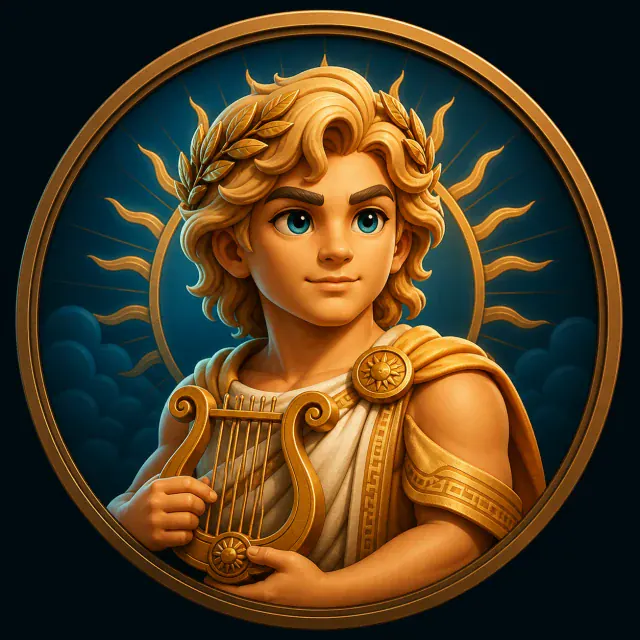
Portrait from the MythBranch atlas
Interpretive illustration, not an ancient likeness
Greek deity research profile · cited sources
Apollo · Prophecy, music, healing, plague & civic order
Apollo is a god of prophecy, music, ritual purification, archery, healing, plague, and the formation of young citizens. Delphi and Delos gave his cult Panhellenic reach, while epic and hymn preserve a harder figure than the later emblem of calm sunlight: Apollo can found sanctuaries, guide choruses, send disease, demand truth, and punish failed recognition.
Identity & cult
Names · attributes · ancient evidence
Apollo’s domains are linked by controlled distance. The archer strikes from afar; the oracle speaks through a ritual institution; music orders voice and movement; purification restores boundaries after pollution; healing answers the possibility of plague. At Delphi his sanctuary organized consultation across cities, and at Delos his birth and festival centered an island network. The kouros-like youthful body of art communicates disciplined presence rather than a complete theology.
Apollo was increasingly identified with the sun, especially in later Greek and Roman thought, but Helios remains the more specific early sun god. Roman Apollo retained his Greek name while entering different political settings, including Augustan ideology. The influential opposition between ‘Apollonian’ order and ‘Dionysian’ ecstasy is a modern philosophical construction, not a simple ancient rule separating two gods who shared Delphi and performance culture.
Genealogy
Genealogical records and atlas relationships
The atlas shows Apollo within Zeus’s descendant generation and keeps his twin link to Artemis visible through shared parentage. Cult centers, prophetic specialists, and mortal beloveds are explained as affiliations rather than forced into family lines.
No line of this type is drawn in the current atlas.
No line of this type is drawn in the current atlas.
Apollo is the son of Zeus and Leto and twin brother of Artemis. The compact tree may display only the Zeus line or selected descendants; ancient sources name sons including Asclepius and preserve additional relationships. Roman and later solar identifications do not change his Greek genealogy.
Open the interactive branch ↗Art & objects
Museum objects · painting · sculpture
The gallery begins with copied ancient types and moves through Baroque transformation, painted conquest, and the modern museum print. ‘Ideal beauty’ is treated as a historical visual language, not proof that Apollo was only gentle or serene.
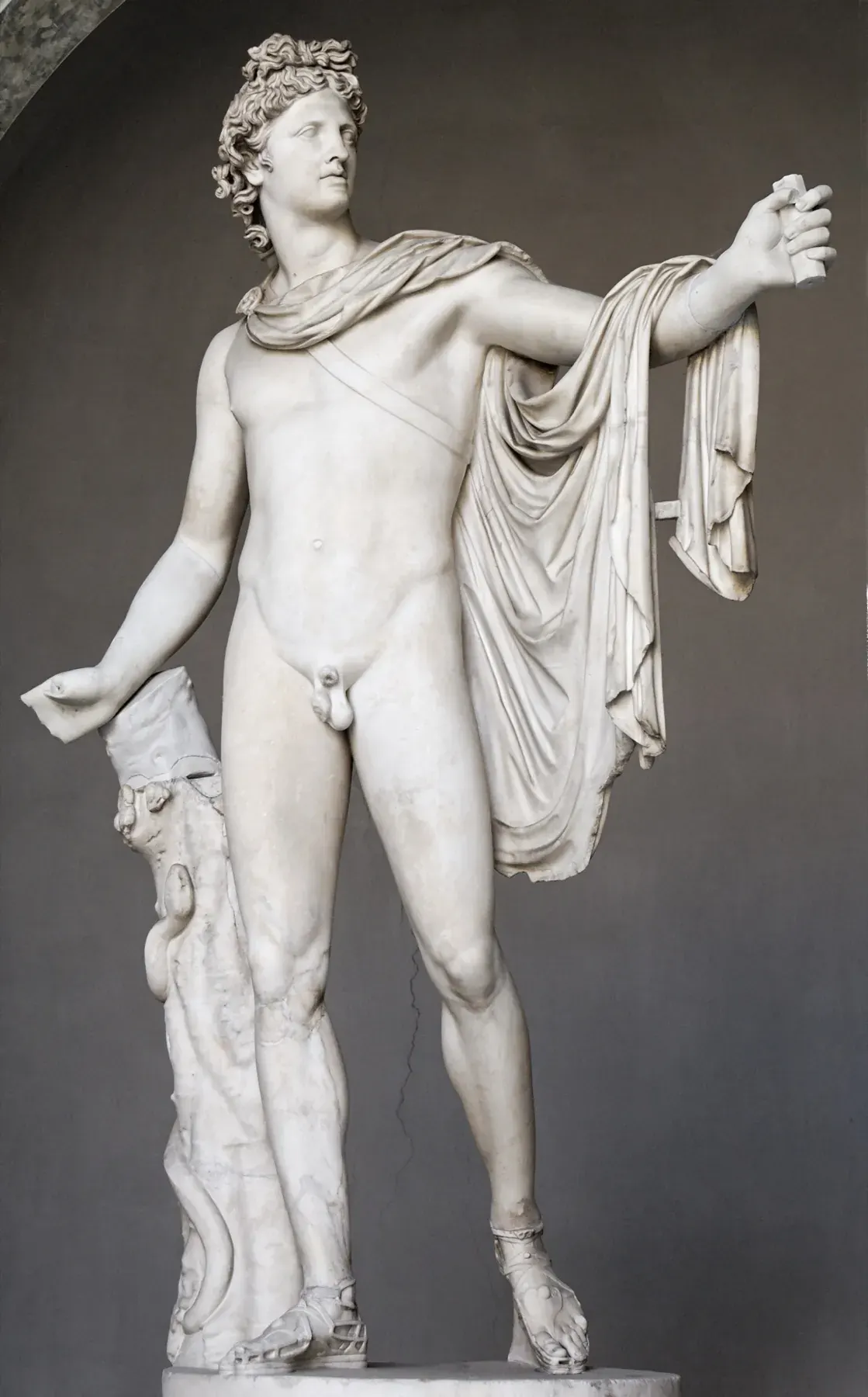
Sculpture · Vatican Museums
Known in Rome by the early sixteenth century, the statue became a benchmark of idealized male beauty. Its modern fame shaped museums and art theory as much as it transmitted an ancient type.
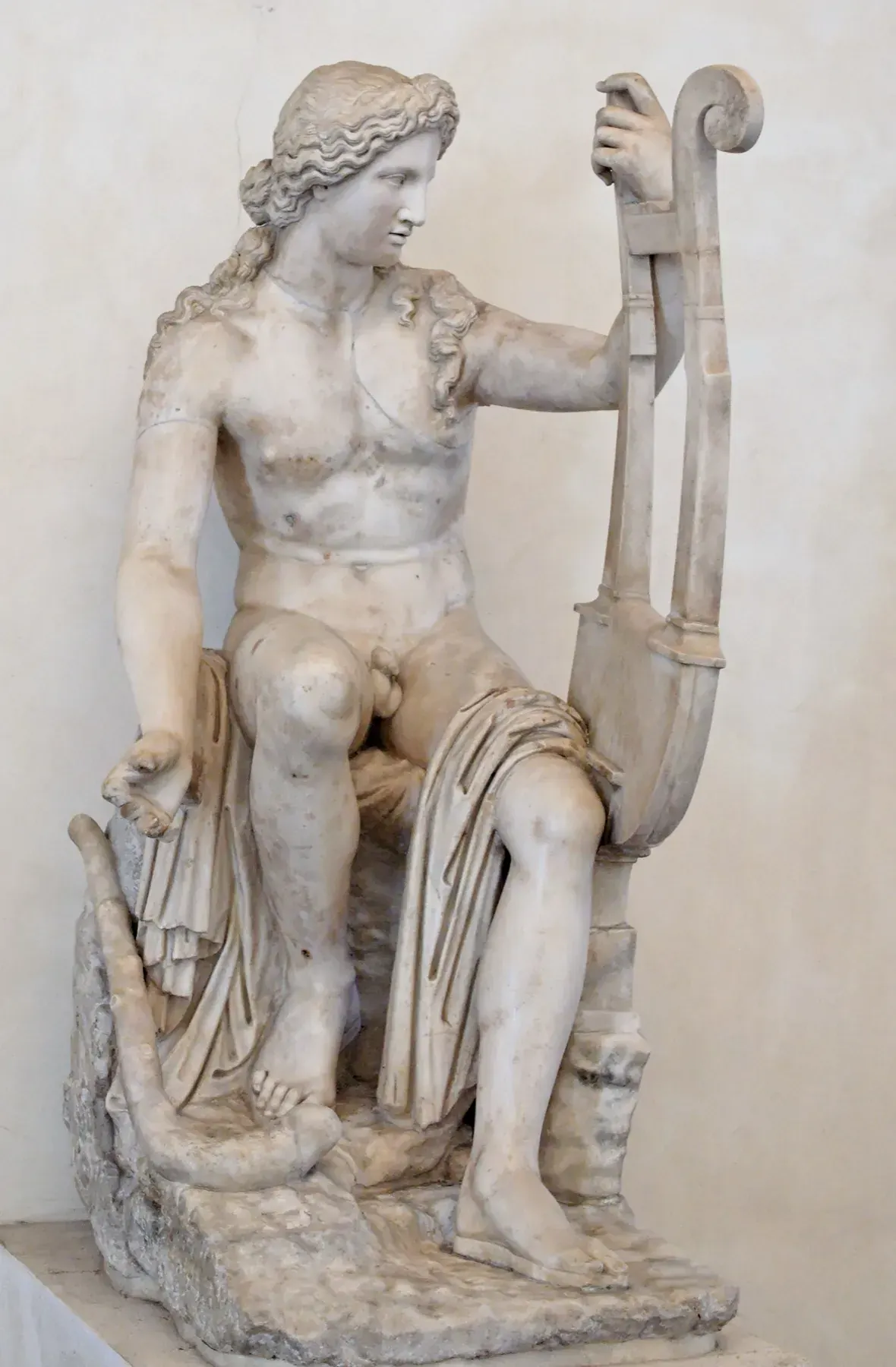
Sculpture · Museo Nazionale Romano, Palazzo Altemps
The cithara-playing type represents Apollo as formal musician and leader of performance. Instrument, long garment, and poised stance define a role far from the naked archer.
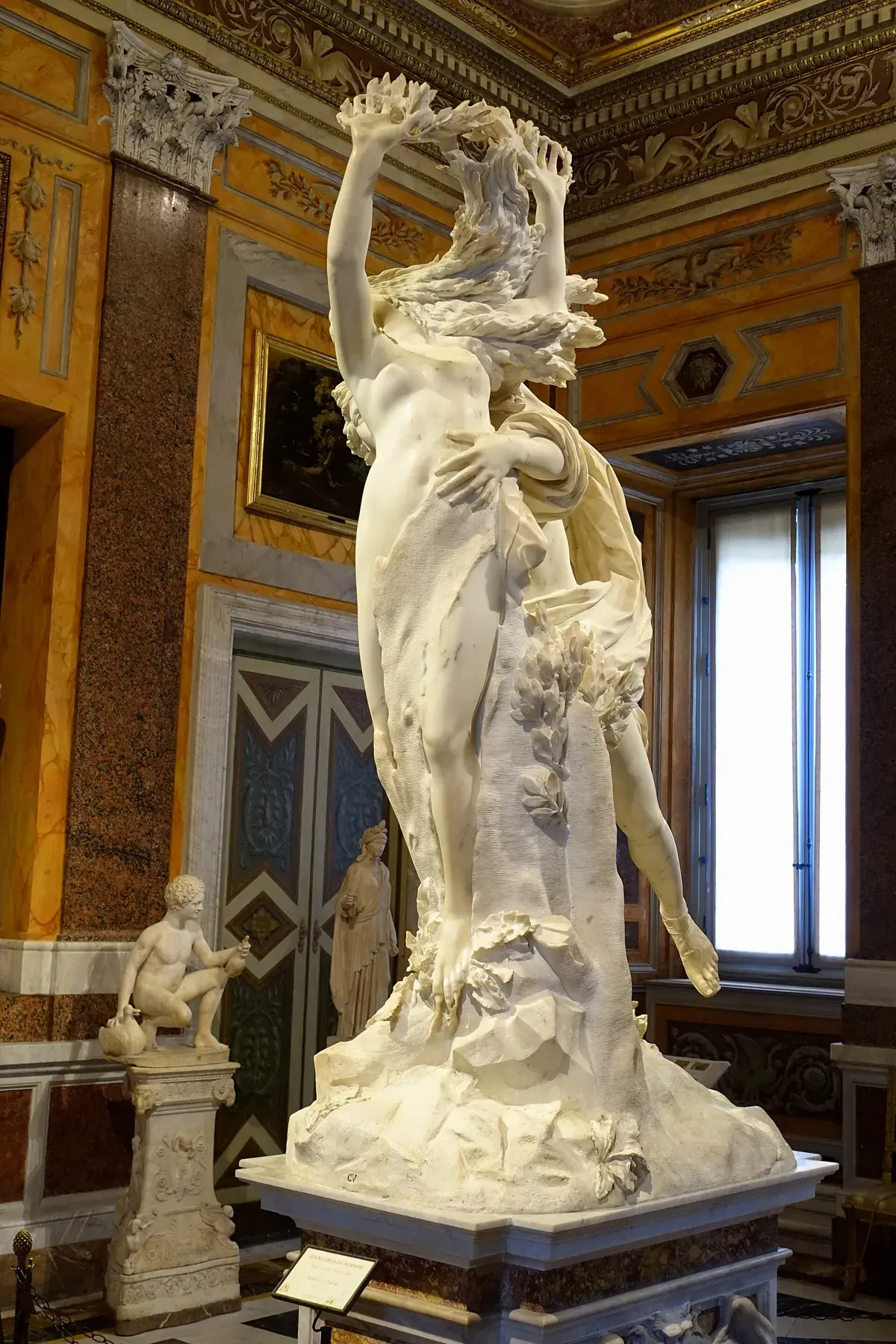
Sculpture · Galleria Borghese
Bernini fixes the instant Daphne’s flesh becomes bark and leaves. Technical virtuosity intensifies rather than resolves the scene’s pursuit, refusal, bodily danger, and metamorphosis.
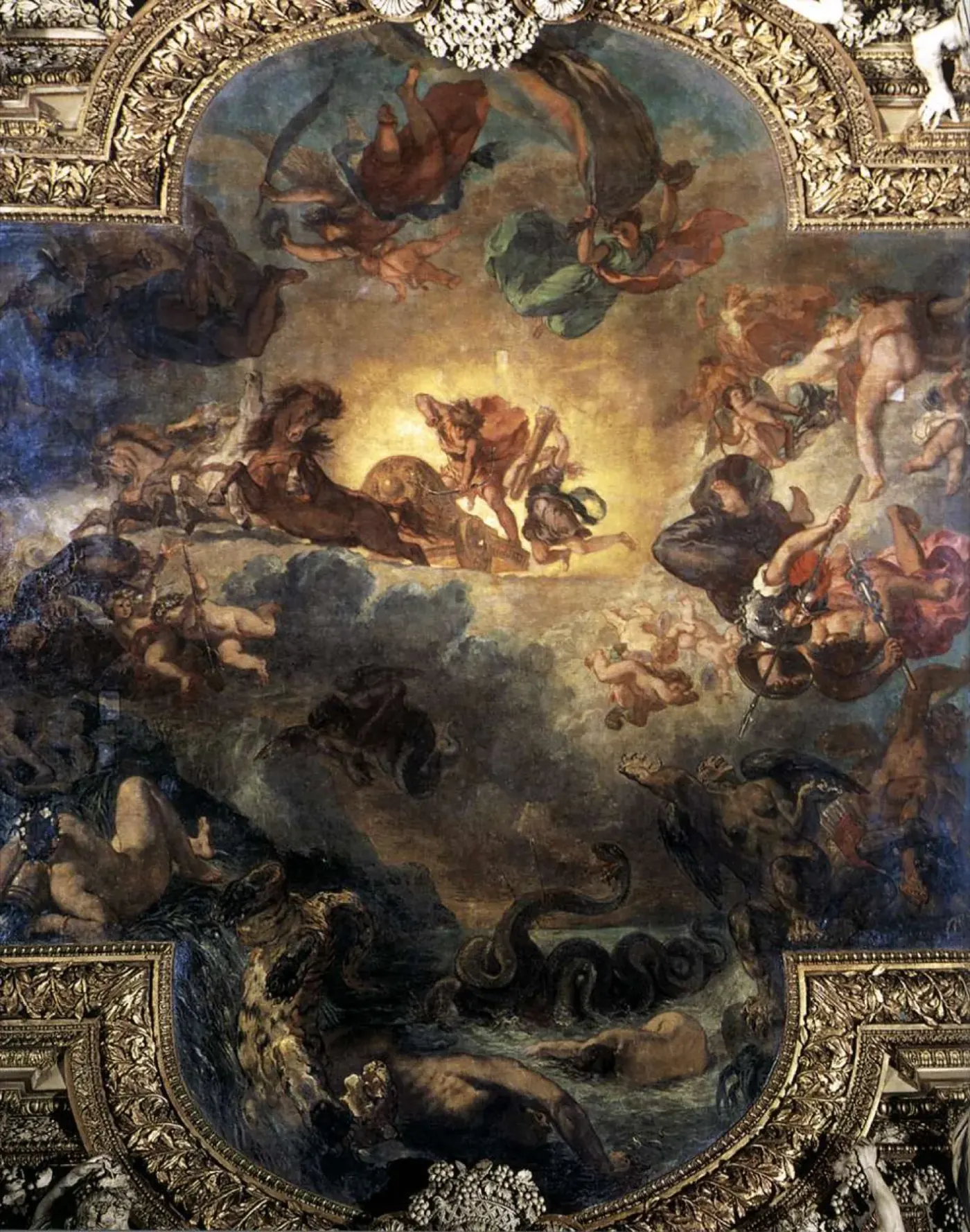
Painting · Musée du Louvre
Created for the Galerie d’Apollon, the ceiling image makes the god’s victory over Python an allegory of light and cultural power. Its royal museum setting is part of that meaning.
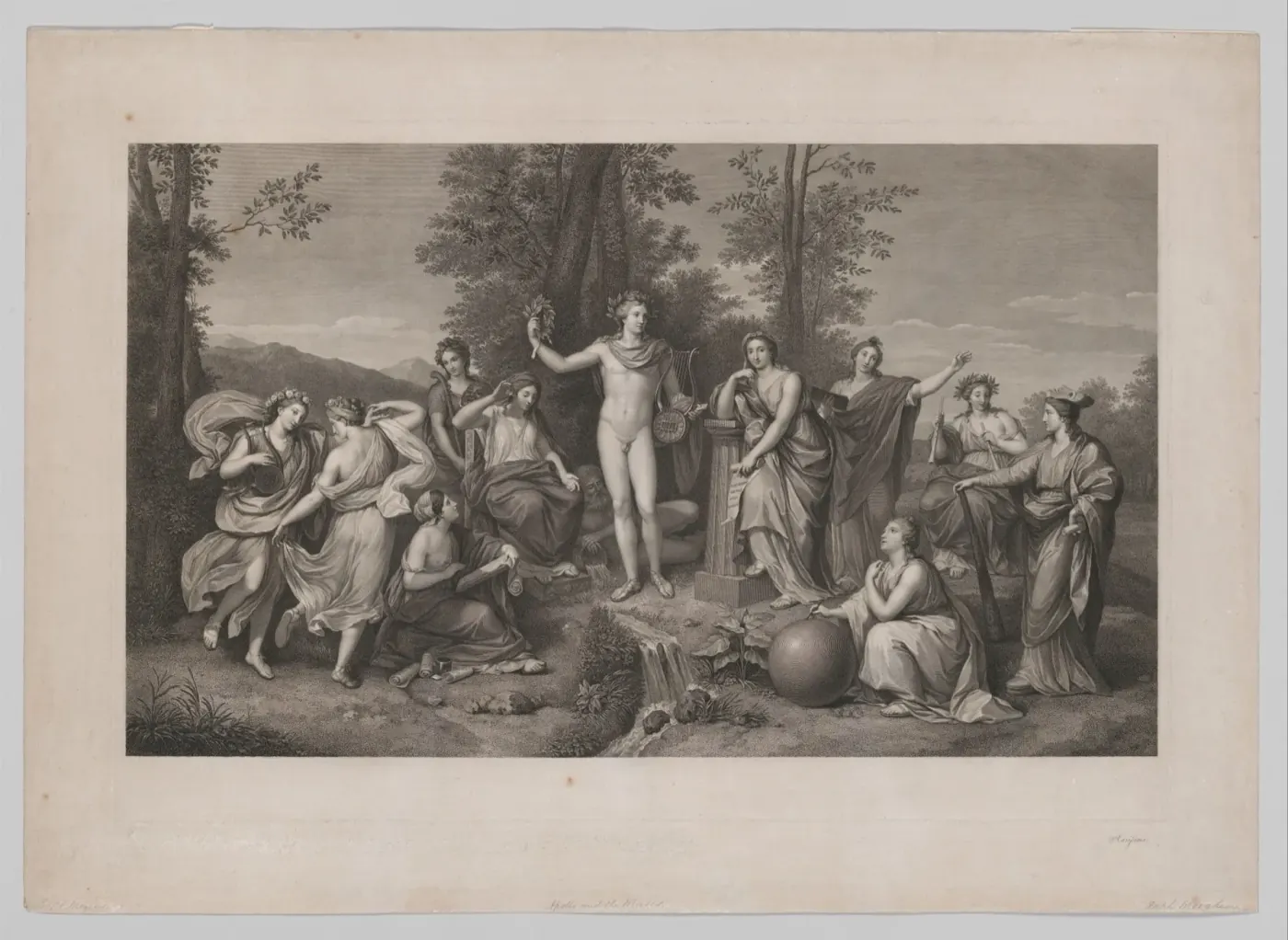
Print · The Metropolitan Museum of Art
The print disseminated Mengs’s Neoclassical Parnassus, where Apollo organizes the Muses as a visual manifesto of disciplined artistic culture.
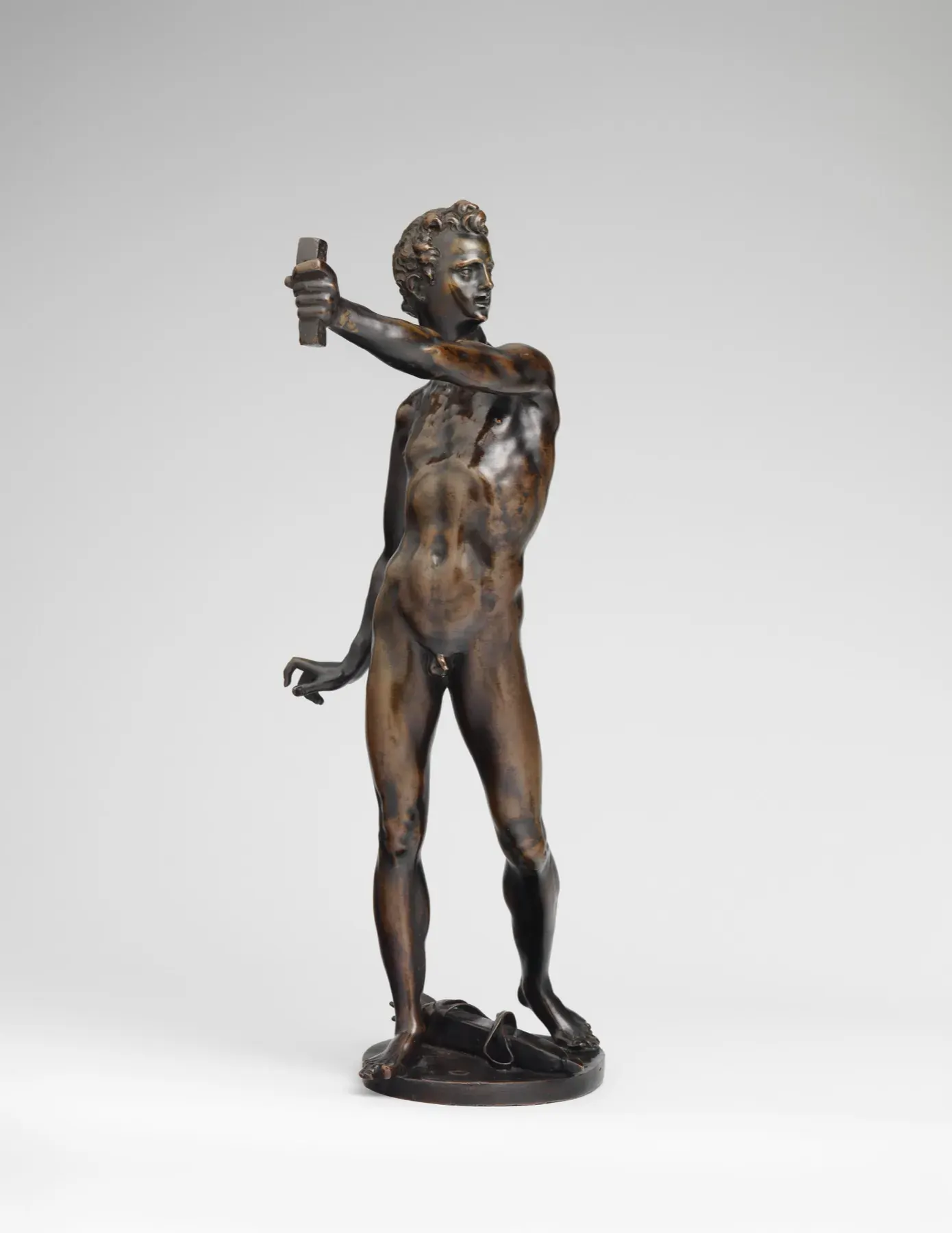
Sculpture · The Metropolitan Museum of Art
The small bronze turns Apollo’s elegant contrapposto into a collectible Mannerist object. The Met’s attribution history shows how scholarship can revise famous names attached by earlier owners.
Art thumbnails use public-domain, CC0, or attributed images. Every card identifies the object record, image source, and license; an editorial crop never replaces the institutional catalogue entry.
Reception across media
Text · stage · screen · scholarship
Apollo-centered works repeatedly test the relation between formal beauty and dangerous power. Music is not decorative accompaniment: it is the very medium through which the god is recognized, disciplined, mocked, or reimagined.
Selected bibliography
Ancient textAnonymous Greek poet(s)
The composite hymn joins Delian birth and Delphic foundation, making geography, festival, priesthood, and performance central to Apollo’s story.
Perseus Digital LibraryOpen record ↗Historical receptionWolfgang Amadeus Mozart
Written when Mozart was eleven, the work adapts the Hyacinthus story for a school setting and alters mythic relationships to fit its libretto and audience.
Mozarteum FoundationOpen record ↗Selected bibliography
Historical receptionIgor Stravinsky / George Balanchine
The ballet follows Apollo’s birth and instruction of the Muses through spare music and choreography that became foundational to twentieth-century neoclassicism.
New York City BalletOpen record ↗ Modern adaptation
Rick Riordan
The Trials of Apollo begins when Zeus casts Apollo into a mortal teenage body. Comic first-person narration turns divine entitlement into vulnerability and accountability.
Disney BooksOpen record ↗Selected bibliography
 Modern adaptation
George O’Connor
A graphic title volume uses the nine Muses to frame different dimensions of Apollo’s stories and cultural authority.
MacmillanOpen record ↗ Scholarship
Fritz Graf
Graf surveys Homer, music, oracle, healing, youth, civic life, origins, and reception while questioning the easy modern equation of Apollo with sunlight alone.
RoutledgeOpen record ↗Institutional and scholarly resources
When modern book covers or publicity images are shown, they appear at small scale for identification and criticism; copyright remains with the named rights holders. Public-domain context images are explicitly labeled.
Sources & method
Sources and documentation
Dates follow conventional scholarly ranges. Cover thumbnails identify modern editions; they do not represent the original material form of an ancient text. Links lead to university archives, publishers, and museum catalogues.
Anonymous Greek poet(s) · 7th–6th c. BCE
Birth at Delos and foundation at Delphi.Anonymous Greek poet · 6th c. BCE
Apollo, Hermes, the cattle, and the exchange of the lyre.Homeric tradition · late 8th–early 7th c. BCE
Plague, priestly honor, Troy, and Apollo’s battlefield interventions.Pseudo-Apollodorus · 1st–2nd c. CE
Genealogy and later-organized mythic narratives.Ovid · 8 CE
Roman literary reception of Daphne, Hyacinthus, Marsyas, and Apollo’s desires.Aeschylus · 458 BCE
Cassandra’s prophetic speech and the violence surrounding Apollo’s gift.The Metropolitan Museum of Art · 2000
Museum context for Greek material and visual culture.Family questions
Apollo is the son of Zeus and Leto and the twin brother of Artemis.
Apollo is associated with prophecy, music, archery, healing, plague, purification, youth, and civic institutions.
Apollo increasingly acquired solar associations, but Helios is the more specific sun god in early Greek tradition.
The Romans retained Apollo’s Greek name and many functions, but Roman worship and political uses—especially under Augustus—created new contexts.