OLYMPIAN · 21
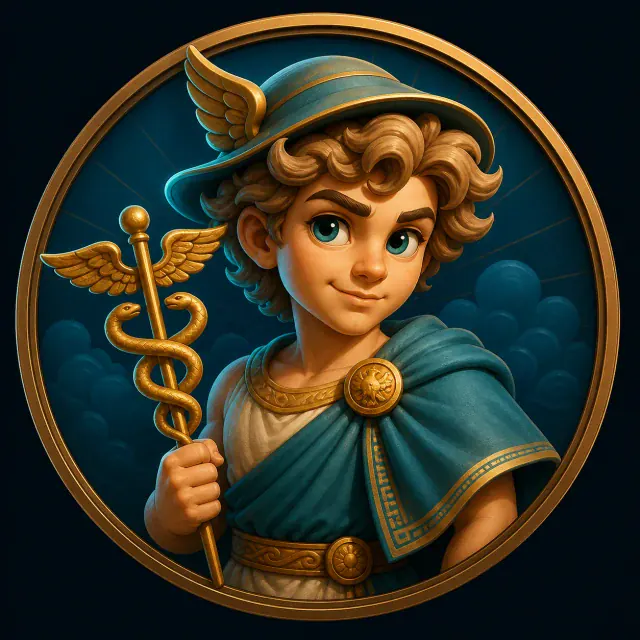
Illustrated portrait of Hermes

Portrait from the MythBranch atlas
Interpretive illustration, not an ancient likeness

Greek mythology research profile · cited sources

Hermes

Mercury · Messenger, trickster, guide & boundary-crosser

Hermes is messenger, herald, thief, guide of souls, protector of travelers and merchants, patron of persuasive speech, and master of boundaries that he can mark because he knows how to cross them. The Homeric Hymn gives him one of antiquity's most complete divine childhoods: born at dawn, he invents the lyre, steals Apollo's cattle, lies brilliantly, negotiates recognition, and acquires new offices before night.

Names · attributes · ancient evidence

Hermes: identity and historical contexts.

Hermes is son of Zeus and Maia, born in a cave on Mount Cyllene. Herms—stone boundary markers with head and phallus—placed his presence on roads, borders, doorways, and civic space. As psychopompos he escorts rather than judges the dead. As messenger he moves divine speech; as trickster he tests ownership and evidence; as god of exchange he makes value circulate. The caduceus is a herald's staff, not originally the medical rod of Asclepius.

Winged helmet and sandals become dominant in later art, but ancient Hermes may wear a broad traveler's hat or appear as a mature bearded herm. Roman Mercury expands commercial and imperial associations. Modern confusion between caduceus and medical symbol arose through later institutional history; it should not be used to call Hermes the Greek god of medicine, although he has relevant roles in luck, transition, and communication.

01Argeiphontes · Slayer of Argus02Psychopompos · Guide of souls03Enodios · Of the road04Dolios · Crafty05Kriophoros · Ram-bearer
01

Boundaries, exchange, and changed status

Hermes creates routes, bargains, translations, and changes of status. A traveler crossing a border becomes guest or stranger; stolen cattle become compensation; a tortoise becomes an instrument; a dead person becomes a guided shade. These narratives define his boundary function through specific social and material relations.

02

The hymn is a divine career compressed into one day

The infant's speed is comic, but the sequence also explains how a younger god enters an already occupied cosmos. Hermes cannot seize Apollo's place, so he invents objects and exchanges them for recognized functions. Divine order expands through negotiation rather than another succession war.

Texts · chronology · variant traditions

Selected ancient narratives involving Hermes.

Hermes's myths show how intelligence converts obstacles into new relations without pretending the trickster is harmless.

01

Homeric Hymn · Birth day

The tortoise becomes a lyre

Soon after birth, Hermes leaves Maia's cave, finds a tortoise, kills it, and stretches strings across the shell to create the lyre. He sings of his parents and his desired divine honors. The first invention combines curiosity, violence, craft, music, and self-presentation.

Anonymous: Homeric Hymn to Hermes ↗
02

Homeric Hymn · Birth day

Apollo's cattle walk backward

Hermes steals Apollo's cattle, disguises their trail, invents fire sticks, sacrifices animals, and returns to his cradle. When confronted, he argues like a helpless newborn. Zeus laughs but orders a resolution. Hermes gives Apollo the lyre and receives the cattle and further powers.

Anonymous: Homeric Hymn to Hermes ↗
03

Io cycle

Hermes kills Argus

Hera assigns many-eyed Argus to guard Io. Zeus sends Hermes, who lulls or charms the watchman and kills him, earning the title Argeiphontes. Ovid elaborates the episode through storytelling and music, while ancient versions vary in method and emphasis.

Ovid: Metamorphoses ↗
04

Epic and hymn

Hermes guides souls and returnees

Hermes leads dead suitors toward the underworld in the Odyssey, brings Priam safely through the Achaean camp in the Iliad, escorts Persephone upward in art and later sources, and moves between divine and mortal spaces without becoming sovereign of any one realm.

Homeric tradition: Iliad ↗Homeric tradition: Odyssey ↗

Genealogical records and atlas relationships

Genealogical evidence and variant traditions.

The atlas shows Hermes as a son of Zeus but omits Maia. His descendants and loves vary across local and literary traditions; Pan's parentage, for example, is not uniform.

Unions drawn in this atlas

00

No line of this type is drawn in the current atlas.

Children drawn in this atlas

00

No line of this type is drawn in the current atlas.

Genealogy note

Maia, daughter of Atlas, is Hermes's mother in the Homeric Hymn. The chart's Zeus line is therefore correct but incomplete, and the profile supplies the missing maternal branch.

Open the interactive branch ↗

Text · stage · screen · scholarship

Selected works concerning Hermes in later reception.

Each selected work treats this figure as its subject, title presence, principal voice, or central dramatic agent. Incidental appearances are excluded. The bibliography also avoids assigning the same representative title to multiple profiles except where a shared primary text is indispensable.

  1. 6th c. BCE or laterHomeric Hymn to HermesNarrative hymn
  2. 2018Olympians: Hermes — Tales of the TricksterGraphic novel
  3. 17th centuryMercury and ArgusCantata tradition
01

Selected bibliography

Ancient hymn & comedy

01 works
02

Selected bibliography

Graphic biography

01 works
03

Selected bibliography

Music & visual reception

01 works

When modern book covers or publicity images are shown, they appear at small scale for identification and criticism; copyright remains with the named rights holders. Public-domain context images are explicitly labeled.

Sources and documentation

Primary texts, scholarship, and catalogue records.

Dates follow conventional scholarly ranges. Cover thumbnails identify modern editions; they do not represent the original material form of an ancient text. Links lead to university archives, publishers, and museum catalogues.

Ancient source

4
  1. 01Homeric Hymn to HermesAnonymous
    Verified text or catalogue record
    Homeric Hymn to Hermes↗

    Anonymous · 6th c. BCE or later

    Birth, lyre, cattle theft, trial, exchange, and divine offices.
    Edition or recordHugh G. Evelyn-White translation · Perseus Digital Library
  2. 02IliadHomeric tradition
    Verified text or catalogue record
    Iliad↗

    Homeric tradition · late 8th–early 7th c. BCE

    Hermes as guide and protector of Priam's dangerous passage.
    Edition or recordOpen translation · Harvard Center for Hellenic Studies
  3. 03OdysseyHomeric tradition
    Verified text or catalogue record
    Odyssey↗

    Homeric tradition · late 8th–early 7th c. BCE

    Messages, moly, Calypso, and guidance of the dead suitors.
    Edition or recordOpen translation · Harvard Center for Hellenic Studies
  4. 04MetamorphosesOvid
    Verified text or catalogue record
    Metamorphoses↗

    Ovid · c. 8 CE

    Roman Mercury's story, music, and killing of Argus.
    Edition or recordLatin text and English translation · Perseus

Academic study

1
  1. 01Hermes the ThiefNorman O. Brown
    Verified text or catalogue record
    Hermes the Thief↗

    Norman O. Brown · 1947

    Influential, debated modern study of exchange, trickery, and social structure.
    Edition or recordScholarly research trail · JSTOR

Family questions

Questions about Hermes's family.

Who are Hermes's parents?

Hermes is the son of Zeus and Maia, daughter of Atlas.

Who are Hermes's siblings and relatives?

Hermes is a son of Zeus and Maia. Through Zeus he has many paternal half-siblings, including Apollo, Artemis, Athena, Ares, and Dionysus; ancient traditions do not supply one universally fixed, complete sibling list. Maia's father Atlas connects Hermes to the Titan line.

What is Hermes the god of?

He governs messages, roads, boundaries, travelers, trade, theft, luck, persuasive speech, and the guidance of souls.

Is the caduceus a medical symbol?

The caduceus is Hermes's herald staff. The single-serpent rod of Asclepius is the more historically specific Greek medical symbol; modern institutions sometimes confused them.