Greek hero dossier · genealogy, variants & 9 cited episodes

Perseus

Perseus · Gorgon-slayer, rescuer of Andromeda & dynastic founder

Perseus is the son of Zeus and the Argive princess Danaë, husband of Andromeda, killer of the mortal Gorgon Medusa, and ancestor of the Perseid rulers—including Heracles through Electryon and Alcmene. His story moves from an oracle and a sea chest to Seriphos, the Gorgons’ remote country, Andromeda’s shore, and the kingdoms of Tiryns and Mycenae. It is not one fixed biography: Hesiod, Pindar, vase painters, Pseudo-Apollodorus, Ovid, Pausanias, and later artists preserve different emphases, equipment, routes, and moral frames.

Oracle · exile · borrowed equipment · controlled sight

Perseus wins by managing what can—and cannot—be seen.

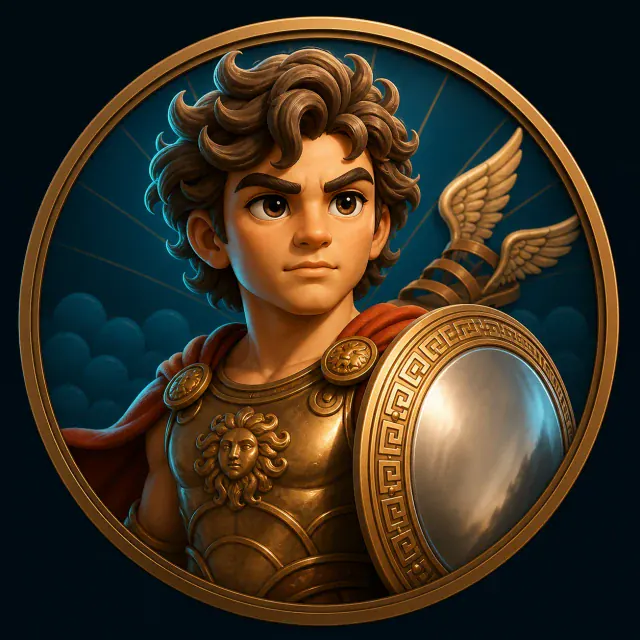
Ancient images identify Perseus through a curved harpe or sickle, a kibisis strong enough to contain Medusa’s head, winged footwear, and some form of concealing headgear. Yet no single early source hands him the familiar modern kit in exactly the same way. Pseudo-Apollodorus distributes guidance and tools among Athena, Hermes, the Graeae, and unnamed nymphs; later mythography moves particular gifts between gods. The hero’s most important skill is therefore not solitary strength but the disciplined use of information, divine help, concealment, distance, and indirect vision.

Three modern shortcuts require labels. First, the detailed story that Medusa was transformed after Poseidon violated her in Athena’s temple is Ovid’s influential Roman account, not a premise stated by Hesiod. Second, Pseudo-Apollodorus has Perseus travel with winged sandals; Pegasus is born when Medusa is killed and is not the hero’s regular mount in that narrative. Third, the polished shield as a literal mirror is powerfully developed in later art and summaries. Ancient sources do connect Athena, a bronze shield, an averted gaze, and guidance, but the precise optical choreography varies.

01Gorgon-slayer · recurring narrative title02Son of Danaë · maternal identifier03Argive hero · dynastic identity04Founder of Mycenae · local tradition05Bearer of the gorgoneion · iconographic role06Perseid ancestor · genealogical identity
01

The quest begins as pressure on Danaë

Polydectes does not send Perseus out merely because a monster needs killing. In Pindar and Pseudo-Apollodorus, the king’s designs on Danaë and Perseus’s resistance create the trap. The Gorgon quest is bound to a threatened household, coerced marriage, and the politics of Seriphos from the start.

02

Equipment has its own source history

The kibisis, winged sandals, cap of Hades, adamantine sickle, shield, and divine guides are not a timeless standardized inventory. Comparing Pseudo-Apollodorus with Hyginus and visual art shows how later retellings consolidate scattered tools into the familiar fantasy loadout.

03

Pegasus belongs to the aftermath before he belongs to Perseus

Hesiod says Pegasus and Chrysaor spring from Medusa when Perseus cuts off her head; Pegasus then reaches Zeus. Bellerophon is the Greek hero most securely associated with riding the horse. Paintings and films that mount Perseus on Pegasus are genuine reception history, not evidence for every ancient version.

04

A genealogy can explain a people without recording history

Herodotus and later mythography connect Perses, the son left with Cepheus, to the name of the Persians. This is Greek aetiological genealogy—a story explaining a name and relationship—not documentary evidence that an actual Persian dynasty descended from Perseus.

Nine episodes from birth prophecy to Mycenae

A rescue cycle framed by an oracle that cannot be escaped.

The most continuous surviving account is the later mythographic synthesis of Pseudo-Apollodorus. Earlier poetry and art preserve only parts of the cycle, while Ovid greatly expands the return journey. The sequence below keeps those layers visible rather than blending them into one anonymous ‘original myth.’

01

Argos · birth oracle

Acrisius tries to prevent his grandson

Acrisius learns that a son born to his daughter Danaë will kill him. Pseudo-Apollodorus says he confines her in a subterranean bronze chamber. Zeus reaches her in a stream or shower of gold, and Perseus is born; the same mythographer notes a variant that made Proetus the father and used the claim to explain the brothers’ feud.

ReadingThe first antagonist is not a monster but a ruler converting fear of succession into imprisonment. Every defensive measure moves the oracle closer to fulfillment.
Pseudo-Apollodorus: Library of Greek Mythology 2.4.1–5 ↗
02

Infancy · exile to Seriphos

Danaë and Perseus cross the sea in a chest

Acrisius shuts mother and child into a wooden chest and casts it into the sea rather than killing them openly. The chest reaches Seriphos, where the fisherman Dictys catches or receives it and raises Perseus. Fragmentary Greek drama treated this terrifying arrival, while the later handbook supplies the compact narrative familiar today.

ReadingPerseus survives because Danaë endures with him and Dictys extends hospitality. The hero’s origin is a story of maternal survival and foster care before it is a story of conquest.
Pseudo-Apollodorus: Library of Greek Mythology 2.4.1–5 ↗
03

Seriphos · the false wedding gift

Polydectes turns a boast into a suicide mission

Polydectes wants access to Danaë and gathers contributions under the pretext of marrying Hippodameia. When Perseus boasts that he could bring even a Gorgon’s head, the king demands exactly that. Pindar remembers the return as a deadly wedding gift that ends Danaë’s forced condition.

ReadingThe quest weaponizes heroic speech. A young man’s impossible promise becomes an instrument for removing him from a household under pressure.
Pindar: Pythian 12 ↗Pseudo-Apollodorus: Library of Greek Mythology 2.4.1–5 ↗
04

Quest · information and equipment

The Graeae guard the route, not the prize

Athena and Hermes direct Perseus toward the Graeae, sisters who share one eye and one tooth. He intercepts the eye during its passage and forces them to reveal the nymphs’ location. From the nymphs he receives winged sandals, the kibisis, and the cap of Hades; Hermes supplies the cutting weapon in Pseudo-Apollodorus. Hyginus rearranges parts of the equipment tradition.

ReadingKnowledge is the first magical object. Perseus cannot reach Medusa until he controls a relay system and assembles tools supplied by others.
Pseudo-Apollodorus: Library of Greek Mythology 2.4.1–5 ↗Hyginus tradition: Astronomica 2.12 ↗
05

Gorgon country · the decapitation

Medusa dies while her immortal sisters sleep

Medusa alone among the three Gorgons is mortal. Perseus approaches while the sisters sleep, looks toward the reflection in a bronze shield or follows Athena’s guidance while turning away, and cuts off Medusa’s head. Hesiod says Pegasus and Chrysaor spring from the wound. Perseus puts the still-dangerous head in the kibisis and escapes Stheno and Euryale under concealment.

ReadingThe scene joins death, birth, image, and reusable force. Medusa’s power survives her body and becomes something the victor can carry, display, and deploy.
Hesiodic tradition: Theogony, lines 270–294 ↗Pindar: Pythian 12 ↗Pseudo-Apollodorus: Library of Greek Mythology 2.4.1–5 ↗
06

Roman expansion · Metamorphoses 4

Ovid sends Perseus past Atlas and the birth of coral

In Ovid’s Roman poem, Atlas refuses hospitality because of a prophecy and is turned into a mountain by the Gorgon head. After the sea-monster battle, seaweed beneath Medusa’s head hardens into coral. These celebrated episodes belong to Ovid’s inventive, interlocking poem and are not part of Pseudo-Apollodorus’s route.

ReadingThe severed head becomes an engine of metamorphosis. Ovid asks what happens when a portable image can remake landscape and matter.
Ovid: Metamorphoses, Books 4–5 ↗
07

Ethiopian shore · rescue and wedding

Andromeda is rescued—and a marriage is contested

Cassiopeia’s boast against the Nereids brings Poseidon’s punishment upon Cepheus’s land, and Andromeda is exposed to a sea monster. Perseus negotiates for her marriage, kills the creature, and frees her. Pseudo-Apollodorus and Ovid then preserve conflict with Phineus, the prior claimant; the Gorgon head ends the wedding battle.

ReadingRescue is also a transfer of marriage and dynasty. Andromeda’s role extends beyond the shore: she travels to Greece, bears the Perseid line, and anchors its international genealogy.
Pseudo-Apollodorus: Library of Greek Mythology 2.4.1–5 ↗Ovid: Metamorphoses, Books 4–5 ↗
08

Return to Seriphos

The Gorgon head ends Polydectes’s rule

Perseus returns to find Danaë and Dictys seeking sanctuary from Polydectes. He displays Medusa’s head to the king and his supporters, turns them to stone, and installs Dictys as ruler. He then returns the borrowed objects and gives the head to Athena, who places it on her protective armor in the major tradition.

ReadingThe original impossible gift becomes evidence, punishment, and regime change. Only after the threatened household is secured does the quest close.
Pindar: Pythian 12 ↗Pseudo-Apollodorus: Library of Greek Mythology 2.4.1–5 ↗
09

Larissa, Tiryns & Mycenae

The discus fulfills the oracle and the dynasty moves

Acrisius stays away from Argos, but at games in Larissa a discus thrown by Perseus accidentally strikes and kills him. Ashamed to inherit the kingdom through the foretold death, Perseus exchanges Argos for the realm of Megapenthes and is linked with Tiryns, Midea, and the foundation or fortification of Mycenae. His children with Andromeda establish the line that leads to Heracles.

ReadingNeither exile nor avoidance defeats the oracle. The ending transforms accidental death into a map of kingdoms and descendants rather than a simple homecoming.
Pseudo-Apollodorus: Library of Greek Mythology 2.4.1–5 ↗Pausanias: Description of Greece, Book 2 ↗Herodotus: Histories 7.61 ↗

Argive ancestry · Seriphos household · Andromeda · Perseids

The family tree runs from a feared grandson to Heracles.

The interactive atlas currently draws only Zeus above Perseus, so this dossier restores the mortal line that gives the oracle its meaning: Acrisius and Danaë, the foster household on Seriphos, Andromeda’s royal family, the children born after the rescue, and the descendant chain through Electryon and Alcmene to Heracles.

Argive ancestry and parents

05

AcrisiusMaternal grandfather; target of the oracle

EurydiceMaternal grandmother in Pseudo-Apollodorus

DanaëMother and fellow castaway

ZeusJupiter

ProetusAlternative father in a reported variant

Seriphos household

03

DictysFisherman, rescuer, foster protector, later king

PolydectesDictys’s brother; hostile king pursuing Danaë

DanaëPerseus protects her on returning from the quest

Marriage and Ethiopian royal house

04

AndromedaWife and mother of the Perseid children

CepheusFather-in-law; king in the rescue tradition

CassiopeiaMother-in-law whose boast triggers the crisis

PhineusAndromeda’s prior claimant and kinsman in major versions

Children and dynastic line

09

PersesSon left with Cepheus; Persian eponym

AlcaeusSon; father of Amphitryon

SthenelusSon; father of Eurystheus

HeleusSon in the mythographic list

MestorSon in the mythographic list

ElectryonSon; father of Alcmene

AutochtheDaughter in Pseudo-Apollodorus

GorgophoneDaughter; major Spartan and Messenian genealogical link

HeraclesHercules
Genealogy note

Pseudo-Apollodorus names Perses, Alcaeus, Sthenelus, Heleus, Mestor, and Electryon as sons of Perseus and Andromeda, plus the daughters Autochthe and Gorgophone. Lists and spellings vary. Perses is left with Cepheus and becomes an eponymous ancestor of Persians in Greek explanatory tradition. Electryon fathers Alcmene, who becomes the mother of Heracles by Zeus; on that line Perseus is Heracles’s great-grandfather. ‘Half-siblings through Zeus’ is theoretically vast, but ancient Perseus narratives do not present a stable sibling household equivalent to his marriage and descendants.

Open the interactive branch ↗

Roman poetry · civic bronze · Victorian cycle · film · counternarrative

Every afterlife rearranges the gaze and the hero’s innocence.

Ovid gives European artists a metamorphic travel narrative; Cellini turns victory into Florentine state imagery; Victorian and children’s literature moralize the quest; cinema assembles a bestiary; recent fiction returns agency to Medusa and her sisters. The differences are the history, not noise to be harmonized away.

  1. 490 BCEPythian 12Athena turns the Gorgons’ lament into music.
  2. c. 8 CEMetamorphosesAtlas, coral, Andromeda, and Phineus enter one Roman arc.
  3. 1545–54Cellini’s PerseusThe severed head becomes a Florentine political image.
  4. 1875–88The Perseus SeriesBurne-Jones designs an unfinished monumental cycle.
  5. 1981Clash of the TitansHarryhausen gives the quest its defining screen monsters.
  6. 2022Stone BlindMedusa’s family retells the killer’s heroic story.
01

Selected bibliography

Ancient & celestial afterlives

02 works
Ancient textPerseus among the constellationsPseudo-Eratosthenes and Hyginus traditions · Hellenistic and Roman compilations
Catasterism and star lore

Perseus among the constellations

Pseudo-Eratosthenes and Hyginus traditions

Catasterism places Perseus in the sky holding the Gorgon’s head, close to Andromeda, Cassiopeia, Cepheus, Pegasus, and Cetus. The familiar celestial family is an ancient act of reception that selects a triumphant final image.

University of Georgia Open EducationOpen record ↗
02

Selected bibliography

Art, print & children’s literature

05 works
03

Selected bibliography

Modern screen & counternarrative

02 works
Early sixteenth-century tapestry showing Perseus rescuing AndromedaModern adaptation
The Met Open Access · object 65.181.16Public domain context · not a film still
Feature film and stop-motion effects

Clash of the Titans

Desmond Davis and Ray Harryhausen

The film combines Perseus, Andromeda, Pegasus, Medusa, and a sea monster renamed the Kraken with an invented divine rivalry. Harryhausen’s final feature gave the Gorgon pursuit and rescue story an enduring screen bestiary; the 2010 remake inherited much of that composite structure.

British Film InstituteOpen record ↗

When modern book covers or publicity images are shown, they appear at small scale for identification and criticism; copyright remains with the named rights holders. Public-domain context images are explicitly labeled.

Sources and documentation

Primary texts, scholarship, and catalogue records.

Dates follow conventional scholarly ranges. Cover thumbnails identify modern editions; they do not represent the original material form of an ancient text. Links lead to university archives, publishers, and museum catalogues.

Ancient source

7
  1. 01Theogony, lines 270–294Hesiodic tradition
    Verified text or catalogue record
    Theogony, lines 270–294↗

    Hesiodic tradition · late 8th–7th century BCE

    The earliest surviving literary genealogy used here: Phorcys and Ceto, the Graeae and Gorgons, Medusa’s mortality, and the births of Pegasus and Chrysaor.
    Edition or recordHugh G. Evelyn-White translation · Perseus Digital Library
  2. 02Pythian 12Pindar
    Verified text or catalogue record
    Pythian 12↗

    Pindar · 490 BCE

    Athena’s music from the Gorgons’ lament, Danaë’s golden conception, Polydectes, Seriphos, and the fair-cheeked Medusa in a compact early witness.
    Edition or recordDiane Arnson Svarlien translation · Perseus Digital Library
  3. 03Library of Greek Mythology 2.4.1–5Pseudo-Apollodorus
    Verified text or catalogue record
    Library of Greek Mythology 2.4.1–5↗

    Pseudo-Apollodorus · 1st–2nd century CE

    The fullest continuous ancient synthesis of the oracle, chest, Seriphos, Graeae, equipment, Medusa, Andromeda, Polydectes, Acrisius, kingdom exchange, and children.
    Edition or recordJames George Frazer translation · Perseus Digital Library
  4. 04Metamorphoses, Books 4–5Ovid
    Verified text or catalogue record
    Metamorphoses, Books 4–5↗

    Ovid · c. 8 CE

    The influential Roman expansion of Atlas, Andromeda, coral, Medusa’s origin, Perseus’s storytelling, and the battle with Phineus.
    Edition or recordA. S. Kline translation · University of Virginia Ovid Collection
  5. 05Description of Greece, Book 2Pausanias
    Verified text or catalogue record
    Description of Greece, Book 2↗

    Pausanias · 2nd century CE

    Argive monuments, the kingdom exchange, Midea, Tiryns, Mycenae, and later local memory of Perseus and the Perseids.
    Edition or recordW. H. S. Jones translation · Perseus Digital Library
  6. 06Histories 7.61Herodotus
    Verified text or catalogue record
    Histories 7.61↗

    Herodotus · 5th century BCE

    A Greek genealogical explanation connecting Perses, son of Perseus and Andromeda, with the name of the Persians.
    Edition or recordA. D. Godley translation · Perseus Digital Library
  7. 07Astronomica 2.12Hyginus tradition
    Verified text or catalogue record
    Astronomica 2.12↗

    Hyginus tradition · late 1st century BCE–early 1st century CE

    A Latin witness for Perseus’s constellation, the Graeae, divine equipment, invisibility, and the placement of Medusa’s head on Minerva’s breast.
    Edition or recordLatin text · Packard Humanities Institute Classical Latin Texts

Academic study

1
  1. 01PerseusDaniel Ogden
    Verified text or catalogue record
    Perseus↗

    Daniel Ogden · 2008

    A book-length study devoted to the complete myth, ancient evidence, art, comparative patterns, and reception rather than only the Medusa episode.
    Edition or recordGods and Heroes of the Ancient World · Routledge

Museum research

1
  1. 01Dangerous Beauty: Medusa in Classical ArtKiki Karoglou
    Verified text or catalogue record
    Dangerous Beauty: Medusa in Classical Art↗

    Kiki Karoglou · 2018

    Museum scholarship on the visual history of Medusa, Perseus’s encounter, the changing Gorgon face, apotropaic images, gender, beauty, and later reception.
    Edition or recordThe Metropolitan Museum of Art Bulletin 75.3

Family questions

Questions about Perseus's family.

Who are Perseus’s parents and grandparents?

In the dominant tradition, Perseus is the son of Zeus and Danaë. Danaë is the daughter of Acrisius, king of Argos, and Eurydice in Pseudo-Apollodorus. The same mythographer reports a minority variant in which Proetus fathered Perseus; the page labels that as a variant rather than merging it into the main line.

Did Perseus have brothers or sisters?

No stable ancient tradition gives Perseus a household of full siblings born to Danaë and the same father. Because Zeus fathers many gods and heroes, modern charts can call numerous figures his paternal half-siblings, but the membership depends on which divine genealogies are combined and is not central to the Perseus cycle.

Who is Perseus’s wife?

Perseus marries Andromeda after rescuing her from the sea monster. She is the daughter of Cepheus and Cassiopeia. Accounts differ in the details of the rescue and the conflict with her prior claimant Phineus, but their marriage and descendants are major parts of the dynastic tradition.

Who are the children of Perseus and Andromeda?

Pseudo-Apollodorus names Perses, Alcaeus, Sthenelus, Heleus, Mestor, and Electryon, as well as the daughters Autochthe and Gorgophone. Ancient and later lists can vary. Electryon’s daughter Alcmene becomes the mother of Heracles.

How did Perseus kill Medusa without turning to stone?

The major sources combine divine guidance, an averted or indirect gaze, concealment, and special equipment. Pseudo-Apollodorus says Athena guided his hand while he looked toward a bronze shield and Medusa slept; he then used the kibisis and cap of Hades to contain the head and escape. Later art makes the shield’s mirror function especially explicit.

Which gods and helpers aided Perseus?

Athena and Hermes are the principal divine guides. The Graeae unwillingly reveal the route, unnamed nymphs provide the kibisis, winged sandals, and cap in Pseudo-Apollodorus, and the cutting weapon is assigned to Hermes or Vulcan/Hephaestus in different later accounts. Dictys protects Danaë and Perseus on Seriphos.

Did Perseus ride Pegasus?

Not in the main narrative preserved by Pseudo-Apollodorus, where Perseus flies with winged sandals. Hesiod says Pegasus is born from Medusa’s severed neck and then goes to Zeus. Bellerophon is the ancient rider most securely linked to Pegasus; Perseus riding the horse is prominent in later art and film.

Did Perseus found Mycenae?

Pausanias and later tradition link Perseus with founding or fortifying Mycenae after exchanging kingdoms with Megapenthes. That is an ancient foundation tradition, not modern archaeological proof that a historical individual named Perseus built the Bronze Age city.

How did Perseus fulfill the oracle about Acrisius?

At games in Larissa, a discus thrown by Perseus accidentally struck and killed Acrisius. The death is not a deliberate murder in Pseudo-Apollodorus. Perseus then felt shame about inheriting Argos through the accident and exchanged kingdoms with Megapenthes.

How did Perseus die?

The best-known continuous account ends with kingdom, foundation, and descendants rather than a detailed death scene. A later mythographic notice makes Megapenthes kill Perseus in revenge for Proetus, but this is a thin and conflicting tradition; it should not be presented as the single canonical ending.