MythBranch · Figure entry
Atlas in Greek Mythology
Atlas in Greek mythology: son of Iapetus, why he holds up the sky, his daughters Maia and Calypso, and his meetings with Heracles and Perseus.
The short answer
Who is Atlas in Greek mythology?
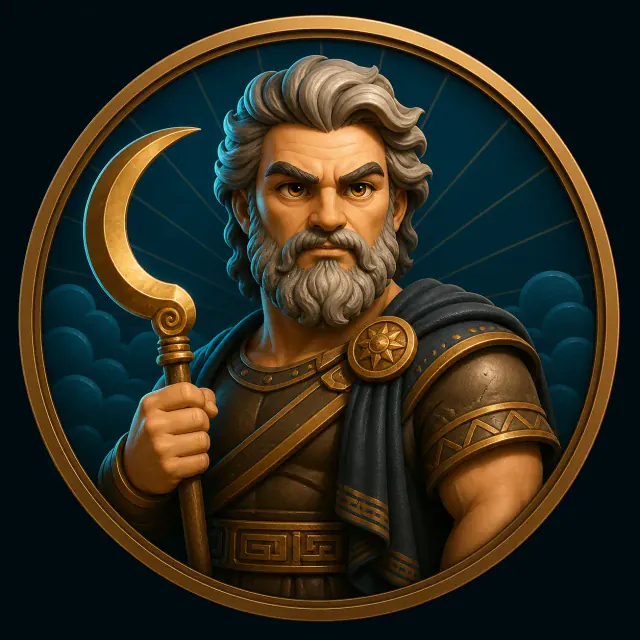
Atlas is a Titan, son of Iapetus and Clymene and brother of Prometheus. Hesiod says Zeus made him stand at the ends of the earth near the Hesperides and hold up the wide sky. The Odyssey instead has him keep the tall pillars that hold earth and sky apart. He is father of Maia, mother of Hermes, and of Calypso, and he meets Heracles over the golden apples.
Holding up the sky
Hesiod places Atlas in the far west, in front of the clear-voiced Hesperides, holding the sky on his head and tireless arms. He calls it the lot that Zeus assigned him. The Theogony does not say what Atlas did to earn it; it sits beside the punishments of his brothers Menoetius and Prometheus.
The Odyssey describes him differently: Atlas of baleful mind, who knows the depths of every sea and keeps the tall pillars that hold earth and sky apart. The common image of Atlas carrying a globe on his shoulders comes later. The Farnese Atlas, a Roman marble, shows him bent under a celestial sphere carved with constellations, the sky, not the earth.
Heracles and the apples of the Hesperides
In Apollodorus, Prometheus tells Heracles not to fetch the golden apples himself but to send Atlas and take the sky in the meantime. Atlas brings three apples and then offers to carry them to Eurystheus, leaving Heracles under the sky. Heracles agrees, asks Atlas to hold it while he puts a pad on his head, and walks off with the apples.
The metope from the Temple of Zeus at Olympia shows the moment of exchange: Atlas offers the apples while Heracles holds the sky, helped by Athena. The story makes the burden transferable, which is why it is the best-known image of Atlas in Greek art.
Perseus turns Atlas to stone
Ovid gives a Roman story of how the mountains of north-west Africa got his name. Atlas, warned that a son of Jupiter would steal his golden apples, refuses Perseus hospitality. Perseus shows him Medusa's head, and Atlas becomes a mountain whose beard and hair turn to forest and whose head and shoulders carry the sky.
Ovid's version conflicts with the Heracles story, which needs Atlas alive in a later generation. Ancient readers lived with the conflict, and the mountain range still carries the name.
Daughters: Maia, the Pleiades and Calypso
Hesiod calls Maia the daughter of Atlas when she bears Hermes to Zeus, which makes Atlas the grandfather of the messenger god. Later handbooks count Maia among the seven Pleiades, daughters of Atlas and the Oceanid Pleione, who became the star cluster.
The Odyssey names Calypso, the nymph who holds Odysseus for seven years, as Atlas's daughter. The name atlas for a book of maps comes from Gerardus Mercator, whose 1595 atlas was named after a legendary King Atlas of Mauretania said to have been a philosopher and astronomer.
Where the versions differ
Greek myth has no single authorised text. These are the points where the sources for Atlas disagree.
- What he holds
- Hesiod: the sky itself. The Odyssey: the pillars that keep earth and sky apart. HesiodHomer
- Why
- Hesiod gives no crime. Later handbooks connect it with the Titans' war against Zeus. HesiodTimothy
- His end
- Ovid turns him to stone; the Heracles story keeps him alive and still holding the sky. OvidApollodorus
Atlas's family ledger
Every line below is a cited assertion in the MythBranch knowledge graph. Variant and later traditions stay labelled, so a disputed parent never looks settled.
Parents
IapetusArchaic Greek · Explicit testimony
Son of Iapetus and Clymene in Hesiod (Theogony 507–511).
ClymeneArchaic Greek · Explicit testimony
Son of Iapetus and Clymene in Hesiod (Theogony 507–511); later sources may vary the mother.
Children
MaiaArchaic Greek · Explicit testimony
Maia, daughter of Atlas, bears Hermes to Zeus (Theogony 938–939).
2 branches from Zeus
The shortest cited route from Zeus to Atlas through the graph. MythBranch Daily scores every guess with this same count.
- 01
Zeus is a parent of HeraclesHesiod, Theogony 921–962 ↗
Heracles → - 02
Heracles faces AtlasApollodorus, Library ↗
Read on in the atlas
Illustrated profiles for the figures Atlas's stories depend on.
Questions about Atlas
Why does Atlas hold up the sky?
Hesiod says it is the lot Zeus assigned him. Later writers connect it with the Titans' defeat, but the Theogony gives no specific crime.
Does Atlas hold the earth or the sky?
The sky. Greek sources describe him supporting the heavens or the pillars between earth and sky; the globe in later art is a celestial sphere.
Who are Atlas's children?
Maia (mother of Hermes) and the other Pleiades, and Calypso in the Odyssey. Some later sources add the Hesperides or the Hyades.
Is Atlas related to Prometheus?
Yes. Both are sons of Iapetus and Clymene in Hesiod, with Menoetius and Epimetheus.
Sources and editions
- Hesiod, Theogony 507–520 ↗
Iapetus' sons and Atlas holding the sky in the far west.
- Homer, Odyssey 1.50–54 ↗
Calypso, daughter of Atlas, who keeps the pillars between earth and sky.
- Hesiod, Theogony 938–939 ↗
Maia, daughter of Atlas, bears Hermes to Zeus.
- Apollodorus, Library 2.5.11; 3.10.1 ↗
Atlas and the apples of the Hesperides; the Pleiades as daughters of Atlas and Pleione.
- Ovid, Metamorphoses 4.627–662 ↗
Perseus turns Atlas into a mountain with Medusa's head.
- Timothy Gantz, Early Greek Myth (1993) ↗
A survey of the early evidence for Atlas's punishment and the Heracles episode.
Passage references point to the ancient evidence; the summaries and readings are MythBranch's. Cite the edition you consult.