01
Divine descent
Semele and the second birth
Semele asks Zeus to appear in divine form and is destroyed by the revelation. Zeus rescues the unborn Dionysus and carries him to a second birth before the child is hidden from Hera’s hostility.
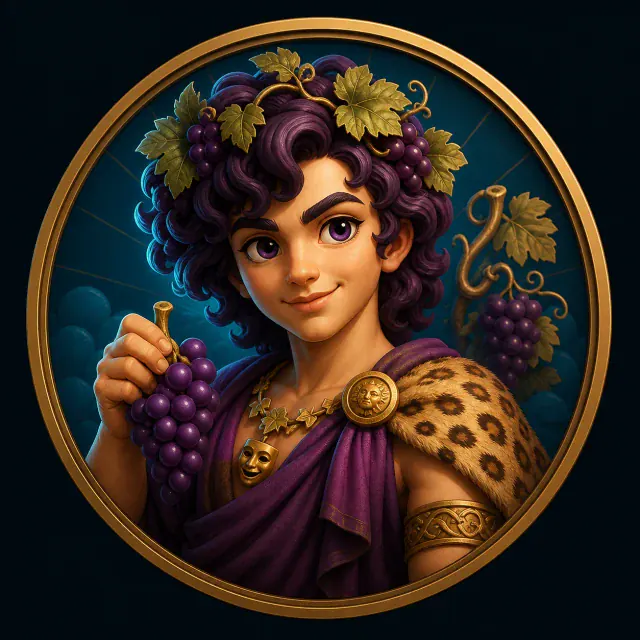
Portrait from the MythBranch atlas
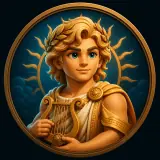
Interpretive illustration, not an ancient likeness
Greek deity research profile · cited sources
Bacchus · Wine, theatre, ecstasy & transformation
Dionysus is the god of wine, theatre, masks, ecstatic ritual, possession, and transformations that unsettle ordinary identity. He can bring joy, release, civic spectacle, terror, and social reversal. His myths repeatedly test recognition: what happens when a household or city refuses a god whose power moves through strangers, performance, altered bodies, and collective emotion?
Identity & cult
Names · attributes · ancient evidence
Dionysian religion ranges far beyond intoxication. Wine joins agriculture, exchange, danger, and regulated festivity; dramatic competitions connect the god with civic institutions; mysteries and gold tablets reveal specialized hopes concerning death; processions, masks, choruses, thyrsoi, ivy, and animal skins create forms of collective identity. The ecstatic maenad matters, but cannot represent every festival, theatre, household image, or ritual association.
Bacchus is Dionysus’s closest Roman name, while Liber overlaps in Roman religion. ‘Twice-born’ commonly refers to Zeus rescuing the unborn god from Semele and completing the pregnancy in his thigh. Orphic traditions preserve another divine childhood involving Dionysus or Zagreus and the Titans. These bodies of evidence influenced later synthesis but should not be flattened into one seamless ancient biography.
Genealogy
Genealogical records and atlas relationships
The atlas draws the Zeus line and includes Dionysus in its selected Twelve Olympians. Semele, Ariadne, and Orphic genealogies require commentary beyond the compact chart.
No line of this type is drawn in the current atlas.
No line of this type is drawn in the current atlas.
Dionysus is the son of Zeus and the mortal Semele in the dominant Theban tradition. The atlas does not yet draw Semele or Ariadne. It uses the common roster in which Dionysus is one of the Twelve Olympians; other ancient and modern lists include Hestia instead. Variation is stated directly rather than explained by a fictional universal resignation.
Open the interactive branch ↗Art & objects
Museum objects · painting · sculpture
Ancient vessels place Dionysus within the act of drinking; Roman sarcophagi turn his procession into cosmic abundance; Renaissance and Baroque painters repeatedly test whether Bacchus appears divine, theatrical, ordinary, or intoxicated.
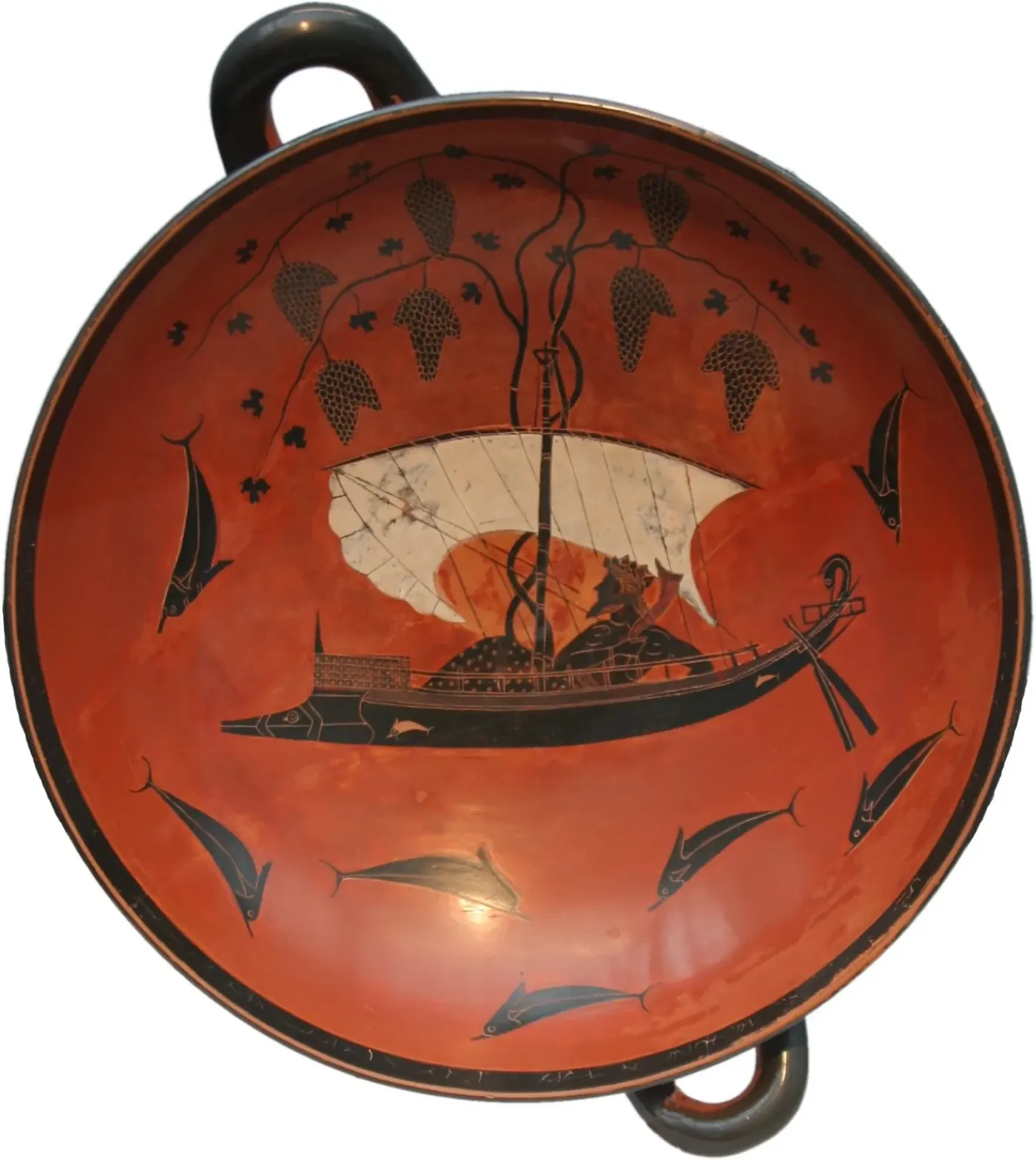
Ancient object · Staatliche Antikensammlungen, Munich
Inside a drinking cup, Dionysus reclines on a ship while a vine grows from the mast and dolphins surround him. Vessel, wine, sea epiphany, and performance converge in one circular image.
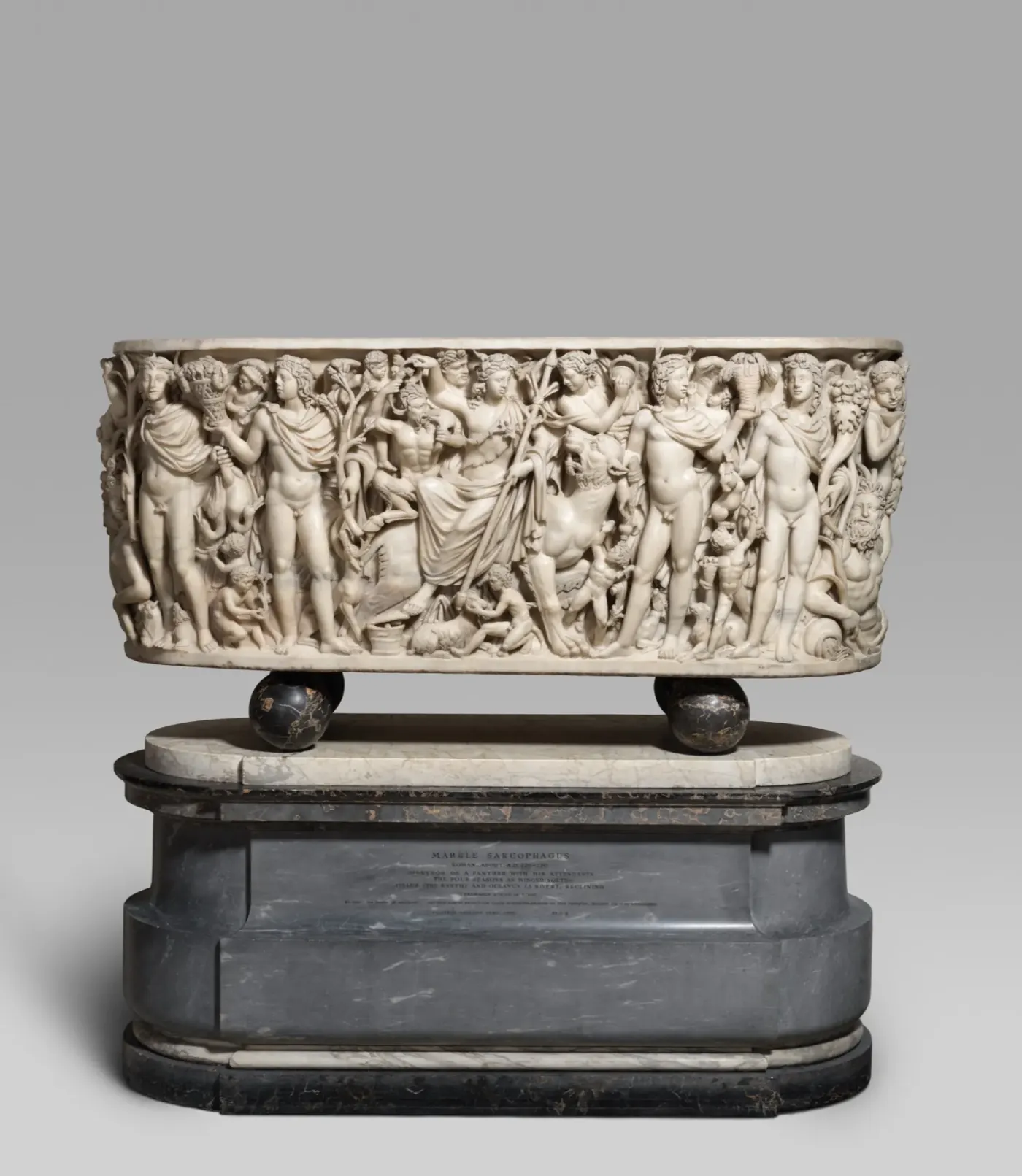
Ancient object · The Metropolitan Museum of Art
A dense procession joins Dionysian triumph to personified seasons, animals, and abundance. The funerary object makes cyclical time and ecstatic movement answer mortality.
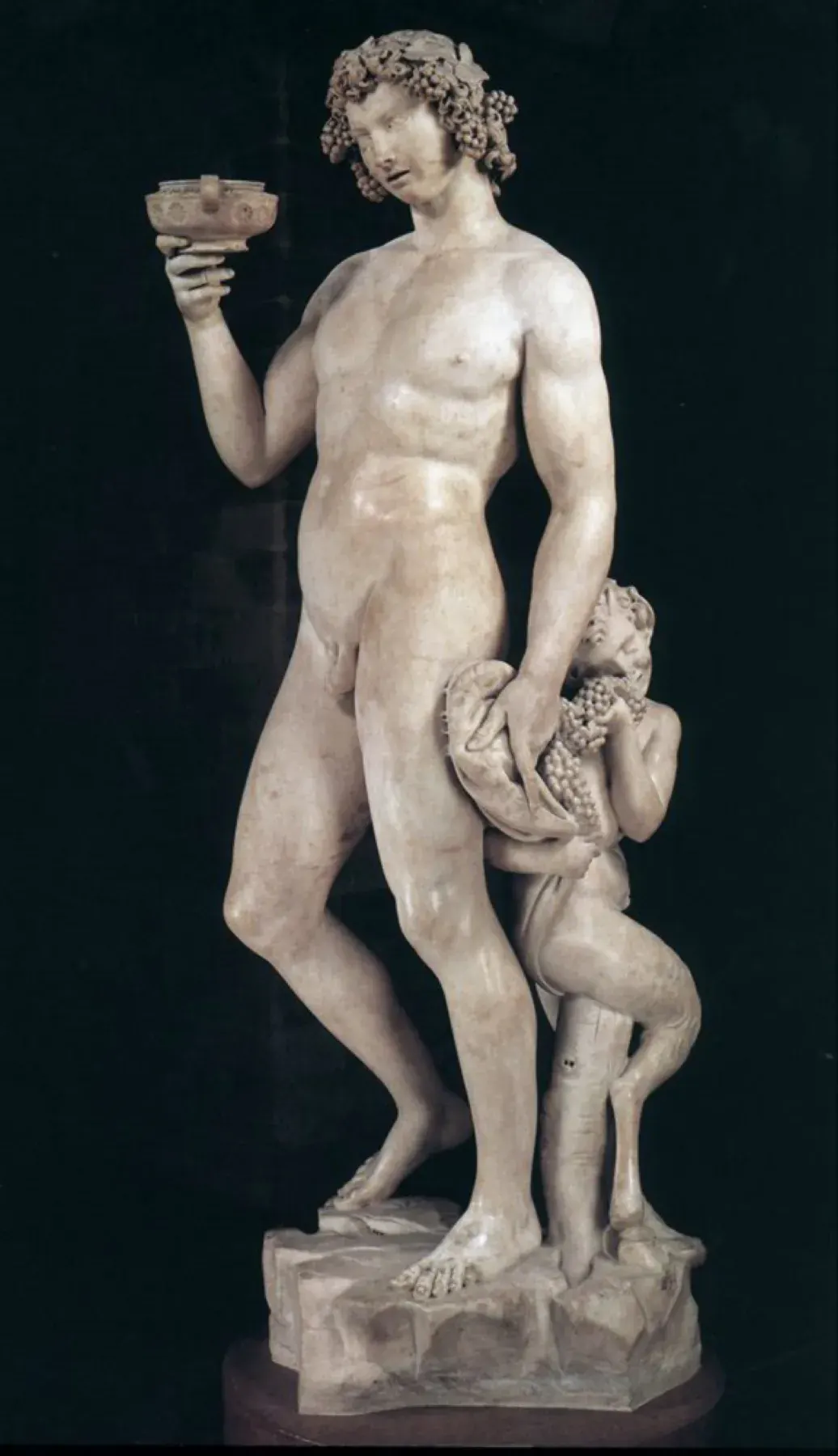
Sculpture · Museo Nazionale del Bargello
The unstable stance, raised cup, grapes, and satyr make intoxication a demanding sculptural problem. The body appears both classically beautiful and physically off balance.
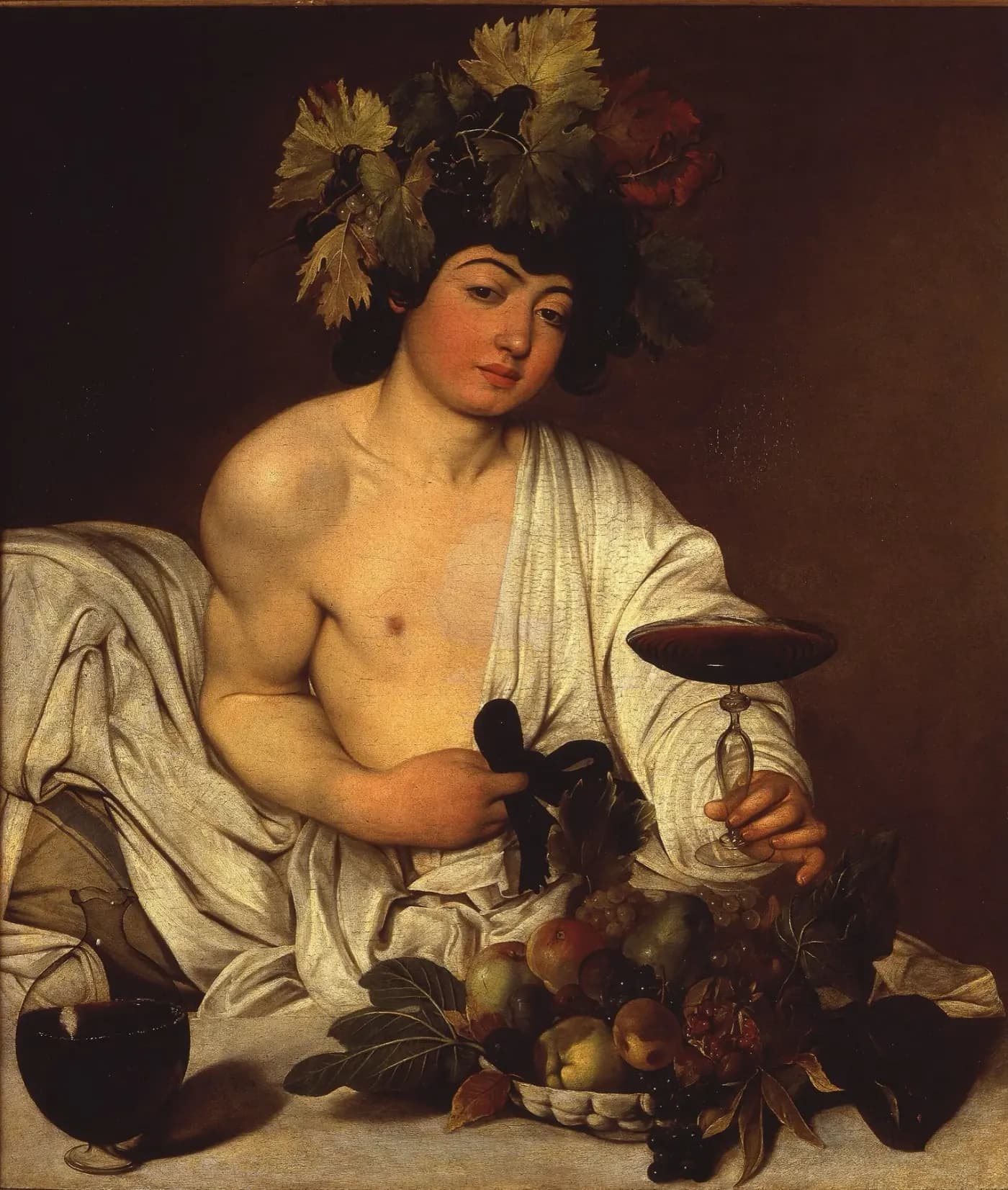
Painting · Uffizi Galleries
The youthful god offers wine beside intensely observed fruit. Naturalism, languor, classical reference, and the risks of ripeness make the invitation difficult to classify as portrait, allegory, or divine presence.
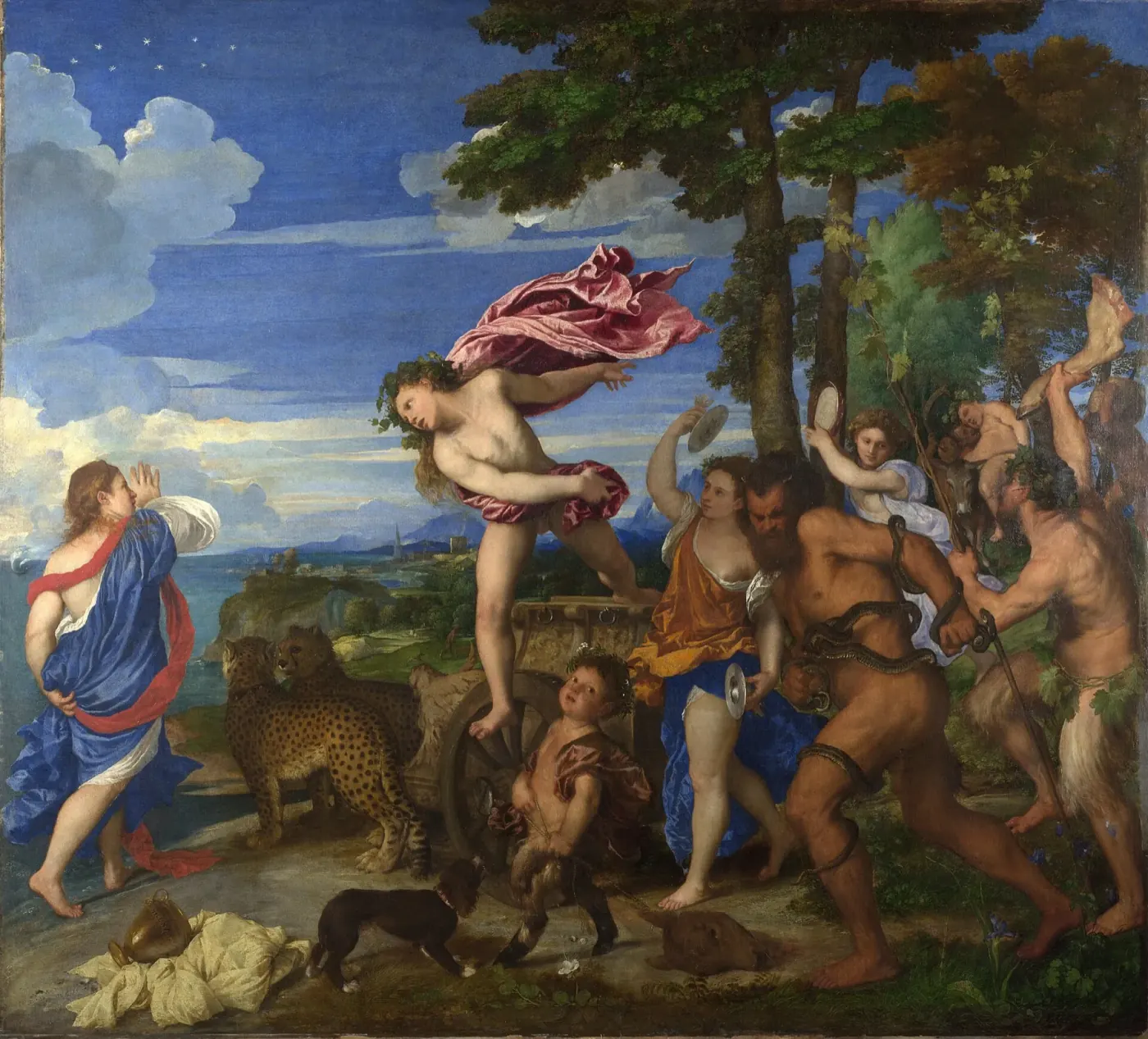
Painting · National Gallery, London
Bacchus leaps from his chariot at the instant he sees Ariadne. Saturated color, the rushing procession, and the crown of stars transform abandonment into suspended recognition.
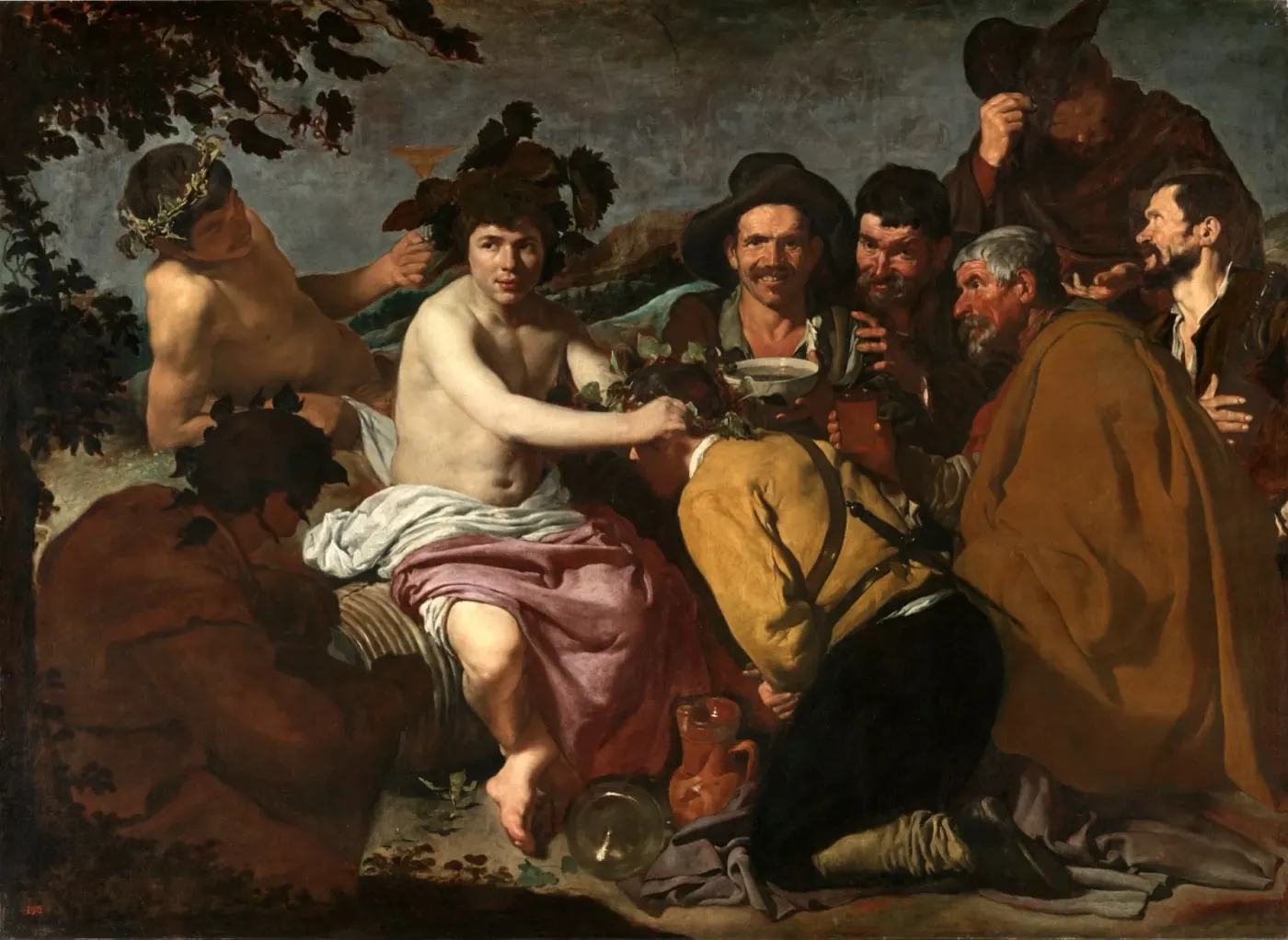
Painting · Museo Nacional del Prado
Bacchus crowns an ordinary drinker among vividly individualized men. The Prado records debate over parody, consolation, poetry, and the meeting of mythological painting with tavern realism.
Art thumbnails use public-domain, CC0, or attributed images. Every card identifies the object record, image source, and license; an editorial crop never replaces the institutional catalogue entry.
Reception across media
Text · stage · screen · scholarship
The bibliography includes works in which Dionysus appears as a dramatic character, comic traveler, operatic figure, graphic-narrative protagonist, or subject of historical study.
Selected bibliography
Ancient dramaEuripides
Dionysus enters as god, stranger, actor, director, witness, and avenger. Pentheus’s attempt to expose the rites makes him part of the performance he wants to control.
Perseus Digital LibraryOpen record ↗Ancient dramaAristophanes
A cowardly, costume-conscious Dionysus travels to the underworld to retrieve a poet and ends as judge of a contest over tragedy’s civic future.
Perseus Digital LibraryOpen record ↗Selected bibliography
Historical receptionRichard Strauss / Hugo von Hofmannsthal
The opera layers backstage comedy over Ariadne’s myth. Bacchus’s late arrival transforms both characters as they misunderstand and remake one another.
Metropolitan OperaOpen record ↗ Modern adaptation
Anne Carson
Carson’s version keeps the violence and strangeness of Euripides while using a contemporary poetic register built for performance and close reading.
New DirectionsOpen record ↗Selected bibliography
 Modern adaptation
George O’Connor
The final Olympians volume focuses on Dionysus’s difficult birth, resistance, transformations, and claim to recognition.
MacmillanOpen record ↗ Scholarship
Richard Seaford
Seaford relates nature, communality, epiphany, mystery cult, death, theatre, psychology, philosophy, and later reception without reducing the god to drunken abandon.
RoutledgeOpen record ↗Institutional and scholarly resources
When modern book covers or publicity images are shown, they appear at small scale for identification and criticism; copyright remains with the named rights holders. Public-domain context images are explicitly labeled.
Sources & method
Sources and documentation
Dates follow conventional scholarly ranges. Cover thumbnails identify modern editions; they do not represent the original material form of an ancient text. Links lead to university archives, publishers, and museum catalogues.
Hesiod · c. 700 BCE
Semele and Dionysus within divine genealogy.Anonymous Greek poet · Antiquity
The pirate abduction and maritime epiphany.Pseudo-Apollodorus · 1st–2nd c. CE
Birth, travels, family, Ariadne, and Semele’s return.Euripides · c. 405 BCE
The central surviving tragedy of Dionysian return and recognition.Aristophanes · 405 BCE
Dionysus as comic underworld traveler and judge of tragedy.Ovid · 8 CE
Roman reception of Bacchus, Ariadne, Midas, and Theban resistance.The Metropolitan Museum of Art · 2000
Museum context for Greek vase painting, sculpture, and ritual objects.Family questions
In the dominant Theban tradition Dionysus is the son of Zeus and the mortal Semele.
Many familiar lists include Dionysus, while others include Hestia. There was no single permanently fixed roster.
Dionysus governs wine, theatre, masks, ecstatic ritual, possession, altered identity, and transformation.
Bacchus is a major Greek and Roman name associated with Dionysus, but Roman Bacchus and Liber developed within distinct ritual and political histories.