OLYMPIAN · 19
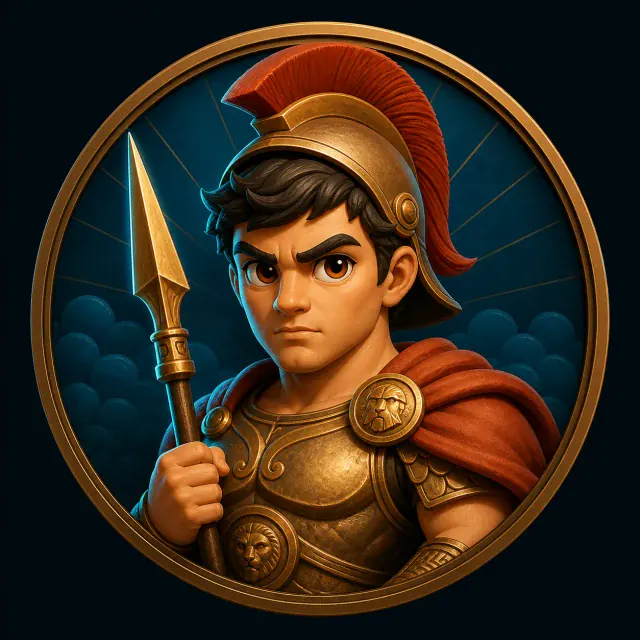
Illustrated portrait of Ares

Portrait from the MythBranch atlas
Interpretive illustration, not an ancient likeness

Greek mythology research profile · cited sources

Ares

Mars · Violent battle and a transformed Roman civic god

Ares is the god of battle's immediate violence: noise, rage, courage, panic, wound, and appetite for conflict. Greek epic can mock or restrain him, especially beside Athena's strategy, yet that does not make him a trivial god. He is son of Zeus and Hera, lover of Aphrodite, and father of figures who embody fear, terror, and martial lineage. Roman Mars becomes a more central civic and ancestral power.

Names · attributes · ancient evidence

Ares: identity and historical contexts.

Ares enters epic as an armored and unstable force, capable of changing sides and of being physically wounded despite immortality. Phobos and Deimos, Fear and Terror, accompany him; Enyo and Eris further characterize the battlefield. Local cults and oaths demonstrate religious functions outside epic ridicule. The contrast with Athena distinguishes dimensions of warfare without establishing a complete opposition between violence and intelligence.

Roman Mars has institutions and narratives distinct from those of Greek Ares. Roman tradition makes Mars father of Romulus, protector of fields and army, and one of the state's central gods. Modern works often inherit the prestige of Mars while casting Ares as an antagonist, a distinction that reflects later moral and political interpretation.

01Enyalios · Warlike02Brotoloigos · Man-slaying03Thouros · Rushing04Chalkeos · Brazen05Aphneios · Abundant, local cult
01

Being wounded does not make battle harmless

When Diomedes wounds Ares with Athena's help, the god cries out and leaves the field. Ancient epic can make the scene comic, but it also materializes war's pain at divine scale. The embodiment of battle suffers battle, while human bodies continue to pay the greater and irreversible cost.


02

Ares and Mars require two histories

Greek and Roman writers identified the gods, yet Mars's agricultural, ancestral, calendar, and imperial roles have no exact Ares counterpart. Art labeled Mars may use nude heroic classicism, armor, Venus, or Roman foundation myth. Each reception item on this page states which cultural figure it presents.

Texts · chronology · variant traditions

Selected ancient narratives involving Ares.

Ares is most revealing when raw force meets strategy, craft, or the social consequences of violence.

01

Iliad · Book 5

Athena guides the spear against Ares

Ares fights for the Trojans until Athena drives Diomedes against him and guides a spear into his body. His cry is compared to thousands of warriors; he complains to Zeus, who condemns his instability but has him healed. The episode stages conflict among divine models of warfare.

Homeric tradition: Iliad ↗
02

Divine prehistory

Ares is confined in a bronze jar

The gigantic Aloadae bind Ares and shut him in a bronze vessel for thirteen months. Hermes eventually frees the weakened god after their stepmother reveals the prison. Epic mentions the episode briefly, giving the unstoppable force of battle a humiliating experience of immobilization.

Homeric tradition: Iliad ↗
03

Odyssey · Book 8

Hephaestus catches Ares and Aphrodite

Helios tells Hephaestus about the lovers. The smith makes an invisible, unbreakable net, traps Ares and Aphrodite in bed, and summons the gods to witness. Poseidon guarantees payment before they are released. The divine audience laughs while marriage, technology, shame, and compensation are negotiated.

Homeric tradition: Odyssey, Book 8 ↗
04

Homeric Hymn 8

The war god asks for restraint

A striking hymn praises Ares's strength and planetary brilliance, then asks him to grant courage, peace, and the ability to restrain deceptive impulses and battle rage. The speaker turns toward the god of war for mastery over warlike excess.

Anonymous: Homeric Hymn to Ares ↗

Genealogical records and atlas relationships

Genealogical evidence and variant traditions.

The atlas shows Ares as a child of Zeus and Hera. It does not draw every union, including the famous relationship with Aphrodite, because the chart uses selective partner lines.

Parents drawn in this atlas

02

Chart-based siblings

00

No line of this type is drawn in the current atlas.

Unions drawn in this atlas

00

No line of this type is drawn in the current atlas.

Children drawn in this atlas

00

No line of this type is drawn in the current atlas.

Genealogy note

Ares and Aphrodite are parents of Phobos, Deimos, and Harmonia in major traditions. His wider heroic descendants vary by region; Roman Mars's ancestry and children belong to a distinct foundation history.

Open the interactive branch ↗

Text · stage · screen · scholarship

Selected works concerning Ares in later reception.

Each selected work treats this figure as its subject, title presence, principal voice, or central dramatic agent. Incidental appearances are excluded. The bibliography also avoids assigning the same representative title to multiple profiles except where a shared primary text is indispensable.

  1. AntiquityHomeric Hymn 8: To AresHymn
  2. 2015Olympians: Ares — Bringer of WarGraphic novel
  3. 2017Wonder WomanFeature film
01

Selected bibliography

Ancient hymn & epic

01 works
02

Selected bibliography

Graphic biography

01 works
03

Selected bibliography

Film & comics

01 works

When modern book covers or publicity images are shown, they appear at small scale for identification and criticism; copyright remains with the named rights holders. Public-domain context images are explicitly labeled.

Sources and documentation

Primary texts, scholarship, and catalogue records.

Dates follow conventional scholarly ranges. Cover thumbnails identify modern editions; they do not represent the original material form of an ancient text. Links lead to university archives, publishers, and museum catalogues.

Ancient source

3
  1. 01IliadHomeric tradition
    Verified text or catalogue record
    Iliad↗

    Homeric tradition · late 8th–early 7th c. BCE

    Ares in combat, wounded by Diomedes, confined by the Aloadae, and contrasted with Athena.
    Edition or recordOpen translation · Harvard Center for Hellenic Studies
  2. 02Odyssey, Book 8Homeric tradition
    Verified text or catalogue record
    Odyssey, Book 8↗

    Homeric tradition · late 8th–early 7th c. BCE

    The song of Ares, Aphrodite, Hephaestus, the net, and compensation.
    Edition or recordOpen translation · Harvard Center for Hellenic Studies
  3. 03Homeric Hymn to AresAnonymous
    Verified text or catalogue record
    Homeric Hymn to Ares↗

    Anonymous · Antiquity

    Direct praise and prayer for restraint, courage, and peace.
    Edition or recordClassical text translation · Theoi library

Academic study

1
  1. 01Ares and Mars in Greek and Roman ReligionClassical scholarship trail
    Verified text or catalogue record
    Ares and Mars in Greek and Roman Religion↗

    Classical scholarship trail · Modern research

    Research pathway for cult, epic characterization, and Roman transformation.
    Edition or recordJSTOR indexed scholarship

Family questions

Questions about Ares's family.

Who are Ares's parents?

Ares is a son of Zeus and Hera in the dominant Greek genealogy.

What is Ares the god of?

Ares embodies the immediate physical and emotional force of battle, including courage, rage, panic, and bloodshed.

Is Mars the same as Ares?

Mars is Ares's closest Roman equivalent, but Mars has much larger Roman civic, agricultural, ancestral, and imperial roles.