01
Divine childhood
Twin of Apollo, child of Leto
Artemis is born to Zeus and Leto and appears as Apollo’s twin. Later tradition often makes her born first and assisting at Apollo’s birth, connecting the virgin goddess paradoxically with childbirth.

Portrait from the MythBranch atlas
Interpretive illustration, not an ancient likeness
Greek deity research profile · cited sources
Diana · Wild animals, transitions, childbirth & the hunt
Artemis is the goddess of wild animals, hunting, virgin autonomy, childbirth, and the dangerous transitions of youth. Her sanctuaries and narratives address relations between wild and civic space, childhood and adulthood, protection and sudden death. Local cult evidence gives these functions considerable regional variation.
Identity & cult
Names · attributes · ancient evidence
Artemis can nurture the young of animals and protect human children while also bringing abrupt death, plague, or sacrifice narratives. Girls’ choruses, coming-of-age rites, hunting imagery, and sanctuaries at Brauron, Ephesus, Sparta, and elsewhere create different local emphases. Her perpetual virginity signals autonomy from marriage, not disinterest in women’s life cycle: childbirth and transitions to adulthood remain central to her cultic range.
Diana is Artemis’s closest Roman equivalent, but Roman Diana’s sanctuary at Aricia and later lunar identity developed in distinct settings. Selene remains the more specific early moon goddess, even though Artemis and Diana increasingly receive lunar attributes. The many-breasted modern description of Artemis of Ephesus is also debated; the cult image belongs to a local Ephesian visual tradition that should not be used as a universal portrait of Greek Artemis.
Genealogy
Genealogical records and atlas relationships
The atlas locates Artemis through Zeus and her sibling generation. Her companies of nymphs, protected children, ritual participants, and hunted figures are central affiliations, but they are not all kin and should not be rendered as family-tree lines.
No line of this type is drawn in the current atlas.
No line of this type is drawn in the current atlas.
Artemis is the daughter of Zeus and Leto and twin sister of Apollo. Her perpetual virginity means marriage and descendants do not organize her profile. Ancient sources still connect her to many companions, local priesthoods, and communities; the atlas reserves lines for genealogy and union rather than converting every relationship into family.
Open the interactive branch ↗Art & objects
Museum objects · painting · sculpture
The Ephesian cult type, short-clad hunter, Renaissance narrative, and American skyline figure do not form a linear evolution. Each belongs to a different ritual, collecting, or patronage context and makes different aspects of Artemis or Diana visible.
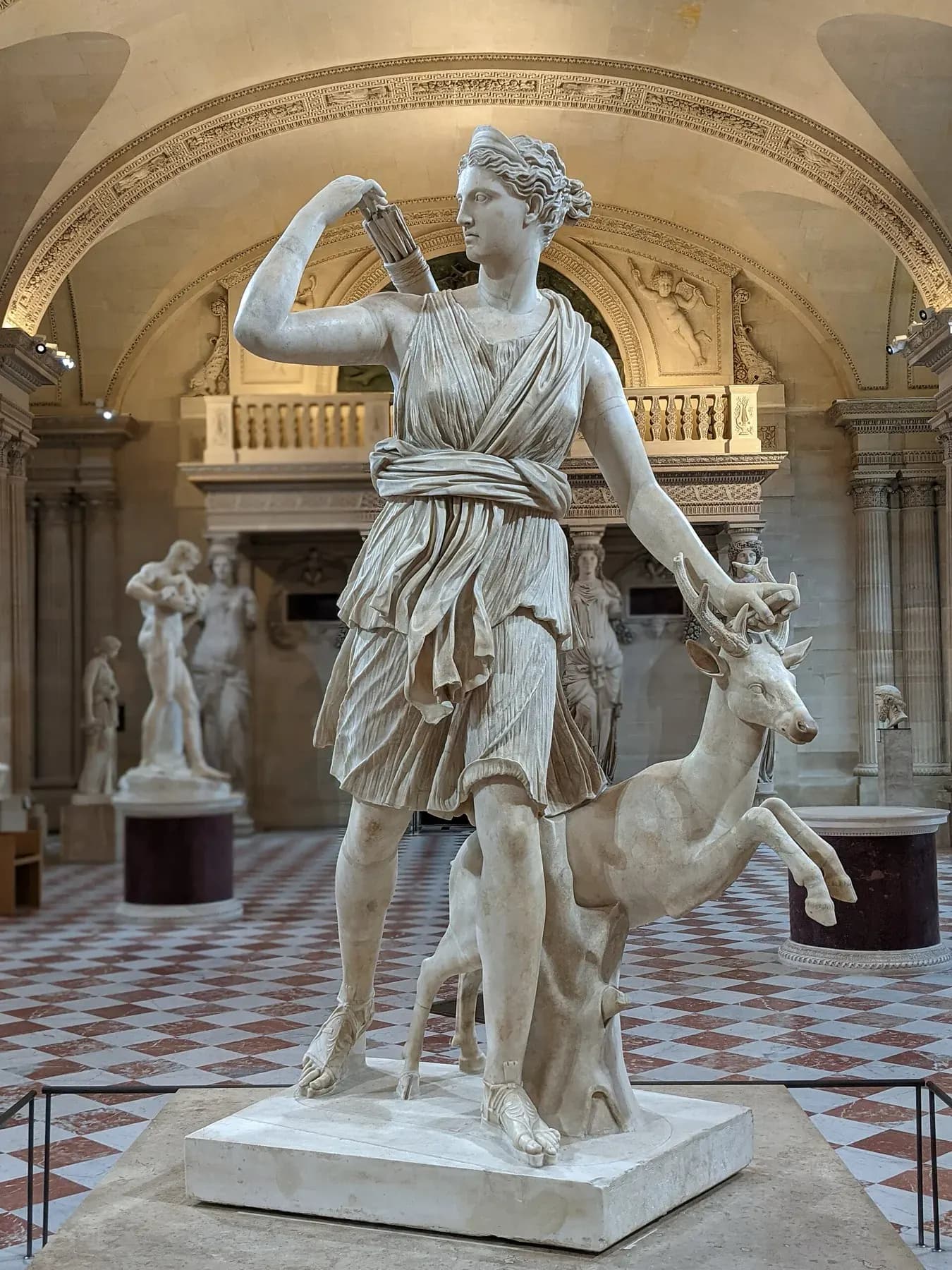
Sculpture · Musée du Louvre
The striding huntress reaches toward her quiver beside a deer. The work became one of the most influential post-antique images of Diana, although its restored elements and Roman copying history matter.
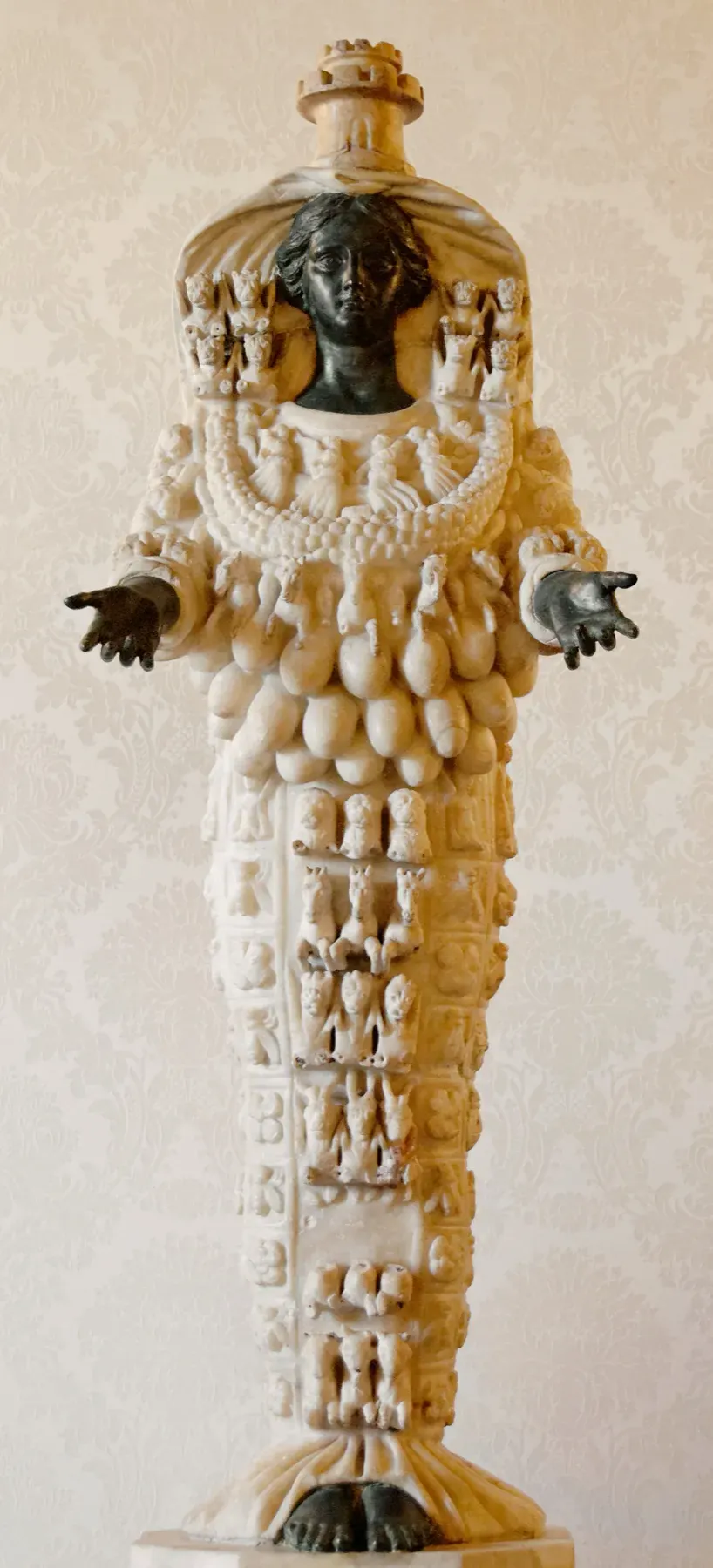
Sculpture · Capitoline Museums
The rigid, densely ornamented type differs sharply from the moving huntress. The museum identifies animal heads and fertility symbols while avoiding a universal claim about every Artemis cult.
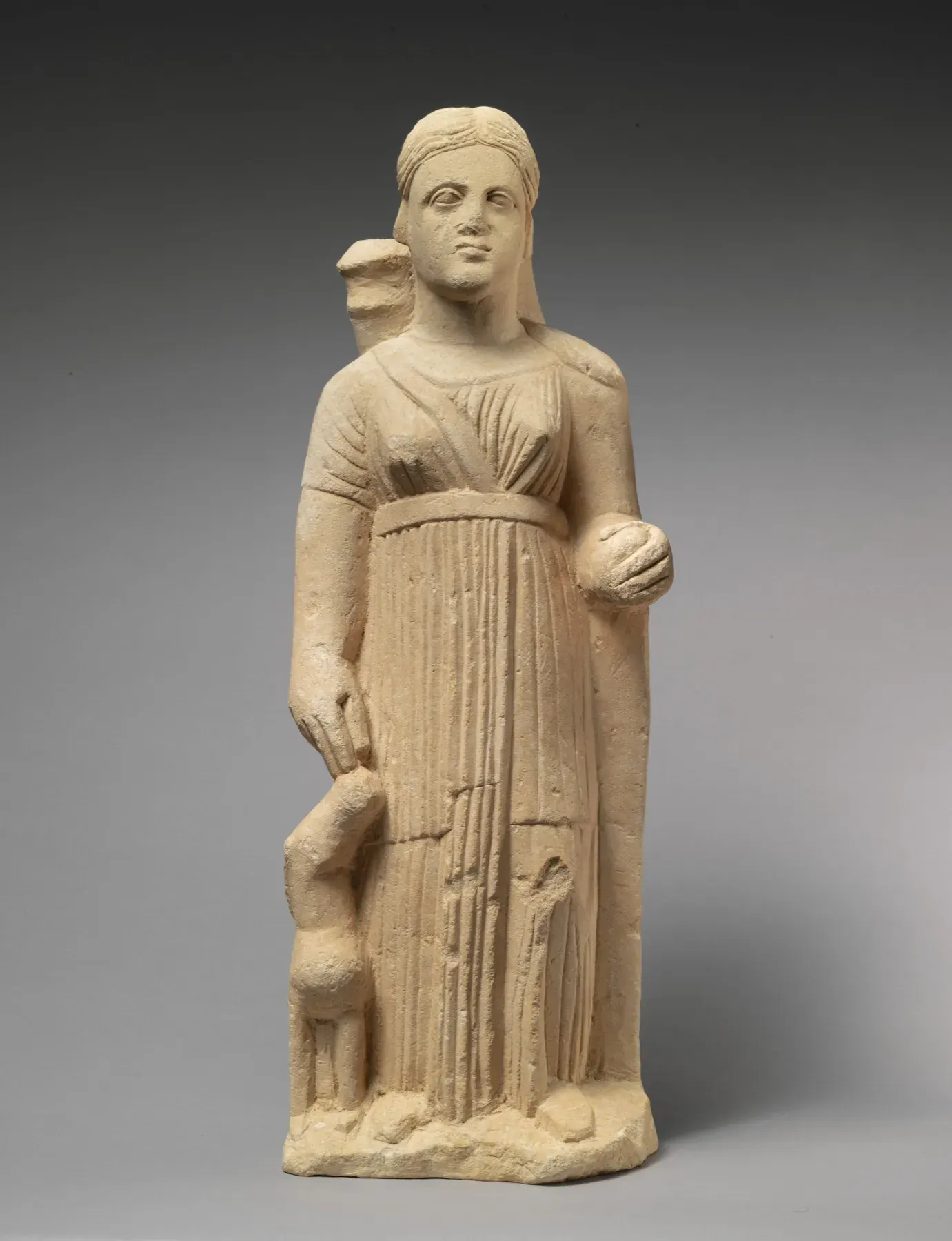
Ancient object · The Metropolitan Museum of Art
Quiver and fawn identify the goddess, while the Met situates the work within Cypriot adaptation of Greek and local divine traditions.
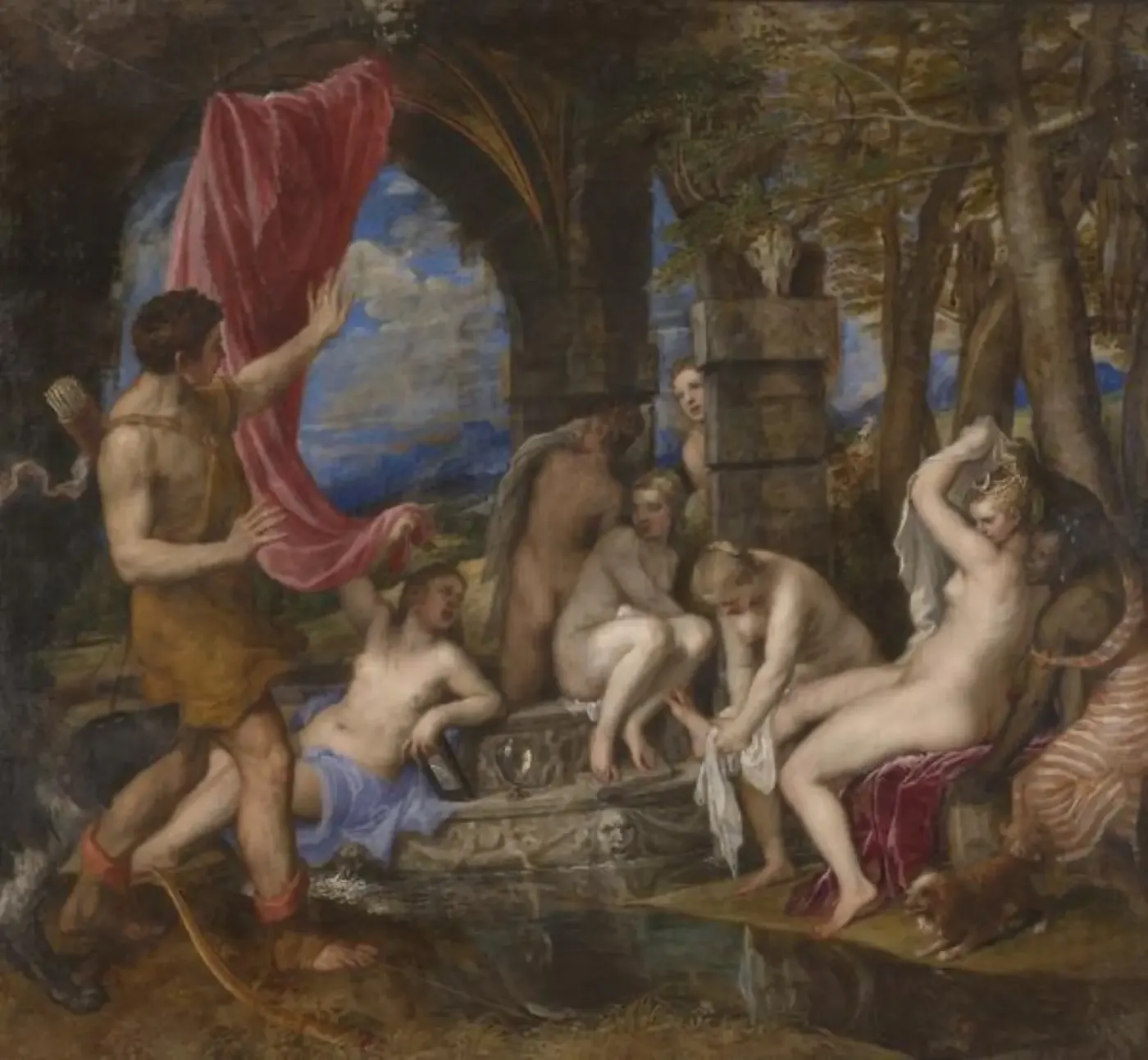
Painting · National Gallery / National Galleries of Scotland
Actaeon enters the bathing place at the moment that determines his death. Titian’s landscape, gaze, and architectural enclosure make accidental sight a charged act of intrusion.
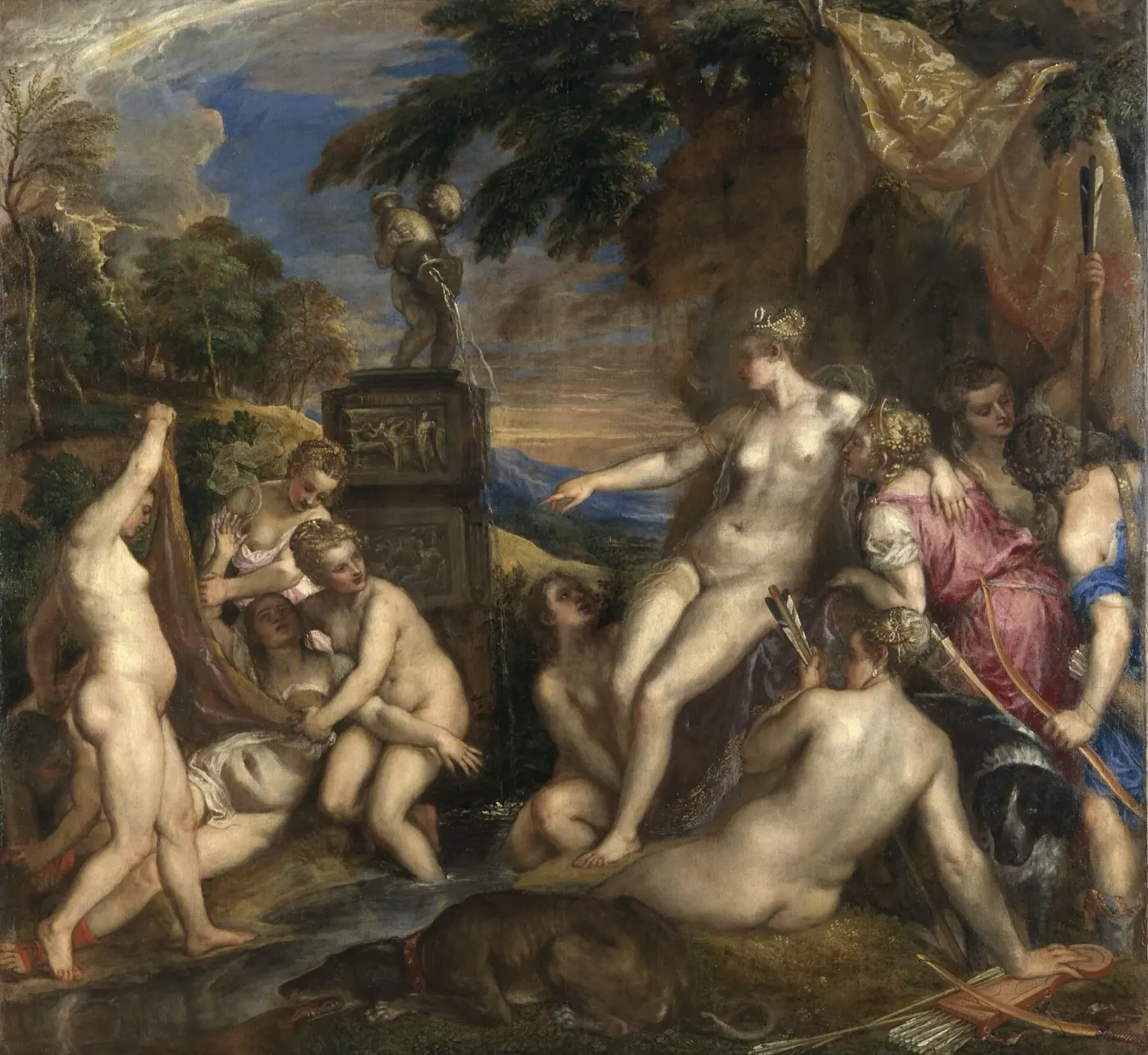
Painting · National Gallery / National Galleries of Scotland
The companion canvas exposes Callisto’s pregnancy before Diana’s group. Its beauty cannot neutralize the scene’s humiliation, coercive stripping, and expulsion.
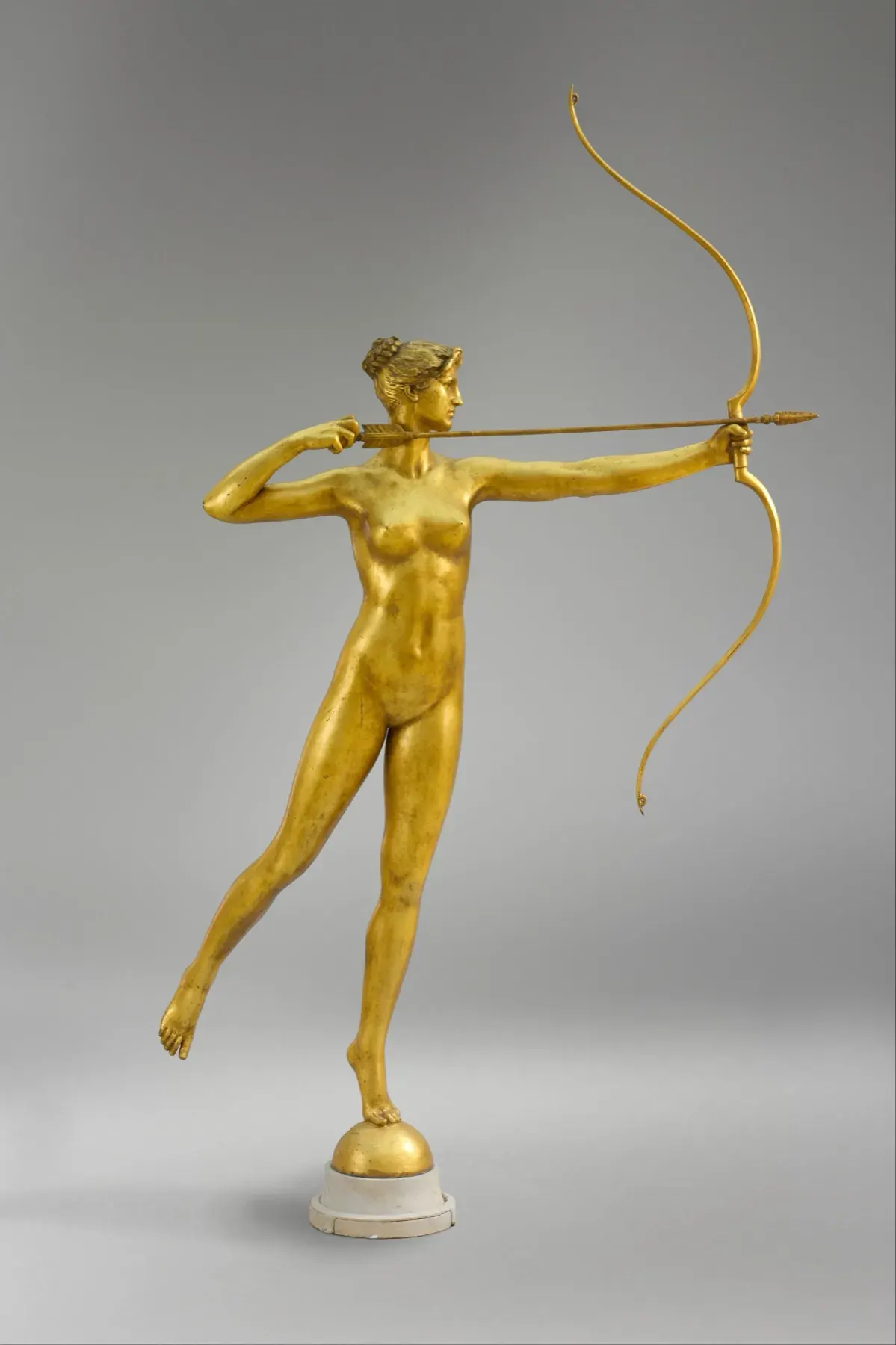
Sculpture · The Metropolitan Museum of Art
Designed from the celebrated weathervane atop Madison Square Garden, the streamlined archer translates Diana into a modern urban silhouette and icon of the New York skyline.
Art thumbnails use public-domain, CC0, or attributed images. Every card identifies the object record, image source, and license; an editorial crop never replaces the institutional catalogue entry.
Reception across media
Text · stage · screen · scholarship
The strongest Artemis receptions focus on autonomy, ritual transition, and contested protection. Works are chosen for a sustained role rather than a stray moon or bow reference.
Selected bibliography
Ancient dramaEuripides
Iphigenia serves Artemis in Tauris and must negotiate ritual violence, sibling recognition, escape, and the transport of a divine image.
Perseus Digital LibraryOpen record ↗Callimachus
Callimachus gives Artemis an unusually sustained first-person program: she asks Zeus for perpetual virginity, many names, bow and arrows, mountain territory, companions, cities, and the role of helping women in childbirth. The catalogue turns divine attributes into chosen offices rather than a modern checklist imposed from outside.
Theoi Classical Texts LibraryOpen record ↗Selected bibliography
 Modern adaptation
Jordanna Max Brodsky
A diminished Artemis living as Selene DiSilva investigates ritual murder in modern Manhattan, joining mystery structure to questions of lost worship and divine identity.
Orbit BooksOpen record ↗ Modern adaptation
Jennifer Saint
The novel centers Atalanta, raised under Artemis’s protection. The goddess is not the protagonist, but her expectations shape the heroine’s formation, autonomy, and eventual conflict.
Headline / HachetteOpen record ↗Selected bibliography
 Modern adaptation
George O’Connor
This graphic volume assigns Artemis the principal role and follows her origin, hunting, companions, and punitive boundary myths.
MacmillanOpen record ↗ Scholarship
Stephanie Lynn Budin
Budin combines texts, inscriptions, archaeology, iconography, girls’ and women’s transitions, plague, cruelty, and modern reception.
RoutledgeOpen record ↗Institutional and scholarly resources
When modern book covers or publicity images are shown, they appear at small scale for identification and criticism; copyright remains with the named rights holders. Public-domain context images are explicitly labeled.
Sources & method
Sources and documentation
Dates follow conventional scholarly ranges. Cover thumbnails identify modern editions; they do not represent the original material form of an ancient text. Links lead to university archives, publishers, and museum catalogues.
Anonymous Greek poet · Antiquity
The bow, hunt, dance, and return to Apollo’s Delphic house.Callimachus · 3rd century BCE
A sustained ancient voice for Artemis’s requested offices, companions, landscapes, cities, weapons, and relation to Zeus.Homeric tradition · late 8th–early 7th c. BCE
Artemis in divine conflict and the memory of Niobe.Pseudo-Apollodorus · 1st–2nd c. CE
Genealogy and organized versions of Niobe, Orion, and other myths.Ovid · 8 CE
Roman reception of Actaeon, Callisto, and Diana’s boundary myths.Euripides · c. 405 BCE
Artemis, sacrifice, war, persuasion, and contested ending.Euripides · c. 414–412 BCE
Priesthood, rescue, recognition, and movement of a cult image.The Metropolitan Museum of Art · 2000
Museum-authored context for Greek visual and material evidence.Family questions
Artemis is the daughter of Zeus and Leto and the twin sister of Apollo.
Artemis is associated with wild animals, hunting, virgin autonomy, childbirth, children, and dangerous transitions into adulthood.
Artemis gained strong lunar associations, especially in later tradition, but Selene is the more specific early Greek personification of the moon.
Diana is Artemis’s closest Roman equivalent, but Diana’s Roman and Italian cult history, including Aricia, gives her distinct contexts.