MythBranch · Figure entry
Ariadne in Greek Mythology
Ariadne in Greek mythology: daughter of Minos and Pasiphae, the thread that saves Theseus, her abandonment on Naxos, and her marriage to Dionysus.
The short answer
Who is Ariadne in Greek mythology?
Ariadne is a princess of Crete, daughter of King Minos and Pasiphae and half-sister of the Minotaur. She falls in love with Theseus and gives him the thread that leads him out of the Labyrinth after he kills the Minotaur. She sails away with him, but he leaves her on the island of Naxos, where the god Dionysus finds her and makes her his wife.
The house of Minos
Ariadne's father is Minos, son of Zeus and Europa; her mother Pasiphae is a daughter of the sun god Helios. Pasiphae's union with the Cretan bull produced the Minotaur, so the monster in the Labyrinth is Ariadne's half-brother. Her sister Phaedra later marries Theseus.
The Iliad already links her with craftsmanship: on the shield of Achilles, Hephaestus makes a dancing floor like the one Daedalus built in Knossos for Ariadne of the lovely hair.
The thread
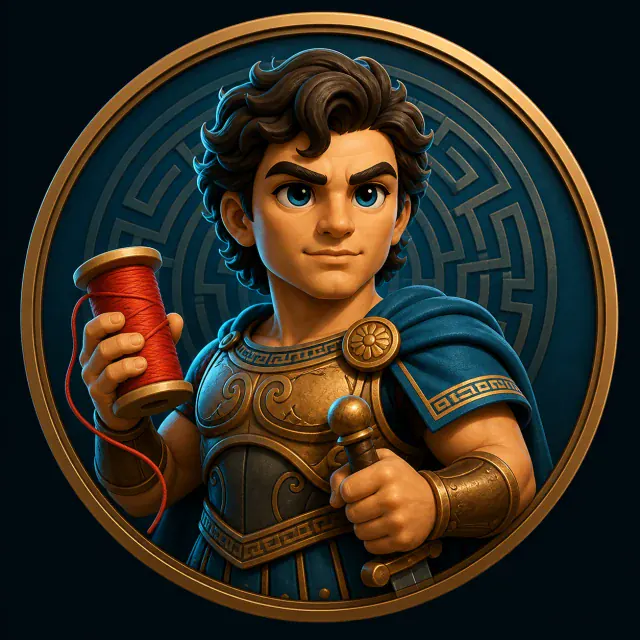
When Theseus arrives among the young Athenians sent to the Minotaur, Ariadne falls in love with him and offers help if he will take her to Athens as his wife. On Daedalus' advice she gives him a thread to tie at the entrance. He kills the Minotaur in the inner chamber and follows the thread out.
Catullus imagines her on the shore of Naxos, watching Theseus' sails disappear, and has her curse him: the curse makes him forget to change his black sails, and his father Aegeus throws himself into the sea.
Left on Naxos
Every version agrees that Ariadne does not reach Athens, but they disagree about why. Theseus abandons her while she sleeps; or Dionysus claims her and Theseus has to give her up; or she dies. Plutarch collects so many accounts that he reports a Naxian theory of two Ariadnes, one who married Dionysus and one whom Theseus left.
Homer's version is the darkest. In the Odyssey, Artemis kills Ariadne on the island of Dia on the word of Dionysus, before Theseus can bring her home.
Bride of Dionysus
Hesiod says golden-haired Dionysus made Ariadne his wife, and Zeus made her deathless and ageless. Apollodorus has Dionysus carry her off to Lemnos, where she bears him sons, among them Oenopion and Staphylus, names connected with wine and grapes.
Ovid says Bacchus took the crown from her head and set it in the sky as the constellation Corona Borealis. The arrival of the god on the beach became a favourite subject in later art, most famously in Titian's Bacchus and Ariadne, and in Richard Strauss's opera Ariadne auf Naxos.
Ariadne's own voice
Roman poets gave Ariadne the speech Greek myth denied her. In Ovid's Heroides she writes to Theseus from the empty beach: she woke, reached for him across the bed, ran to the shore, climbed a rock and waved her veil at his sails. Catullus has her lament that no woman should ever trust a man's oath.
The lament became a musical form of its own. Only one piece survives from Monteverdi's lost opera Arianna of 1608: Ariadne's lament, which was copied and imitated across Europe.
Where the versions differ
Greek myth has no single authorised text. These are the points where the sources for Ariadne disagree.
- Why she stays on Naxos
- Theseus abandons her; or Dionysus takes her from him; or she dies there. Plutarch lists many versions. Plutarch
- Death
- Homer: Artemis kills her on Dia. Hesiod: Zeus makes her immortal as Dionysus' wife. HomerHesiod
- Her crown
- Ovid makes her crown the constellation Corona Borealis. Ovid
Ariadne's family ledger
Every line below is a cited assertion in the MythBranch knowledge graph. Variant and later traditions stay labelled, so a disputed parent never looks settled.
Parents
MinosClassical Greek · Explicit testimony
Ariadne belongs to the Cretan royal house.
PasiphaeClassical Greek · Explicit testimony
Ariadne belongs to the Cretan royal house.
Partners
DionysusArchaic Greek · Explicit testimony
Golden-haired Dionysus made Ariadne, daughter of Minos, his wife (Theogony 947–949).
2 branches from Zeus
The shortest cited route from Zeus to Ariadne through the graph. MythBranch Daily scores every guess with this same count.
- 01
Zeus is a parent of DionysusApollodorus, Library ↗
Dionysus → - 02
Dionysus and Ariadne are partnersHesiod, Theogony 921–962 ↗
Read on in the atlas
Illustrated profiles for the figures Ariadne's stories depend on.
Questions about Ariadne
Who are Ariadne's parents?
King Minos of Crete and Pasiphae, daughter of Helios.
Is the Minotaur Ariadne's brother?
Her half-brother: both are children of Pasiphae, but the Minotaur's father is the Cretan bull.
Why did Theseus leave Ariadne?
The sources disagree: he abandoned her, or Dionysus claimed her, or she died on the island.
Who did Ariadne marry?
The god Dionysus, who found her on Naxos. Hesiod says Zeus made her immortal.
Sources and editions
- Ovid, Heroides 10 ↗
Ariadne's letter to Theseus from the shore of Naxos.
- Apollodorus, Library 3.1.2–4; Epitome 1.8–9 ↗
The house of Minos, the thread and Dionysus on Naxos.
- Homer, Iliad 18.590–592 ↗
Daedalus' dancing floor for Ariadne at Knossos.
- Catullus, Poem 64.52–264 (Latin text) ↗
Ariadne's lament on Naxos and her curse on Theseus.
- Plutarch, Life of Theseus 19–20 ↗
The many versions of Ariadne's fate, including two Ariadnes on Naxos.
- Homer, Odyssey 11.321–325 ↗
Artemis kills Ariadne on Dia on the word of Dionysus.
- Hesiod, Theogony 947–949 ↗
Dionysus makes Ariadne his wife; Zeus makes her immortal.
- Ovid, Metamorphoses 8.169–182 ↗
The Labyrinth, Ariadne's thread and the crown set among the stars.
Passage references point to the ancient evidence; the summaries and readings are MythBranch's. Cite the edition you consult.