MythBranch · Reading mythology
Heracles’ Twelve Labors: Order, Sources, and the Two Rejected Tasks
Read the twelve labors in Pseudo-Apollodorus, explain why two of the original ten were rejected, and compare Homer’s earlier allusions.
The short answer
What are Heracles’ twelve labors, and why were twelve required?
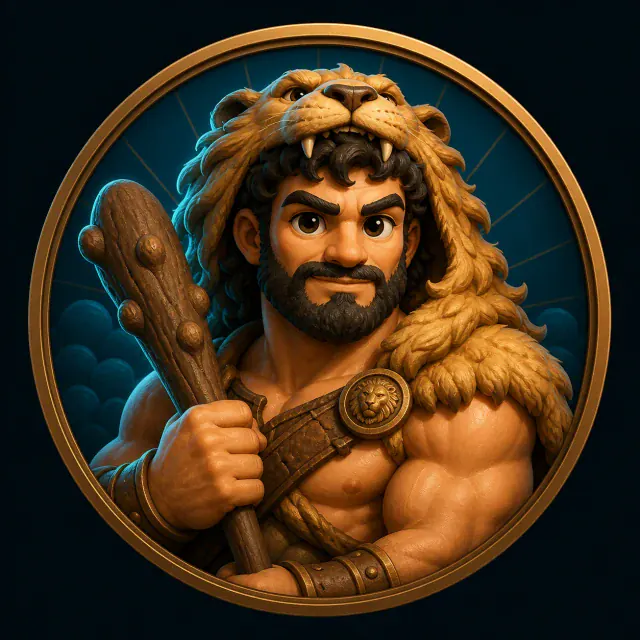
In Pseudo-Apollodorus, Heracles initially owes ten labors. Eurystheus refuses to count the Hydra and Augeas tasks, so the apples of the Hesperides and Cerberus complete the twelve narrated assignments.
Begin with a named ancient account
The familiar twelve make a useful introduction to Heracles, called Hercules in many Latin and English treatments. For a continuous account, read Pseudo-Apollodorus, Library 2.4.12–2.5.12. The preliminary passage places the hero’s madness and killing of his children before his service to Eurystheus. After purification, he consults Delphi and receives instructions to live at Tiryns, serve Eurystheus for twelve years, and perform ten labors. Keep those numbers separate: the term of service is not the initial number of assignments.
This guide follows the Library’s sequence because its numbered tasks can be checked passage by passage. It does not present that arrangement as the only ancient canon or as a complete biography. The same work includes adventures within the labors and further campaigns after them. Distinguish the task Eurystheus imposes from incidents encountered along the way; otherwise almost any exploit can accidentally become an additional labor.
The twelve labors in order
This table follows Pseudo-Apollodorus, Library 2.5.1–12. Each row separates the assignment from its outcome: capture does not always mean killing, and completing a task does not always earn Eurystheus’s credit. The passage numbers let you check each entry in the linked translation.
Scroll the table sideways to see every column.
| Labor | Task and completion condition | Source |
|---|---|---|
| 1. Nemean lion | 2.5.1: Bring the lion’s skin. Heracles strangles the invulnerable animal and carries the lion to Mycenae; Eurystheus then requires future trophies to be shown outside the gates. | Pseudo-Apollodorus, Library 2.4.12–2.5.12 |
| 2. Lernaean Hydra | 2.5.2: Kill the Hydra. Iolaus burns the severed necks to stop new heads growing; Heracles buries the immortal head under a rock. Eurystheus refuses credit because Iolaus helped. | Pseudo-Apollodorus, Library 2.4.12–2.5.12 |
| 3. Ceryneian hind | 2.5.3: Bring Artemis’s sacred hind alive to Mycenae. After a year’s pursuit, Heracles shoots and captures it, appeases Artemis by explaining the command, and delivers it alive. | Pseudo-Apollodorus, Library 2.4.12–2.5.12 |
| 4. Erymanthian boar | 2.5.4: Bring the boar alive. Heracles drives it from cover, pursues it into deep snow, traps it, and carries it to Mycenae. | Pseudo-Apollodorus, Library 2.4.12–2.5.12 |
| 5. Augean cattle yard | 2.5.5: Remove the cattle dung in one day. Heracles diverts two rivers through the yard after agreeing on a tenth of Augeas’s cattle as payment. Augeas refuses to pay; Eurystheus rejects the task as work undertaken for hire. | Pseudo-Apollodorus, Library 2.4.12–2.5.12 |
| 6. Stymphalian birds | 2.5.6: Drive away the birds. Athena supplies bronze clappers; Heracles uses their noise to startle the birds into flight and shoots them. | Pseudo-Apollodorus, Library 2.4.12–2.5.12 |
| 7. Cretan bull | 2.5.7: Bring the bull. Heracles captures it in Crete and shows it to Eurystheus, then releases it. The animal later reaches Marathon. | Pseudo-Apollodorus, Library 2.4.12–2.5.12 |
| 8. Mares of Diomedes | 2.5.8: Bring the mares to Mycenae. Heracles takes them from their keepers and defeats Diomedes’s people, but the mares kill his companion Abderus. He delivers them to Eurystheus, who releases them. | Pseudo-Apollodorus, Library 2.4.12–2.5.12 |
| 9. Hippolyte’s belt | 2.5.9: Fetch the belt desired by Eurystheus’s daughter Admete. Hippolyte initially promises it willingly; Hera’s false kidnapping report brings an Amazon attack. Suspecting betrayal, Heracles kills Hippolyte, takes the belt, and delivers it to Eurystheus. | Pseudo-Apollodorus, Library 2.4.12–2.5.12 |
| 10. Geryon’s cattle | 2.5.10: Fetch the cattle from Erythia. Heracles kills their guards and Geryon, then drives the herd through further dangers to Eurystheus, who sacrifices the delivered cattle to Hera. | Pseudo-Apollodorus, Library 2.4.12–2.5.12 |
| 11. Apples of the Hesperides | 2.5.11: Fetch the golden apples, after the Hydra and Augeas tasks are excluded. Atlas obtains them while Heracles supports the sky; an alternative says Heracles kills the guardian snake and picks them himself. He delivers them; Athena ultimately returns them. | Pseudo-Apollodorus, Library 2.4.12–2.5.12 |
| 12. Cerberus | 2.5.12: Bring Cerberus from Hades. The underworld ruler permits this if Heracles subdues the hound without using his weapons. Heracles masters it, shows it to Eurystheus, and takes it back to Hades. | Pseudo-Apollodorus, Library 2.4.12–2.5.12 |
Tasks 1–4: killing is not always the instruction
The first four assignments occupy Library 2.5.1–4: (1) the Nemean lion; (2) the Lernaean Hydra; (3) the Ceryneian hind; and (4) the Erymanthian boar. Eurystheus wants the lion’s skin and the Hydra killed, but the hind and boar brought back alive. These verbs matter. A list of four animals misses the different conditions under which Heracles must demonstrate success, particularly when the hind belongs to Artemis.
The Hydra also introduces the problem of assistance. Iolaus burns the places where severed heads would regenerate, enabling Heracles to defeat the creature. Eurystheus consequently refuses to count this assignment toward the ten. The story records a completed victory and a rejected credit at the same time. When taking notes, preserve both facts. Calling it simply a failed labor obscures what Heracles achieves; calling it an unqualified success obscures the king’s power over the reckoning.
Tasks 5–8: work, capture, and loss
Library 2.5.5–8 continues with (5) cleaning Augeas’s cattle yard in one day; (6) the Stymphalian birds; (7) the Cretan bull; and (8) the mares of Diomedes. Heracles redirects rivers to remove the dung and uses equipment supplied by Athena to drive the birds into the air. These episodes reward practical methods as well as physical strength. The bull and mares require transport back to the authority who issued the command.
Augeas promises Heracles a share of his cattle as payment, then denies the agreement. Eurystheus rejects this labor because it was undertaken for hire. Do not change that into a claim that Heracles actually received his wages: the dispute over payment is part of the narrative. The mares episode also contains the death of Abderus, entrusted with guarding them. Reading the surrounding prose keeps the human costs visible instead of turning the sequence into twelve effortless trophies.
Tasks 9–12: belt, cattle, apples, and Cerberus
The remaining assignments in Library 2.5.9–12 are (9) Hippolyte’s belt; (10) Geryon’s cattle; (11) the golden apples of the Hesperides; and (12) Cerberus. The transition to the apples explicitly recalls the two rejected tasks. Thus twelve describes the narrated assignments, while ten describes the original obligation after Eurystheus’s exclusions. Neither the Hydra nor the cattle yard disappears from the familiar twelve-item list.
Read the apples account with particular care: the compiler preserves alternatives about how Heracles obtains them. Such alternatives exist inside a single surviving work, not only between different authors. In the Cerberus episode, permission and conditions again accompany force: the ruler below permits the capture if Heracles masters the creature without his weapons. Cerberus is eventually returned. Fetching a guardian from the dead is therefore not equivalent to killing that guardian or permanently abolishing the underworld’s boundary.
Compare Homer without importing the later list
Iliad 19.95–133 supplies a different kind of evidence. Agamemnon tells how Hera turns Zeus’s announcement about a coming ruler to Eurystheus’s advantage: she hastens Eurystheus’s birth and delays Heracles’s. The account explains subordination through a divine oath and manipulated birth order. It is a speech within Agamemnon’s explanation of his own disastrous conduct, not a neutral handbook chapter presenting the twelve tasks.
Iliad 8.357–369 offers another allusion. Athena complains that Zeus forgets her help to his son during Eurystheus’s demands, including the expedition for the hound of Hades. This establishes that the task has an epic witness outside the Library. It does not establish the Library’s complete twelve-item order in the Iliad. Record the precise extent of the evidence: Homeric references to service and particular exploits, followed by a later connected account that supplies the ordered reading used here.
Read the assignment and its judgment together
For a second reading, make four short notes for each task: what is commanded, what method is used, who assists, and what Eurystheus accepts. Compare Iolaus’s disqualifying help with Athena’s equipment in the birds episode without inventing a universal rule that the text never states. The discrepancy is a useful question about the king’s judgments, not a reason to silently rewrite either passage.
Then return to the two Homeric speeches and ask why their speakers recall Heracles at those moments. This separates the sequence of adventures from the uses made of a famous hero. The proposed emphasis on command and recognition is this guide’s editorial interpretation; the twelve assignments and counting exceptions are claims tied to the Library. Keeping that distinction visible allows other readings of endurance, violence, or divine hostility without confusing an interpretation with an ancient quotation.
Test the comparison in individual lives
Each profile brings the question back to a particular figure, an ancient passage, and the limits of the diagram.
Questions this comparison raises
Why did Heracles perform twelve labors instead of ten?
In the Library, Eurystheus rejects the Hydra because Iolaus helped and the Augeas task because it was undertaken for payment. The apples and Cerberus extend the narrated assignments to twelve.
Is this the only ancient order of the labors?
No. This guide follows Pseudo-Apollodorus, Library 2.5. Its arrangement should not be imposed on every ancient poem, image, or retelling.
Does the Iliad narrate all twelve labors?
No. The passages used here recall Eurystheus’s authority and the hound of Hades. They do not supply the Library’s full ordered catalogue.
Sources and editions
- Pseudo-Apollodorus, Library 2.4.12–2.5.12 ↗
J. G. Frazer, 1921 public-domain translation. Principal sequence; 2.5.2 and 2.5.5 explain rejection, and 2.5.11 recalls both.
- Homer, Iliad 19.95–133 ↗
A. T. Murray, 1924 public-domain translation. Agamemnon’s account of birth order and Zeus’s oath; not a twelve-labor catalogue.
- Homer, Iliad 8.357–369 ↗
A. T. Murray, 1924 public-domain translation. Athena recalls assisting Heracles, including the hound of Hades.
Passage references identify the ancient evidence; the interpretive argument is MythBranch's reading. Cite the edition you consult and preserve disagreements between sources.