HERO · 25
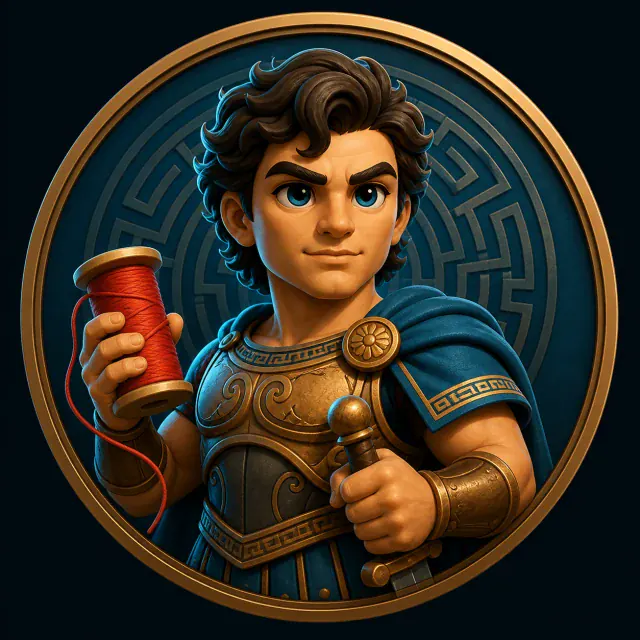
Illustrated portrait of Theseus

Portrait from the MythBranch atlas
Interpretive illustration, not an ancient likeness

Greek mythology research profile · cited sources

Theseus

Theseus · Monster-slayer, king, and unstable civic founder

Theseus is Athens' great civic hero: son of Aegeus or Poseidon, traveler who clears the road from Troezen, killer of the Minotaur, partner and abandoner of Ariadne, king associated with political unification, and participant in later disastrous adventures. Athenian art and drama make him a model founder, but tragedy and modern novels expose the costs imposed on Ariadne, Hippolytus, Phaedra, the Amazons, and conquered communities.

Names · attributes · ancient evidence

Theseus: identity and historical contexts.

Theseus is recognizable through the Minotaur contest, Ariadne's thread, the sword and sandals left beneath a rock, and scenes of road exploits. Ancient Athens developed him into a counterpart of Heracles who could represent democracy, synoecism, naval power, and civic rescue. Yet his biography also includes abduction, broken promises, failed fatherhood, reckless friendship with Pirithous, and an isolated death on Scyros.

Many accounts preserve both Aegeus and Poseidon as fathers of Theseus, associating the hero with Athenian kingship and divine descent. Accounts of Ariadne's fate vary: she may be abandoned, lost, or transferred to Dionysus by divine command. Sources also differ over the Minotaur's name Asterion and the extent of his human characterization. These variations qualify the victorious Athenian narrative.

01Theseus · Athenian hero02Synoikistēs · Unifier03Kallistēs · Culture hero04Son of Aegeus05Son of Poseidon
01

The road labors turn travel into territorial claim

Periphetes, Sinis, the Crommyonian Sow, Sciron, Cercyon, and Procrustes are defeated on the route to Athens. Each encounter reverses a villain's own method. The sequence makes Theseus morally legible as a purifier while also mapping the hero's approach to the city he will claim.
02

Civic ideology and personal failure coexist

Athenian public tradition could credit Theseus with unifying Attica and founding institutions, while tragedy uses his authority to produce catastrophe in Hippolytus and other stories. The same king can embody collective order and disastrous judgment. That tension is richer than deciding whether he was simply good or bad.

Texts · chronology · variant traditions

Selected ancient narratives involving Theseus.

Theseus's major stories move from recovered tokens and imitative labors to Cretan victory, political foundation, family disaster, and death.

01

Birth and recognition

The sword and sandals beneath the rock

Aegeus leaves tokens beneath a heavy stone at Troezen for Aethra's child to recover when strong enough. Theseus lifts the rock and chooses the dangerous land route to Athens. Medea recognizes him before Aegeus does and attempts to eliminate the possible heir in one major tradition.

Plutarch: Life of Theseus ↗Pseudo-Apollodorus: Library of Greek Mythology ↗
02

Cretan expedition

Ariadne's thread leaves the Labyrinth

Theseus joins the Athenian youths sent to Crete, wins Ariadne's help, enters the Labyrinth, kills the Minotaur, and follows the thread out. On the return he leaves Ariadne on Naxos in disputed circumstances and forgets to change the ship's sail, leading Aegeus to leap into the sea.

Pseudo-Apollodorus: Library of Greek Mythology ↗Plutarch: Life of Theseus ↗
03

Civic foundation

Athens claims a unifying king

Plutarch assembles traditions in which Theseus unites Attic communities, reorganizes civic life, creates festivals, and establishes political institutions. The retrospective biography writes later Athenian identity into a heroic past whose evidence mixes cult, monument, poetry, and political memory.

Plutarch: Life of Theseus ↗Pausanias: Description of Greece ↗
04

Euripidean tragedy

Hippolytus dies under a father's curse

Phaedra falls under Aphrodite's power and leaves an accusation after death. Theseus believes it and invokes one of Poseidon's promised curses against Hippolytus. A sea-born bull destroys the son's chariot; Artemis reveals the truth too late for reconciliation to save him.

Euripides: Hippolytus ↗
05

Late heroic adventures

The underworld chair and lonely death

Theseus and Pirithous attempt to abduct daughters of Zeus and descend for Persephone. They are trapped on seats of forgetfulness or confinement; Heracles rescues Theseus in some versions. Later expelled from Athens, Theseus dies on Scyros when Lycomedes causes his fall.

Pseudo-Apollodorus: Library of Greek Mythology ↗Plutarch: Life of Theseus ↗

Genealogical records and atlas relationships

Genealogical evidence and variant traditions.

The atlas gives Theseus a heroic node but cannot represent his double paternity, Aethra, Ariadne, Phaedra, Hippolytus, Acamas, Demophon, or the many civic relations surrounding his cult.

Parents drawn in this atlas

01

Chart-based siblings

00

No line of this type is drawn in the current atlas.

Unions drawn in this atlas

00

No line of this type is drawn in the current atlas.

Children drawn in this atlas

00

No line of this type is drawn in the current atlas.

Genealogy note

Aegeus is social and dynastic father; Poseidon is biological father in competing or combined traditions; Aethra is mother. The contradictions are important to Athenian claims and should remain visible.

Open the interactive branch ↗

Text · stage · screen · scholarship

Selected works concerning Theseus in later reception.

Each selected work treats this figure as its subject, title presence, principal voice, or central dramatic agent. Incidental appearances are excluded. The bibliography also avoids assigning the same representative title to multiple profiles except where a shared primary text is indispensable.

  1. 1958The King Must DieHistorical novel
  2. 1962The Bull from the SeaHistorical novel
  3. 428 BCEHippolytusTragedy
01

Selected bibliography

Modern novels

02 works
02

Selected bibliography

Ancient drama

01 works

When modern book covers or publicity images are shown, they appear at small scale for identification and criticism; copyright remains with the named rights holders. Public-domain context images are explicitly labeled.

Sources and documentation

Primary texts, scholarship, and catalogue records.

Dates follow conventional scholarly ranges. Cover thumbnails identify modern editions; they do not represent the original material form of an ancient text. Links lead to university archives, publishers, and museum catalogues.

Ancient source

4
  1. 01Library of Greek MythologyPseudo-Apollodorus
    Verified text or catalogue record
    Library of Greek Mythology↗

    Pseudo-Apollodorus · 1st–2nd c. CE

    Birth, road deeds, Minotaur, Ariadne, Amazons, underworld, and descendants.
    Edition or recordGreek text and translation · Perseus Digital Library
  2. 02Life of TheseusPlutarch
    Verified text or catalogue record
    Life of Theseus↗

    Plutarch · late 1st–early 2nd c. CE

    Critical ancient biography assembling variants, monuments, civic institutions, and political memory.
    Edition or recordGreek text and translation · Perseus Digital Library
  3. 03HippolytusEuripides
    Verified text or catalogue record
    Hippolytus↗

    Euripides · 428 BCE

    Theseus, Phaedra, Hippolytus, the curse, and failed recognition.
    Edition or recordGreek text and translation research · Perseus
  4. 04Description of GreecePausanias
    Verified text or catalogue record
    Description of Greece↗

    Pausanias · 2nd c. CE

    Theseus's cult sites, images, bones, and Athenian memory.
    Edition or recordGreek text and translation · Perseus Digital Library

Museum research

1
  1. 01Theseus deeds cupThe British Museum
    Verified text or catalogue record
    Theseus deeds cup↗

    The British Museum · c. 520–510 BCE

    Object record for a visual cycle of the road and Minotaur deeds.
    Edition or recordBritish Museum Collection Online

Family questions

Questions about Theseus's family.

Who are Theseus's parents?

Aethra is his mother. Aegeus and Poseidon supply competing or doubled paternity in major traditions.

Who is in Theseus's family tree?

Aethra is Theseus's mother, while Aegeus and Poseidon supply competing or doubled fatherhood. Major branches also include Ariadne, Phaedra, and the Amazon mother of Hippolytus; children attributed to Theseus include Hippolytus, Acamas, and Demophon, with details varying by source.

How did Theseus escape the Labyrinth?

Ariadne gave him a thread or plan that allowed him to retrace his route after killing the Minotaur.

Was Theseus a good king?

Athenian civic tradition celebrates him as a unifier, while tragedy and other myths emphasize failed judgment, abandonment, abduction, and political exile.