
DEITY · 22
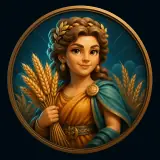
Illustrated portrait of Persephone

Portrait from the MythBranch atlas
Interpretive illustration, not an ancient likeness

Greek mythology research profile · cited sources

Persephone

Proserpina · Daughter, abducted bride, and queen below

Persephone is daughter of Demeter and Zeus, the Kore or Maiden who becomes queen beside Hades. Her abduction, partial return, and underworld sovereignty connect family conflict, marriage, grain, ritual initiation, and mortality. Ancient poetry gives her direct speech, reports her response to events in the underworld, and describes her authority as queen; the familiar seasonal interpretation accounts for only part of that evidence.

Names · attributes · ancient evidence

Persephone: identity and historical contexts.

Kore means Maiden and can function as a cult title; Persephone names the formidable underworld goddess. The relation between the names does not require a modern split personality, but it does allow ritual and poetry to emphasize different statuses. In epic, ‘dread Persephone’ sends shades or receives the dead. At Eleusis, mother and daughter are the Two Goddesses whose loss and reunion structure sacred hope.

Versions disagree on how much pomegranate Persephone eats, whether Hades gives it secretly or she chooses it, and how long she remains below. Modern romance frequently centers love between Hades and Persephone; that can produce thoughtful adaptation, but it should not overwrite the Homeric Hymn's abduction, Zeus's prior agreement, Demeter's famine, and Persephone's own account. The page labels creative changes rather than presenting them as recovered ancient consent.

01Kore · Maiden02Despoina · Mistress03Hagnē · Holy04Praxidikē · Exacting justice05Basileia nertērōn · Queen of those below
01

Daughter and queen are simultaneous roles

The settlement does not restore the situation before abduction. Persephone returns to Demeter and also retains an underworld throne. Her power lies in the difficult coexistence of daughterhood, marriage, seasonal movement, and sovereignty. Adaptations choose different sides of that division because the ancient story itself refuses a single stable home.

02

Ancient visual artists choose different moments

Some vases show the violent chariot abduction; others show Persephone rising, enthroned, receiving heroes, or standing with Demeter and Triptolemus. No one image is the whole myth. A gallery that includes both descent and ascent keeps viewers from learning the story only through Bernini's spectacular force.

Texts · chronology · variant traditions

Selected ancient narratives involving Persephone.

Persephone's central cycle changes meaning depending on whether the speaker is mother, daughter, husband, worshipper, or modern adapter.

01

Homeric Hymn to Demeter

The flower opens into abduction

Persephone gathers flowers with divine companions when Gaia produces an extraordinary narcissus as a trap. The earth opens, Hades drives out, seizes her, and carries her below while she cries to Zeus. The landscape's beauty and the violence of transition occupy the same instant.

Anonymous: Homeric Hymn to Demeter ↗
02

Reunion with Demeter

Persephone tells her own account

After Hermes brings her upward, Demeter questions her about food consumed below. Persephone recounts Hades giving her the pomegranate and names the companions present before the abduction. Her direct speech supplies evidence not mediated by Zeus, Hades, or Demeter.

Anonymous: Homeric Hymn to Demeter ↗
03

Underworld encounters

The queen receives the living

Odysseus fears that dread Persephone may send a Gorgon head; Orpheus appeals to the underworld rulers; Heracles, Pirithous, and other heroes enter versions of her realm. As queen, Persephone can be terrifying, judicial, compassionate, or ritually invoked rather than the absent girl of the meadow.

Homeric tradition: Odyssey ↗Pseudo-Apollodorus: Library of Greek Mythology ↗

Genealogical records and atlas relationships

Genealogical evidence and variant traditions.

The atlas shows Persephone as Demeter's child and linked with Hades. Zeus, her father in the Homeric Hymn, is part of the wider genealogy even when every line is not simultaneously visible.

Parents drawn in this atlas

01

Chart-based siblings

00

No line of this type is drawn in the current atlas.

Unions drawn in this atlas

01

Children drawn in this atlas

00

No line of this type is drawn in the current atlas.

Genealogy note

Ancient sources vary on possible children and underworld companions. The profile centers the secure Demeter–Zeus parentage and Hades marriage rather than combining late genealogies into one household.

Open the interactive branch ↗

Text · stage · screen · scholarship

Selected works concerning Persephone in later reception.

Each selected work treats this figure as its subject, title presence, principal voice, or central dramatic agent. Incidental appearances are excluded. The bibliography also avoids assigning the same representative title to multiple profiles except where a shared primary text is indispensable.

  1. 1934PerséphoneMelodrama / ballet-oratorio
  2. 2018–2025Lore OlympusWebcomic / graphic novel
  3. 2019A Touch of DarknessNovel
01

Selected bibliography

Stage & music

01 works
02

Selected bibliography

Comics & novels

02 works

When modern book covers or publicity images are shown, they appear at small scale for identification and criticism; copyright remains with the named rights holders. Public-domain context images are explicitly labeled.

Sources and documentation

Primary texts, scholarship, and catalogue records.

Dates follow conventional scholarly ranges. Cover thumbnails identify modern editions; they do not represent the original material form of an ancient text. Links lead to university archives, publishers, and museum catalogues.

Ancient source

3
  1. 01Homeric Hymn to DemeterAnonymous
    Verified text or catalogue record
    Homeric Hymn to Demeter↗

    Anonymous · 7th–6th c. BCE

    Abduction, Persephone's testimony, pomegranate, settlement, and Eleusis.
    Edition or recordHarvard Center for Hellenic Studies translation
  2. 02OdysseyHomeric tradition
    Verified text or catalogue record
    Odyssey↗

    Homeric tradition · late 8th–early 7th c. BCE

    Dread Persephone and the authority of the underworld queen.
    Edition or recordOpen translation · Harvard Center for Hellenic Studies
  3. 03Library of Greek MythologyPseudo-Apollodorus
    Verified text or catalogue record
    Library of Greek Mythology↗

    Pseudo-Apollodorus · 1st–2nd c. CE

    Genealogy, abduction, marriage, and heroic underworld traditions.
    Edition or recordGreek text and translation · Perseus Digital Library

Academic study

1
  1. 01The Search for the Missing GirlClassical scholarship trail
    Verified text or catalogue record
    The Search for the Missing Girl↗

    Classical scholarship trail · Modern research

    Research pathway for gender, ritual, consent, language, and cult interpretation.
    Edition or recordJSTOR indexed scholarship

Museum research

1
  1. 01Great Eleusinian ReliefThe Metropolitan Museum of Art
    Verified text or catalogue record
    Great Eleusinian Relief↗

    The Metropolitan Museum of Art · Museum record

    Curatorial evidence for Persephone, Demeter, Triptolemus, and Eleusinian iconography.
    Edition or recordMet Collection object 14.130.9

Family questions

Questions about Persephone's family.

Who are Persephone's parents?

Persephone is the daughter of Demeter and Zeus in the Homeric Hymn to Demeter.

Why does Persephone return to the underworld?

The pomegranate binds her to part of each year below in the hymn's settlement. Sources differ on amount, intention, and the division of time.

Is Persephone only the goddess of spring?

No. She is also Kore, daughter of Demeter, queen of the underworld, a formidable power over the dead, and a central goddess of Eleusinian ritual.