MythBranch · Reading mythology
Theseus and the Minotaur: Ariadne’s Thread and the Escape
Follow Theseus into the Labyrinth, compare Ariadne’s help and the killing of the Minotaur, and read the different endings in three ancient accounts.
The short answer
How does Theseus defeat the Minotaur and escape the Labyrinth?
Ariadne supplies the thread that lets Theseus retrace his route after killing the Minotaur. The Epitome says he kills it with his fists; Ovid leaves the method unspecified. Their escape leads to sharply different accounts of Theseus’s separation from Ariadne.
The voyage begins with Athens’s tribute
Plutarch’s Life of Theseus 15–17 begins the Cretan expedition with a crisis shared by Athenian families. After the death of his son Androgeus in Attica, Minos makes war on Athens; famine and disease deepen the suffering. An agreement requires the Athenians to send seven young men and seven young women to Crete every nine years. In the familiar account that Plutarch records, the Minotaur destroys the captives, or they perish because they cannot escape the Labyrinth.
When the third tribute approaches, Theseus volunteers to share his fellow citizens’ danger. His father Aegeus cannot persuade him to stay. This gives the mission a public purpose: the king’s son exposes himself to the fate threatening other households. Plutarch also preserves Hellanicus’s different account, in which Minos selects Theseus himself. Voluntary courage and compulsory selection offer different beginnings, even though both place the hero among the young Athenians sent to Crete.
The Labyrinth makes survival a problem of finding the way
Ovid’s Metamorphoses 8.152–168 pauses over the prison before reaching Theseus. Minos wants the Minotaur concealed, and Daedalus constructs passages whose turns confuse anyone trying to follow them. Ovid compares their movement to the winding Maeander River: a route doubles back and seems to approach its own beginning. Even the builder can scarcely retrace the way. The description makes the building an active obstacle, capable of defeating a survivor who has already overcome its inhabitant.
The Minotaur combines human and bovine form, but Ovid gives the battle far less space than the architecture around it. That distribution prepares the reader to appreciate Ariadne’s contribution. Killing the creature solves only one part of the danger. A successful rescue also requires a dependable connection between the entrance and the place reached inside. The thread will preserve that connection while Theseus’s attention is occupied by movement and combat. Ovid’s river comparison also gives the reader an experience of uncertainty before the escape is explained. The repeated turns slow the story down; the brief mention of the thread then supplies an unexpectedly modest answer to an elaborate construction. A small portable object defeats the builder’s confusing paths.
Ariadne obtains the knowledge and supplies the thread
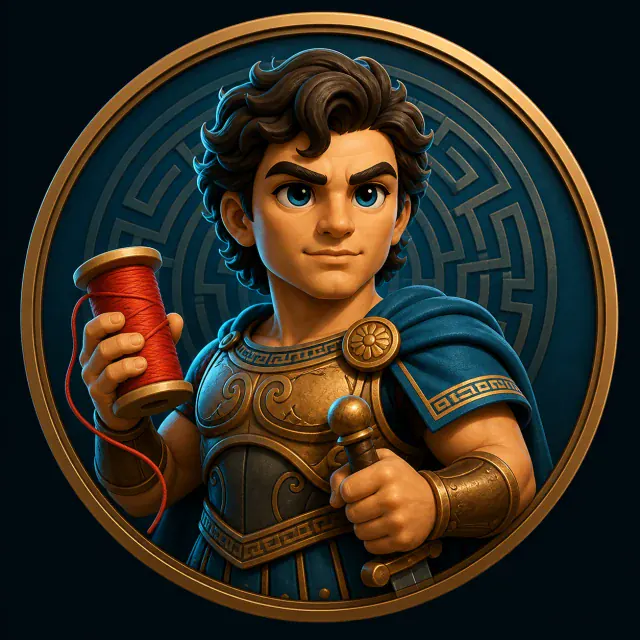
In the Epitome E.1.7–9, Ariadne falls in love with Theseus and offers assistance on condition that he take her to Athens as his wife. He agrees. She asks Daedalus how to get out of the Labyrinth and gives Theseus a thread following his instructions. Theseus fastens it to the door and draws it behind him as he enters. After finding the Minotaur at the far end, he kills it with blows of his fists and returns by gathering up the thread.
Each person contributes something specific: Daedalus knows the structure, Ariadne secures and passes on the instructions, and Theseus carries out the dangerous encounter. Plutarch’s familiar version likewise credits Ariadne with the thread and teaching him its use, though it does not specify the weapon. Ovid compresses the killing and escape into a few lines. A sword may belong in other tellings or images, but it is not the method stated by the Epitome.
Escape from Crete brings a disputed separation
The Epitome sends Theseus away by night with Ariadne and the young Athenians. They reach Naxos, where Dionysus falls in love with Ariadne and carries her away. Theseus then sails on in grief. In this telling the separation interrupts a successful escape and helps explain the mistake that will follow on the homeward voyage. Ariadne’s disappearance is an action attributed to the god, rather than a decision narrated as Theseus’s betrayal.
Ovid gives the separation another shape. Theseus leaves Ariadne on Dia, identified in the translation with Naxos, and she is abandoned and lamenting when Bacchus finds her. The poem moves from the hero’s departure to the god’s love and the transformation of her crown into stars. The contrast is consequential: a rescued group can celebrate Theseus’s victory while Ariadne experiences its aftermath as desertion. Ovid’s short ending allows that cost to remain beside the heroic success.
Plutarch keeps rival accounts in view
Plutarch 19–20 records the thread story, then opens out into alternatives. In a version attributed to Philochorus, Taurus is a powerful and unpopular man, and Theseus defeats him in games. Minos responds by releasing the young captives and cancelling the tribute. This produces liberation through a contest and a ruler’s decision, without requiring a fight against a composite creature. Plutarch’s collection lets readers see how substantially the same remembered victory could be reworked.
Ariadne’s fate draws still more accounts. Plutarch reports desertion, other attachments, and a Cypriot story in which a storm separates the couple and Ariadne dies before Theseus returns. These alternatives are presented as disagreements. They give Ariadne different destinations and different kinds of remembrance. The comparison below keeps the main narrative choices together so that the route out of the Labyrinth does not hide the dispute about what happened after it.
Scroll the table sideways to see every column.
| Question | What the accounts say | Source |
|---|---|---|
| Why does Theseus go? | Plutarch records both volunteering and a version in which Minos chooses him. | Plutarch, Life of Theseus 15–20 |
| Who makes escape possible? | Ariadne provides the thread; the Epitome also describes her consultation with Daedalus. | Pseudo-Apollodorus, Epitome E.1.7–10Plutarch, Life of Theseus 15–20Ovid, Metamorphoses 8.152–182 |
| How is the Minotaur killed? | The Epitome specifies fists. Ovid’s brief account does not name a weapon. | Pseudo-Apollodorus, Epitome E.1.7–10Ovid, Metamorphoses 8.152–182 |
| Why are the lovers separated? | Dionysus carries Ariadne away in the Epitome; Theseus abandons her in Ovid. | Pseudo-Apollodorus, Epitome E.1.7–10Ovid, Metamorphoses 8.152–182 |
| What replaces the monster in another version? | Plutarch reports Philochorus’s contest against the man Taurus. | Plutarch, Life of Theseus 15–20 |
The return turns victory into another loss
The Epitome E.1.10 continues with a signal arranged before the expedition: a white sail is to announce Theseus’s survival. Grieving for Ariadne, he forgets to change the sail. Aegeus sees the dark sail, believes his son dead, and throws himself down from the Acropolis. The escape from one enclosed place therefore ends with a fatal misunderstanding at home. The promised sign fails even though the person it was meant to announce has survived.
Reading the three works in sequence makes their different interests clear. Start with the Epitome for the practical chain from promise to thread, combat, escape, and forgotten sail. Turn to Ovid for the winding architecture and Ariadne’s abandonment, then to Plutarch for the public crisis and competing memories. Theseus remains the killer of the Minotaur in the central story, but Ariadne’s help and the consequences of leaving Crete determine what kind of victory the reader encounters.
Test the comparison in individual lives
Each profile brings the question back to a particular figure, an ancient passage, and the limits of the diagram.
Questions this comparison raises
Did Theseus kill the Minotaur with a sword?
The Epitome specifies blows with his fists. Ovid’s account in Metamorphoses 8 does not name a weapon, so a sword should not be inserted into a summary attributed to that passage.
Why did Theseus need Ariadne’s thread?
The thread marked his route from the door into the Labyrinth and let him retrace it after the killing. In the Epitome, Ariadne obtains the instructions from Daedalus.
Did Theseus abandon Ariadne?
He does in Ovid’s account. In the Epitome, Dionysus carries her away and Theseus grieves. Plutarch preserves several further versions rather than settling on a single fate.
Why did Theseus forget the white sail?
The Epitome connects the mistake with his grief over Ariadne. Aegeus interprets the unchanged dark sail as proof that his son has died.
Sources and editions
- Pseudo-Apollodorus, Epitome E.1.7–10 ↗
J. G. Frazer translation. Ariadne’s agreement, Daedalus’s instructions, killing with fists, Dionysus’s removal of Ariadne, and the forgotten sail.
- Plutarch, Life of Theseus 15–20 ↗
John Dryden translation. Tribute, volunteering and selection, Ariadne’s thread, Taurus, and competing accounts of Ariadne’s fate. This edition does not print section numbers.
- Ovid, Metamorphoses 8.152–182 ↗
Brookes More translation. Daedalus’s Labyrinth, the thread, Theseus’s abandonment of Ariadne, and Bacchus’s placing of her crown among the stars.
Passage references identify the ancient evidence; the interpretive argument is MythBranch's reading. Cite the edition you consult and preserve disagreements between sources.