MONSTER · 30
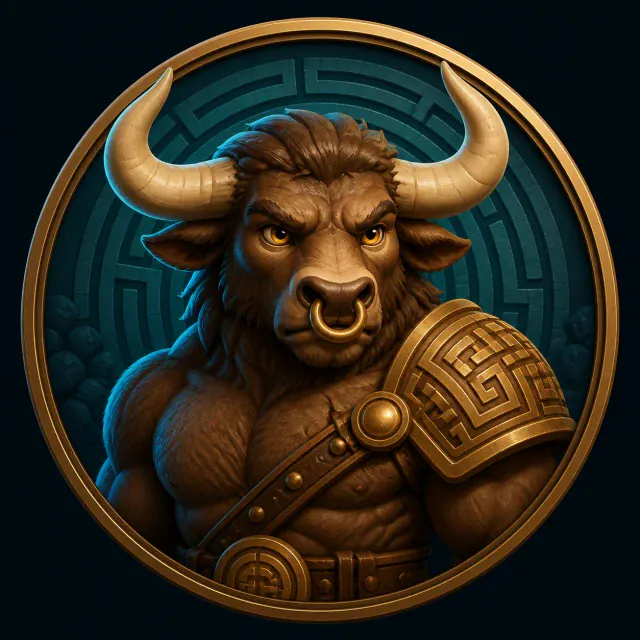
Illustrated portrait of Minotaur

Portrait from the MythBranch atlas
Interpretive illustration, not an ancient likeness

Greek mythology research profile · cited sources

Minotaur

Asterion · The hidden body at the center of Cretan power

The Minotaur is the bull-human child of Pasiphaë and the Cretan Bull, hidden in Daedalus's Labyrinth and killed by Theseus with Ariadne's help. Ancient sources often call him Asterion or Asterius as well as Minotaur, ‘bull of Minos.’ Later art moves from heroic combat to the creature's confinement, loneliness, desire, and viewpoint, making him one of the clearest examples of a defeated monster becoming a modern tragic subject.

Names · attributes · ancient evidence

Minotaur: identity and historical contexts.

Minotauros defines the creature through Minos, though Minos is not the biological father. Asterion gives him an individual name shared with a Cretan king and linked etymologically with stars. Ancient visual art often shows a human body with bull head and tail, making wrestling composition possible. The Labyrinth is both architectural technology and political concealment: Daedalus creates a space that keeps the consequences of royal offense out of public view.

The myth's causes vary in detail, but Minos fails to sacrifice a magnificent bull sent by Poseidon; Pasiphaë is made to desire it; Daedalus builds the wooden cow; and the child is confined. Modern archaeology at Knossos does not prove a historical Minotaur or identical Labyrinth. Bull ritual, palace complexity, and later Athenian imagination can inform reception without turning myth into a decoded newspaper report.

01Minōtauros · Bull of Minos02Asterion · Starry one03Bull-man04Labyrinth inhabitant05Cretan monster
01

The body records adult failures

Poseidon's demand, Minos's broken sacrifice, Pasiphaë's imposed desire, Daedalus's craft, and royal confinement all precede the Minotaur's violence. The creature becomes the visible bearer of decisions made by gods and adults. Modern retellings focus on his innocence because the ancient causal chain already makes blame unstable.

02

Athens tells the Cretan center

The tribute of youths, Theseus's victory, and return give Athens a story of liberation from Cretan domination. That political viewpoint shapes who is hero and who is monster. Ariadne's knowledge and the Minotaur's hidden life complicate the clean civic opposition without erasing the sacrificial danger.

Texts · chronology · variant traditions

Selected ancient narratives involving Minotaur.

The Minotaur cycle is built by other people's choices before the creature receives any action of his own.

01

Cretan kingship

Minos keeps Poseidon's bull

Minos asks Poseidon for a sign of legitimate rule and promises to sacrifice the bull sent from the sea. When he keeps the extraordinary animal, the god punishes the household by making Pasiphaë desire it. Daedalus constructs a wooden cow that makes the impossible union possible.

Pseudo-Apollodorus: Library of Greek Mythology ↗
03

Athenian tribute

Ariadne gives Theseus a route

Theseus joins or is chosen among the Athenian tribute. Ariadne falls in love or chooses to help and gives him thread, directions, or both. He kills the Minotaur and follows the line out. Later sources disagree about weapon, wrestling, and the exact mechanics of escape.

Pseudo-Apollodorus: Library of Greek Mythology ↗Plutarch: Life of Theseus ↗
04

Modern literary reversal

The monster speaks as Asterion

Jorge Luis Borges's ‘The House of Asterion’ lets a lonely first-person inhabitant describe his infinite house, games, solitude, and expectation of a redeemer. Only the final lines reveal Theseus reporting the Minotaur's death. The reader's recognition becomes the story's decisive turn.

Jorge Luis Borges: The House of Asterion ↗

Genealogical records and atlas relationships

Genealogical evidence and variant traditions.

The atlas shows the Minotaur as an encounter figure near Theseus but does not draw Pasiphaë, the Cretan Bull, Minos, Ariadne, or Daedalus. Prose restores biological, royal, and technical relations.

Parents drawn in this atlas

00

No line of this type is drawn in the current atlas.

Chart-based siblings

00

No line of this type is drawn in the current atlas.

Unions drawn in this atlas

00

No line of this type is drawn in the current atlas.

Children drawn in this atlas

00

No line of this type is drawn in the current atlas.

Genealogy note

Pasiphaë is the Minotaur's mother and the Cretan Bull his father. Minos is stepfather and political namesake; Ariadne is maternal half-sister. These categories should not be collapsed into one simple parent line.

Open the interactive branch ↗

Text · stage · screen · scholarship

Selected works concerning Minotaur in later reception.

Each selected work treats this figure as its subject, title presence, principal voice, or central dramatic agent. Incidental appearances are excluded. The bibliography also avoids assigning the same representative title to multiple profiles except where a shared primary text is indispensable.

  1. 1947The House of AsterionShort story
  2. 1985The Minotaur: A BalladNovella / ballad
  3. 1885The MinotaurOil painting
01

Selected bibliography

Modern fiction

02 works
02

Selected bibliography

Painting & social allegory

01 works

When modern book covers or publicity images are shown, they appear at small scale for identification and criticism; copyright remains with the named rights holders. Public-domain context images are explicitly labeled.

Sources and documentation

Primary texts, scholarship, and catalogue records.

Dates follow conventional scholarly ranges. Cover thumbnails identify modern editions; they do not represent the original material form of an ancient text. Links lead to university archives, publishers, and museum catalogues.

Ancient source

3
  1. 01Library of Greek MythologyPseudo-Apollodorus
    Verified text or catalogue record
    Library of Greek Mythology↗

    Pseudo-Apollodorus · 1st–2nd c. CE

    Minos's bull, Pasiphaë, Daedalus, Labyrinth, tribute, Ariadne, and Theseus.
    Edition or recordGreek text and translation · Perseus Digital Library
  2. 02Metamorphoses, Book 8Ovid
    Verified text or catalogue record
    Metamorphoses, Book 8↗

    Ovid · c. 8 CE

    Roman poetic account of the Labyrinth, Minotaur, Theseus, and Ariadne.
    Edition or recordLatin text and English translation · Perseus
  3. 03Life of TheseusPlutarch
    Verified text or catalogue record
    Life of Theseus↗

    Plutarch · late 1st–early 2nd c. CE

    Variants and rationalizing traditions around tribute and Cretan victory.
    Edition or recordGreek text and translation · Perseus Digital Library

Academic study

1
  1. 01The House of AsterionJorge Luis Borges
    Verified text or catalogue record
    The House of Asterion↗

    Jorge Luis Borges · 1947

    Scholarly research trail for the central modern point-of-view reversal.
    Edition or recordJSTOR indexed criticism

Museum research

1
  1. 01The MinotaurTate
    Verified text or catalogue record
    The Minotaur↗

    Tate · 1885

    Authoritative object record and Victorian social context.
    Edition or recordTate collection N01634

Family questions

Questions about Minotaur's family.

Who are the Minotaur's parents?

Pasiphaë is his mother and the Cretan Bull his father; Minos is the royal stepfather whose name the title Minotaur carries.

What is the Minotaur's name?

Ancient and later sources often call him Asterion or Asterius as well as Minotaur.

How did Theseus kill the Minotaur?

Ancient accounts vary on weapon and combat, but Ariadne's thread or guidance allowed Theseus to leave the Labyrinth after the killing.