MythBranch · Reading mythology
The Twelve Olympians: Rosters, Kinship, and Ancient Variants
Compare ancient lists of the Twelve Olympians, why Hades rules outside the council, and how Hestia and Dionysus appear across Greek sources.
The short answer
Who are the Twelve Olympians, and why do ancient lists vary?
Modern handbooks usually group Zeus, Hera, Poseidon, Demeter, Athena, Apollo, Artemis, Ares, Aphrodite, Hephaestus, and Hermes with either Hestia or Dionysus. Ancient Greek texts and sanctuaries preserved the number twelve while varying its membership across genealogies, philosophical dialogues, and local altars.
Six siblings do not equal a twelve-seat council
Hesiod’s Theogony 453–458 names six children born to Rhea and Cronus: Hestia, Demeter, golden-sandaled Hera, strong Hades, loud-sounding Earth-Shaker Poseidon, and wise Zeus. That sibling group forms the first generation of rulers who displace Cronus, yet six siblings cannot fill twelve places. Readers who treat the Twelve Olympians as a single birth cohort confuse a family branch with a larger divine council assembled across two generations.
Later sections of the Theogony, at 886–942, introduce the younger deities who complete familiar twelve-god selections. Zeus swallows Metis before giving birth to Athena from his head; Leto bears Apollo and Artemis; Hera bears Ares with Zeus and produces Hephaestus without union; Maia bears Hermes; and Cadmus’s mortal daughter Semele bears immortal Dionysus. Genealogical poetry supplies these distinct parentages without pausing to legislate which twelve names belong on a classroom poster.
Why Hades rules as a brother outside Olympus
Hades belongs to Cronus and Rhea’s six children, yet standard counts of the Twelve Olympians leave him out. Homer’s Iliad 15.187–193 clarifies his standing through Poseidon’s speech to Iris. Three brothers born of Cronus and Rhea divided all things into three portions by lot: Poseidon received the grey sea to inhabit forever, Hades drew the murky darkness beneath the earth, and Zeus received the broad sky among clouds and bright air, while earth and high Olympus remained common ground.
Poseidon invokes that settlement to resist Zeus’s peremptory command on the Trojan plain, showing that the allotment defines sovereign jurisdiction rather than inferiority of birth. Hades is absent from routine assemblies on Mount Olympus because his allotted kingdom lies below among the dead, where Persephone rules beside him. Leaving Hades off an Olympian roster reflects residence and cultic sphere rather than banishment from his brothers’ family.
Hestia’s hearth permanence in hymn and philosophy
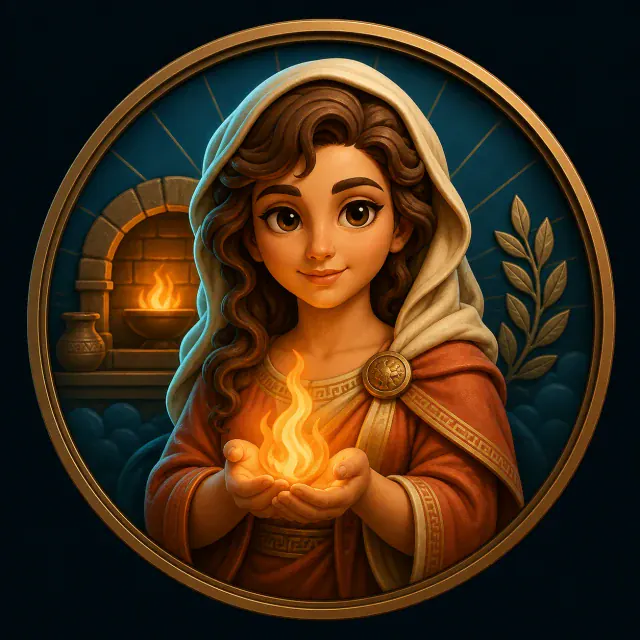
Popular modern summaries often claim that Hestia stepped down from a twelfth throne on Olympus so Dionysus could take her seat peacefully. Surviving Greek and Roman literature does not narrate that resignation. In the Homeric Hymn to Aphrodite 21–32, Hestia refuses courtship from Poseidon and Apollo, touches the head of aegis-bearing Zeus to swear perpetual virginity, and receives a compensating privilege instead of marriage: she sits at the center of the house, takes the richest portion, and receives honor in every temple of the gods.
Plato’s Phaedrus 246e–247a turns that domestic centrality into a cosmic arrangement. Socrates describes Zeus driving his winged chariot first across heaven to order and care for all things, followed by a host of gods and spirits marshaled in eleven divisions, while Hestia alone remains in the house of the gods. The dialogue explicitly counts the remaining leaders among the number of the twelve, treating Hestia’s stillness at home as the fixed anchor of the group rather than evidence that she surrendered membership.
Sanctuary altars group twelve gods differently
Material and ritual records show how much local worship could depart from modern textbook lists. At Athens, the younger Pisistratus dedicated an Altar of the Twelve Gods in the Agora during the late sixth century BCE, creating a civic center from which road distances were measured. Farther west at Olympia, Pausanias 5.14.8–10 records six double altars established by Heracles, each shared by a pair of deities so that sacrifices honored twelve powers across the sanctuary precinct.
Pausanias’s six pairs at Olympia join Zeus Olympius with Poseidon, Hera with Athena, Hermes with Apollo, the Graces with Dionysus, Artemis with the river Alpheus, and Cronus with Rhea. Several familiar names appear, yet Hephaestus, Ares, Aphrodite, Demeter, and Hestia are absent from these six double altars, while river, collective, and Titan deities occupy full places. A cultic twelve organized around local landscape, festival athletics, and ancestral memory worked by pairing meaningful neighbors rather than checking off one panhellenic register.
Scroll the table sideways to see every column.
| Ancient witness | Grouping or scene | What it establishes | Source |
|---|---|---|---|
| Hesiod, Theogony 453–458, 886–942 | Six children of Cronus and Rhea, followed by Zeus’s unions and offspring | Separates the six first-generation siblings from younger gods without fixing a twelve-name roster. | Hesiod, Theogony 453–458 and 886–942 |
| Homer, Iliad 15.187–193 | Three brothers divide sea, underworld darkness, and sky by lot | Explains Hades’ full sibling rank alongside his subterranean realm outside Olympian councils. | Homer, Iliad 15.187–193 |
| Homeric Hymn to Aphrodite 21–32 | Hestia refuses marriage and receives the central hearth and temple shares | Grounds Hestia’s stationary honor in household and sanctuary rites without a throne transfer. | Homeric Hymn 5 to Aphrodite 21–32 |
| Plato, Phaedrus 246e–247a | Zeus leads eleven heavenly squadrons while Hestia stays in the divine house | Counts Hestia within a twelve-ruler framework defined by cosmic motion and domestic stillness. | Plato, Phaedrus 246e–247a |
| Pausanias 5.14.8–10 | Six double altars at Olympia honoring twelve paired powers | Demonstrates a sanctuary twelve that includes Dionysus, the Graces, Alpheus, Cronus, and Rhea. | Pausanias, Description of Greece 5.14.8–10 |
| Pseudo-Apollodorus, Library 1.3–1.4; 3.5.3 | Genealogical chapters on Zeus’s family and Dionysus’s ascent with Semele | Narrates Dionysus’s divine recognition and heavenly ascent without Hestia vacating a seat. | Pseudo-Apollodorus, Library 1.1.5 and 1.3–1.4Pseudo-Apollodorus, Library 3.4.3–3.5.3 |
Dionysus enters heaven without a resignation myth
Dionysus’s position requires special care because his mortal mother Semele sets his birth apart from Hera’s or Leto’s children. Hesiod already calls Semele’s son immortal at Theogony 940–942, and Pseudo-Apollodorus, Library 3.4.3–3.5.3, follows his rescue from Semele’s ashes, his concealment in Zeus’s thigh, the spread of viticulture and ecstatic rites across Asia and Greece, and his descent to Hades to bring Semele up to heaven under the name Thyone. His entry among the heavenly gods crowns a narrative of contested recognition.
In Library 1.1–1.4, the compiler organizes the older and younger gods by parentage rather than by twelve numbered chairs. When modern reference tables alternate between Hestia and Dionysus in the twelfth slot, they are reconciling two genuine features of ancient evidence—Hestia’s place among the elder siblings and Dionysus’s prominence in civic festivals, temple friezes, and sanctuary altars—to preserve the traditional count of twelve. Naming that editorial compromise keeps twentieth-century retellings distinct from ancient testimony.
How to read a twelve-god chart accurately
When consulting a chart or textbook list of the Twelve Olympians, identify three variables first: which eleven recurring gods appear, whether Hestia or Dionysus holds the twelfth slot, and where Hades and Persephone are placed. Check each deity’s parent lines separately from council membership. On MythBranch’s family tree, Cronus and Rhea connect to six children, while Zeus’s unions and solo births generate a wider younger generation whose honors come from specific narratives.
Next, match the claim you are testing to its genre. Use Hesiod for birth sequence and marriages, Iliad 15 for cosmic allotment among brothers, the Aphrodite hymn and Plato for Hestia’s place in the house, and Pausanias for sanctuary altar pairs. Keeping each witness distinct turns a puzzling discrepancy between two lists into clear evidence of how Greek communities organized divine power across home, assembly, and festival ground.
Test the comparison in individual lives
Each profile brings the question back to a particular figure, an ancient passage, and the limits of the diagram.
Questions this comparison raises
Did Hestia give up her throne on Olympus to Dionysus?
No surviving ancient Greek or Roman text narrates Hestia resigning a seat for Dionysus. That story comes from modern retellings trying to harmonize lists that count either Hestia or Dionysus as the twelfth Olympian.
Why is Hades excluded from the Twelve Olympians?
In Iliad 15.187–193, Hades receives the underworld darkness by lot while Zeus takes the sky and Poseidon the sea. He is a full brother of Zeus, but his permanent realm lies below rather than in the Olympian council.
Are all Twelve Olympians brothers and sisters?
No. Cronus and Rhea have six children in Hesiod’s Theogony 453–458, and Hades is usually omitted from the Twelve. Deities such as Athena, Apollo, Artemis, Hermes, Ares, and Hephaestus belong to the next generation.
Did Greek sanctuaries worship the exact same twelve gods?
No. Pausanias 5.14.8–10 describes six double altars at Olympia that pair Zeus, Poseidon, Hera, Athena, Hermes, Apollo, Dionysus, and Artemis with the Graces, the river Alpheus, and Cronus and Rhea.
Sources and editions
- Hesiod, Theogony 453–458 and 886–942 ↗
H. G. Evelyn-White, 1914 public-domain translation. Cronus and Rhea’s six children and the births of the younger Olympian generation.
- Homer, Iliad 15.187–193 ↗
A. T. Murray, 1924 public-domain translation. Poseidon’s account of the threefold division of sea, underworld, and sky, with earth and Olympus held in common.
- Homeric Hymn 5 to Aphrodite 21–32 ↗
H. G. Evelyn-White, 1914 public-domain translation. Hestia’s oath of virginity and her honored place in the center of houses and temples.
- Plato, Phaedrus 246e–247a ↗
Harold North Fowler, 1914 translation, Perseus Digital Library. Zeus leads eleven heavenly divisions while Hestia remains in the house of the gods.
- Pausanias, Description of Greece 5.14.8–10 ↗
W. H. S. Jones, 1918 public-domain translation. The six double altars of the twelve gods at Olympia.
- Pseudo-Apollodorus, Library 1.1.5 and 1.3–1.4 ↗
J. G. Frazer, 1921 public-domain translation. Genealogical arrangement of Rhea’s children and Zeus’s offspring.
- Pseudo-Apollodorus, Library 3.4.3–3.5.3 ↗
J. G. Frazer, 1921 public-domain translation. Semele, Dionysus’s wanderings, the recovery of Thyone from Hades, and ascent to heaven.
Passage references identify the ancient evidence; the interpretive argument is MythBranch's reading. Cite the edition you consult and preserve disagreements between sources.