MythBranch · Reading mythology
Medusa’s Story: Perseus, Athena, and the Serpent Hair
Read Medusa’s story through Hesiod, the Library, and Ovid: her death, Perseus’s reflected view, and the different accounts of her serpent hair.
The short answer
What happens in Medusa’s story, and why do accounts of her transformation differ?
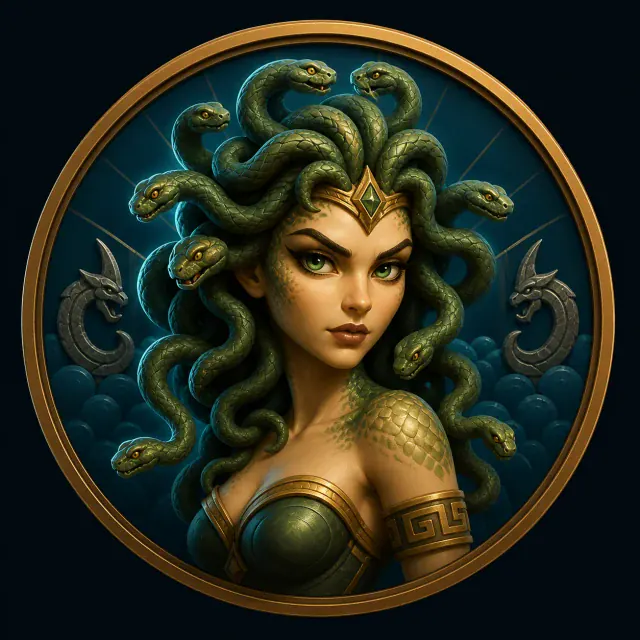
Perseus beheads Medusa, the mortal Gorgon, and her head retains its petrifying power. Hesiod recounts her death without a transformation story; Ovid later explains her serpent hair through an encounter with Neptune in Minerva’s temple and the goddess’s punishment.
Hesiod begins with a mortal Gorgon
In Hesiod’s Theogony 270–286, Medusa lives with Sthenno and Euryale beyond Ocean, near the realm of Night. The distance places the sisters outside ordinary human geography. Of the three Gorgons, Medusa alone can die. Hesiod introduces her through this vulnerability and the suffering attached to her fate, then moves quickly from Poseidon’s union with her in a flowering meadow to Perseus cutting off her head. There is no preceding scene in which Athena changes a woman into a Gorgon.
The killing produces an unexpected beginning. Pegasus and Chrysaor emerge when Medusa is beheaded; Pegasus eventually reaches Zeus and carries his thunder and lightning. A creature born from the death of a distant Gorgon thus enters the service of the ruler of the gods. Read this short passage first for its sequence: mortal sister, encounter with Poseidon, beheading, new life. Hesiod supplies that sequence without explaining the serpent hair or describing Perseus’s equipment.
Perseus is sent on an apparently impossible mission
The Library 2.4.2 gives Perseus a reason to seek Medusa. Polydectes, king of Seriphus, wants access to Perseus’s mother Danae, but her grown son stands in his way. During a collection supposedly intended for a wedding gift, Perseus boasts that he would provide even a Gorgon’s head. Polydectes turns the offer into a command. The expedition begins in a household threatened by a king’s desire, rather than with Medusa attacking Perseus’s city.
Hermes and Athena guide him toward the Graeae, who share an eye and a tooth. By seizing these, Perseus obtains directions to the nymphs who possess the equipment he needs. He receives winged sandals, a bag called the kibisis, and a cap that conceals its wearer. Hermes also gives him a cutting weapon. The preparations make the encounter a problem of access, sight, and escape; strength alone would leave him exposed to the Gorgons’ power.
A reflected image lets Perseus approach
Perseus finds the Gorgons asleep. The Library describes frightening bodies with tusks, bronze hands, and golden wings, and says that those who behold them become stone. Medusa’s mortality makes her the possible target. With his face turned away, Perseus watches her image in a bronze shield while Athena guides his hand. He beheads her, places the head in his bag, and escapes the pursuing sisters because the cap keeps him invisible. The shield provides a way to see without meeting the fatal sight directly.
Ovid also makes the reflected view and sleeping victim central to Perseus’s account. At his wedding feast after rescuing Andromeda, the hero describes a landscape of petrified people and animals before recalling the killing. That setting gives the episode a second audience: guests hear the victor tell how he survived. Medusa never delivers a corresponding account of her own life in this passage. The difference between the speaker’s triumph and her silence becomes especially striking when the guests ask about her hair.
Ovid explains the hair through Minerva’s punishment
At Metamorphoses 4.794–803, Perseus answers a guest who asks why Medusa alone has snakes among her hair. He says that she was renowned for beauty, especially her hair, and reports an encounter with Neptune in Minerva’s temple. The episode is commonly read as sexual violation. The linked Brookes More translation uses a euphemistic expression for Neptune’s action; its wording should not be treated as evidence that Medusa consented. This account belongs to Perseus’s speech in Ovid’s Roman poem, with Neptune and Minerva corresponding to Poseidon and Athena.
Minerva turns away and covers her eyes, then changes Medusa’s hair into snakes as punishment for the temple’s violation. The punishment falls on Medusa, a disturbing feature of the story that readers can confront without inventing a speech or motive for her. Ovid explicitly describes the alteration of her hair. He does not here narrate a transformation of her entire body, call her a priestess, or explain the change as a protective gift. Those additions would change the scene’s meaning.
Three accounts give the same death different surroundings
The passages are easiest to compare by following a particular event across them. Hesiod’s brief account concentrates on mortality and the lives that emerge after the beheading. The Library expands the expedition into a sequence of instructions, objects, and evasions. Ovid lets a question at a feast draw the narrative backward into Medusa’s former beauty. These are different emphases, with details that sometimes resist being fitted into one continuous biography.
Athena’s role shows the difference clearly. In the Library she helps Perseus kill Medusa and later receives the head; a separate reported explanation associates the killing with a beauty rivalry. In Ovid, Minerva’s alteration of the hair answers a different question. Reading the passages beside each other preserves the force of each scene: the dangerous mission, the unequal punishment, and the astonishing births all remain visible.
Scroll the table sideways to see every column.
| Story detail | Ancient account | Source |
|---|---|---|
| Medusa can die | Hesiod distinguishes her from her immortal sisters. | Hesiod, Theogony 270–286 |
| Perseus’s preparations | The Library supplies the Graeae, nymphs, equipment, and divine guidance. | Pseudo-Apollodorus, Library 2.4.2–3 |
| The reflected view | The Library and Ovid describe looking through a bronze shield’s reflection. | Pseudo-Apollodorus, Library 2.4.2–3Ovid, Metamorphoses 4.753–803 |
| Serpent hair | Ovid’s Perseus explains it as Minerva’s punishment after the temple encounter. | Ovid, Metamorphoses 4.753–803 |
| Pegasus and Chrysaor | Hesiod and the Library connect their emergence with Medusa’s beheading. | Hesiod, Theogony 270–286Pseudo-Apollodorus, Library 2.4.2–3 |
Medusa’s power survives her death
The Library 2.4.3 follows the head back into the human conflicts that began the expedition. Perseus returns to Seriphus to find Danae and Dictys sheltering at altars from Polydectes. He exposes the head to the king and his companions, turning them to stone. Medusa’s power provides the means of ending the danger to his mother, although Medusa herself has been killed to obtain it. The rescue and the cost belong to the same narrative.
Perseus finally gives the head to Athena, who places it on her shield. Ovid’s explanation ends with Minerva wearing the snakes to frighten her enemies. Both endings transfer terror into divine possession. Returning to Hesiod afterward changes the scale again: instead of a trophy, the reader encounters Pegasus flying to Zeus. These closing movements give Medusa consequences beyond the instant of her death, even though none of these passages grants her an extended speaking part.
Test the comparison in individual lives
Each profile brings the question back to a particular figure, an ancient passage, and the limits of the diagram.
Questions this comparison raises
Was Medusa always a Gorgon?
Hesiod presents her among the Gorgons without a transformation episode. Ovid explains her serpent hair through an earlier scene of beauty and punishment. These passages do not give one shared account of her beginnings.
How did Perseus avoid turning to stone?
In the Library and Ovid, he looks at Medusa’s reflected image in a bronze shield while she sleeps. The Library also gives him Athena’s guidance and equipment that enables his escape.
Did Athena turn Medusa into a monster to protect her?
Ovid describes Minerva’s change of the hair as punishment. A protective transformation is a reinterpretation, not the explanation supplied in this passage.
What came from Medusa when she died?
Hesiod and the Library name Pegasus and Chrysaor as emerging at her beheading. Hesiod then follows Pegasus into Zeus’s service.
Sources and editions
- Hesiod, Theogony 270–286 ↗
H. G. Evelyn-White translation. Medusa’s mortality, Poseidon, beheading, and the emergence of Pegasus and Chrysaor.
- Pseudo-Apollodorus, Library 2.4.2–3 ↗
J. G. Frazer translation. Perseus’s commission, equipment, reflected view, escape, and transfer of the head to Athena.
- Ovid, Metamorphoses 4.753–803 ↗
Brookes More translation. Perseus narrates at the wedding feast; the final explanation concerns Medusa’s hair. The translation euphemizes Neptune’s action.
Passage references identify the ancient evidence; the interpretive argument is MythBranch's reading. Cite the edition you consult and preserve disagreements between sources.