MythBranch · Reading mythology
Daedalus, Icarus, and the Cretan Labyrinth
Connect the flight of Daedalus and Icarus to Athens, Pasiphae, the Cretan Labyrinth, and Sicily across Homer, Ovid, the Epitome, and Diodorus.
The short answer
How does the flight of Daedalus and Icarus connect to the Labyrinth myth?
Exiled from Athens for killing his gifted nephew Talos or Perdix, the master craftsman Daedalus serves King Minos in Crete by building Pasiphae’s wooden cow, constructing the Labyrinth for the Minotaur, and giving Ariadne the thread device for Theseus. Confined by Minos as punishment, Daedalus fashions waxed feather wings, reaching Sicily while Icarus falls into the sea.
Before Crete: Daedalus’s Athenian workshop and envious crime
Standalone anthology excerpts often begin with Daedalus and Icarus already trapped on Crete, leaving readers uncertain how an Athenian inventor came to work for Minos. Pseudo-Apollodorus, Library 3.15.8, places Daedalus in the royal Athenian line of Erechtheus, calls him the finest architect and first discoverer of statues, and explains his flight from Attica through professional jealousy. His sister’s young son Talos became his pupil, picked up a serpent’s jawbone, used it to cut through slender wood, and imitated its jagged teeth in iron to invent the saw; fearing the boy would surpass his own reputation, Daedalus hurled Talos down from the Acropolis.
Tried and condemned by Athens’s Areopagus court when caught burying the corpse, Daedalus fled to Minos in Crete. Ovid’s Metamorphoses 8.236–259 and Diodorus Siculus 4.76.4–7 preserve the same Athenian crime with variations: Ovid names the twelve-year-old nephew Perdix, credits him with inventing both the saw from a fish’s spine and the two-legged iron compass, and adds that Minerva caught the falling boy in mid-air and clothed him in feathers as a low-nesting partridge that forever avoids high roofs.
Knossos, Pasiphae’s cow, and the Cretan Labyrinth
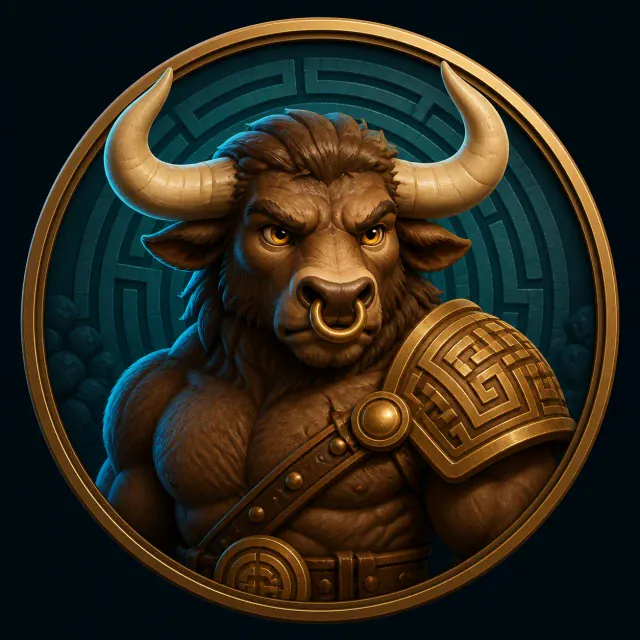
Once in Crete, Daedalus’s technical skill produces both court splendor and dynastic concealment. Homer’s brief Epic reference at Iliad 18.590–592 remembers the pleasant side of his Cretan patronage: forging scenes on Achilles’ shield, Hephaestus fashions a dancing-place like the one Daedalus once made in broad Knossos for fair-haired Ariadne. In the mythographic accounts of Library 3.1.3–4 and Diodorus 4.77.1–4, however, Poseidon punishes Minos for withholding a promised sea-born bull by inspiring Queen Pasiphae with passion for the animal, and Daedalus constructs a hollow wooden cow on wheels covered in real hide so the union produces bull-headed Asterius, called the Minotaur.
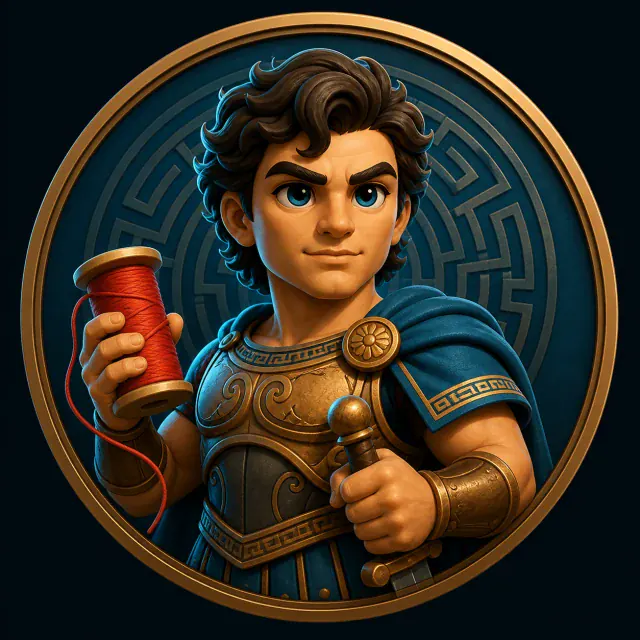
To hide that living scandal from public sight while trapping Athenian tribute youths sent after Androgeus’s death, Minos commissions Daedalus to build the Labyrinth—an enclosure whose tangled, doubling passages baffle anyone trying to retrace the entrance (Library 3.15.8; Ovid, Metamorphoses 8.152–168). When Theseus arrives among the third Athenian tribute, Ariadne consults Daedalus, receives the thread solution for navigating his own maze, and enables Theseus to kill the Minotaur and sail away by night (Epitome 1.8–9).
Imprisonment, waxed feathers, and the middle course
Discovering that the Athenian architect who built the prison had also supplied the secret of escaping it, Minos turns his anger back on Daedalus. In Epitome 1.12, Minos shuts Daedalus inside the Labyrinth itself alongside his son Icarus, born to Minos’s enslaved woman Naucrate. Ovid’s Metamorphoses 8.183–202 frames the confinement more broadly across the island: weary of long exile and blocked by Minos on land and water, Daedalus declares that though Minos possesses earth and waves, the sky remains open, and sets his mind toward unattempted arts that alter human nature’s bounds.
Laying feathers in graduated order from shortest to longest like unequal reeds in a shepherd’s pipe, Ovid’s Daedalus binds the middle shafts with linen thread and curves the bases with softened wax while young Icarus stands laughing beside the workbench, chasing wind-blown down and thumbing yellow wax without knowing he handles his own peril. Fitting the wings, Daedalus instructs Icarus to hold the middle track—low moisture will weigh down the plumes, high heat will scorch the wax—and his aged cheeks grow wet with tears and his fatherly hands tremble as he kisses the boy for the last time.
Scroll the table sideways to see every column.
| Episode | How surviving ancient accounts present it | Source |
|---|---|---|
| Athenian exile (Talos / Perdix) | Library 3.15.8 and Diodorus 4.76 name the murdered nephew Talos and record Areopagus condemnation; Ovid 8.236–259 calls him Perdix and adds Minerva’s partridge transformation. | Pseudo-Apollodorus, Library 3.1.3–4 and 3.15.8Ovid, Metamorphoses 8.152–259Diodorus Siculus, Library of History 4.76–79 |
| Cretan works before the flight | Iliad 18.590–592 recalls Ariadne’s dancing-floor at Knossos; Library 3, Epitome 1, Ovid 8, and Diodorus 4 connect Pasiphae’s wooden cow, the Labyrinth, and Ariadne’s thread. | Homer, Iliad 18.590–592Pseudo-Apollodorus, Library 3.1.3–4 and 3.15.8Pseudo-Apollodorus, Epitome 1.8–15Ovid, Metamorphoses 8.152–259Diodorus Siculus, Library of History 4.76–79 |
| Escape from Crete | Epitome 1.12 and Ovid 8.183–235 narrate feathered wings fastened with wax; Diodorus 4.77.5–9 adds a rationalized variant in which Pasiphae supplies a ship. | Pseudo-Apollodorus, Epitome 1.8–15Ovid, Metamorphoses 8.152–259Diodorus Siculus, Library of History 4.76–79 |
| Death and burial of Icarus | In Epitome 1.12–13 and Ovid 8.223–235, sun heat melts the wax over the Icarian Sea (with Heracles burying the body on Doliche in Apollodorus, and Daedalus burying him in Ovid); in Diodorus’s ship variant, Icarus drowns landing carelessly. | Pseudo-Apollodorus, Epitome 1.8–15Ovid, Metamorphoses 8.152–259Diodorus Siculus, Library of History 4.76–79 |
| Sicilian refuge and Minos’s death | Epitome 1.13–15 and Diodorus 4.78–79 follow Daedalus to King Cocalus at Kamikos, where Minos’s spiral-shell test exposes him and Cocalus’s daughters kill Minos in the bath. | Pseudo-Apollodorus, Epitome 1.8–15Diodorus Siculus, Library of History 4.76–79 |
Icarus’s fall and Ovid’s structural echo
Rising across the Aegean past Samos, Delos, and Paros while astonished anglers, shepherds, and plowmen mistake the pair for gods, Icarus abandons his guide out of delight in bold flight and climbs toward high heaven (Metamorphoses 8.217–235; Epitome 1.12–13). Near the scorching sun, the fragrant wax softens and melts; Icarus shakes bare arms that catch no air, calls his father’s name as dark blue water closes over his mouth, and leaves feathers floating on the waves so Daedalus, no longer a father, locates the corpse by its scattered plumes.
Ancient authors differ on who buries Icarus on the island thereafter named Icaria: Ovid has Daedalus inter the boy himself while a chattering partridge claps its wings from a muddy ditch in open Schadenfreude over the craftsman’s grief, whereas Epitome 1.13 (and Library 2.6.3) says Heracles found the body washed ashore on Doliche, buried it, renamed the island Icaria, and received a startlingly lifelike statue in Pisa from grateful Daedalus—so lifelike that Heracles struck it at night mistaking the wood for a living intruder. Ovid’s juxtaposition with Perdix turns the tragedy from a bare proverb against pride into an uncanny symmetry between two youths lost from great heights.
Sicily, the spiral shell, and Diodorus’s rationalized voyage
Daedalus’s story does not end on Icaria’s shore. Both Epitome 1.13–15 and Diodorus Siculus 4.78–79 follow the survivor west to Kamikos in Sicily, ruled by King Cocalus, where Daedalus constructs rock-cut defenses, an artificial lake, a steam-heated cave sanctuary, and a golden honeycomb for Aphrodite on Mount Eryx. Determined to recapture his fugitive architect, Minos sails to Sicily with a fleet and announces a reward across every town for anyone who can pass a linen thread through the tight spiral chambers of a triton shell.
Cocalus brings the shell inside to Daedalus, who bores a tiny hole at the tip, ties the thread to an ant, and lets the insect walk through the coiled interior—revealing immediately that only the Labyrinth’s maker could dwell in Cocalus’s palace. Pretending to surrender his guest while entertaining Minos first, Cocalus sends his daughters (who admired Daedalus’s clever gifts) to bathe the Cretan king; they hold Minos in boiling bathwater—or pour boiling water or pitch through overhead pipes—and return his corpse claiming he slipped and died.
Rationalization and craft across the cycle
Diodorus Siculus 4.77.5–9 also preserves an instructive ancient rationalization beside the wing legend: in that second account, Pasiphae secretly gave Daedalus and Icarus a vessel to flee Crete, Icarus drowned stepping recklessly ashore on a precipitous island, and onlookers later spoke of waxed wings because father and son escaped on sails—which Diodorus elsewhere associates with early maritime invention. Rather than proving what historically occurred in Bronze Age Crete, Diodorus’s double report shows Greek historians already distinguishing poetic marvel from plausible seafaring.
Read the cycle as one continuous chain of problems solved and created by human artifice: an iron saw in Athens produces murder and exile; a wooden cow in Knossos necessitates a stone Labyrinth; a ball of thread undoes the Labyrinth and traps its maker; feathered wings carry the father free while costing his son; and a threaded sea-shell in Sicily brings down Minos himself. Every triumph of ingenuity carries forward the consequences of the device built just before it.
Test the comparison in individual lives
Each profile brings the question back to a particular figure, an ancient passage, and the limits of the diagram.
Questions this comparison raises
Why were Daedalus and Icarus imprisoned on Crete?
In Epitome 1.8–12, Minos confined them after learning that Daedalus had built Pasiphae’s wooden cow and then taught Ariadne how Theseus could escape the Labyrinth with a thread.
Why had Daedalus left Athens in the first place?
Library 3.15.8, Ovid 8.236–259, and Diodorus 4.76 state that Daedalus threw his talented nephew (named Talos or Perdix, inventor of the saw) down from the Athenian Acropolis out of professional envy.
Where did Daedalus go after Icarus fell into the sea?
In Epitome 1.13–15 and Diodorus 4.78–79, Daedalus reached King Cocalus at Kamikos in Sicily, where Cocalus’s daughters killed the pursuing Minos in a scalding bath.
Did any ancient writer offer a non-magical explanation of the flight?
Yes. Alongside the waxed-wing story, Diodorus Siculus 4.77.5–9 reports a rationalized version in which Pasiphae helped Daedalus and Icarus escape Crete by ship and Icarus drowned landing carelessly on an island.
Sources and editions
- Homer, Iliad 18.590–592 ↗
A. T. Murray, 1924 public-domain translation. Hephaestus models a dancing-place on the one Daedalus built in Knossos for Ariadne.
- Pseudo-Apollodorus, Library 3.1.3–4 and 3.15.8 ↗
J. G. Frazer, 1921 public-domain translation. Daedalus’s Athenian lineage, the killing of Talos, Pasiphae’s wooden cow, and the building of the Labyrinth.
- Pseudo-Apollodorus, Epitome 1.8–15 ↗
J. G. Frazer, 1921 public-domain translation. Ariadne’s thread, confinement with Icarus, waxed wings, Heracles burying Icarus, Cocalus’s spiral shell, and Minos’s death.
- Ovid, Metamorphoses 8.152–259 ↗
Brookes More, 1922 public-domain translation. The Labyrinth, wing-making, flight and fall of Icarus, and the partridge transformation of Perdix.
- Diodorus Siculus, Library of History 4.76–79 ↗
C. H. Oldfather, 1935 translation. Daedalus’s statues, Talos, Crete, both the wing account and the rationalized ship escape, and works in Sicily.
Passage references identify the ancient evidence; the interpretive argument is MythBranch's reading. Cite the edition you consult and preserve disagreements between sources.