OLYMPIAN · 20
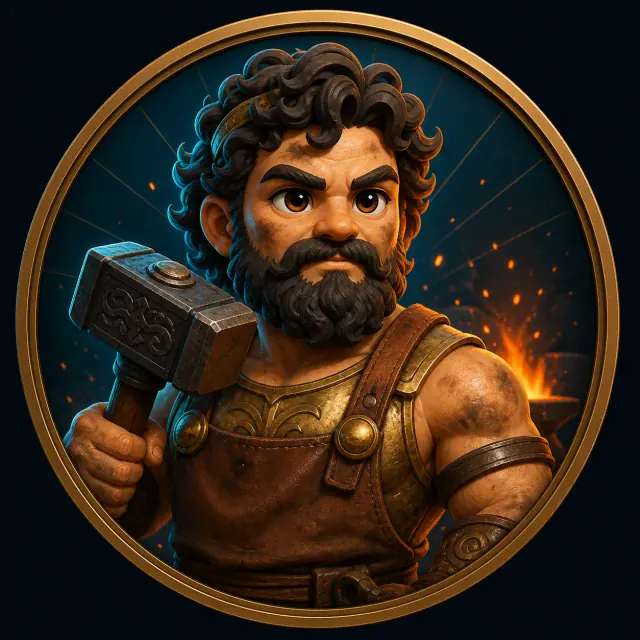
Illustrated portrait of Hephaestus

Portrait from the MythBranch atlas
Interpretive illustration, not an ancient likeness

Greek mythology research profile · cited sources

Hephaestus

Vulcan · Fire, metalwork, technology & difficult belonging

Hephaestus is the divine smith of fire, metalwork, architecture, jewelry, weapons, furniture, and self-moving machines. His disabled body and repeated expulsion from Olympus are not incidental comic marks: they shape myths about skill, dependence, humiliation, marriage, and the labor hidden behind divine splendor. Roman Vulcan shares fire and craft but develops a distinct relationship to destructive urban flame.

Names · attributes · ancient evidence

Hephaestus: identity and historical contexts.

Hephaestus makes Achilles' armor, Zeus's thunderbolt traditions, palaces, chains, tripods, golden attendants, and traps. Epic describes his movement and body with language that can be mocked by other gods while simultaneously presenting craft no one else can equal. His workshop may be on Olympus or located beneath volcanic islands in later imagination, where fire and hammering turn geology into divine industry.

Ancient sources disagree about parentage and falls. Hesiod makes Hera bear Hephaestus without Zeus; Homeric passages can call him son of Zeus and Hera or focus on Hera casting him away. One fall follows an attempt to defend Hera and ends on Lemnos; another explains maternal rejection. These are variants, not stages that automatically combine into one biography. Modern readers should also avoid romanticizing disability as compensation by genius.

01Klytotekhnēs · Famous craftsman02Amphigyēeis · Strong in both arms / debated03Polymētis · Resourceful04Chalkeus · Bronze-worker05Aitnaios · Of Etna, later cult
01

Divine labor remains labor

Gods enjoy objects whose production epic actually describes: heat, bellows, metal, tools, planning, and skilled hands. Hephaestus makes luxury and military power possible, yet his status is unstable. The mythology exposes a hierarchy in which elites depend on technical work they can socially devalue.

02

Automata and modern terminology

Golden attendants support Hephaestus, self-moving tripods enter assemblies, and crafted guard figures blur the distinction between artifact and life. The modern word ‘robot’ is useful only as a comparison, since it introduces engineering assumptions absent from epic. The poems emphasize wonder, agency, service, and the authority of the maker without providing a mechanical account.

Texts · chronology · variant traditions

Selected ancient narratives involving Hephaestus.

Hephaestus's myths repeatedly turn exclusion into designed counterpower rather than battlefield dominance.

01

Competing birth traditions

Hephaestus is thrown from Olympus

Hera casts out the infant because of his body in one tradition; in Iliad 1, Zeus hurls him after he tries to help Hera. He falls for a day and lands on Lemnos, where the Sintians care for him. The variants locate disability, family violence, and foster community differently.

Homeric tradition: Iliad ↗Hesiodic tradition: Theogony ↗
02

Odyssey · Book 8

The hidden net catches the lovers

After learning that Aphrodite and Ares meet in his bed, Hephaestus makes invisible unbreakable bonds. He traps them and summons the gods. The public spectacle wins laughter, negotiation, and guaranteed compensation, but it does not restore an ideal marriage.

Homeric tradition: Odyssey, Book 8 ↗
03

Iliad · Book 18

The shield of Achilles

Thetis asks Hephaestus to replace the armor lost with Patroclus. The god forges a shield containing city, war, harvest, dance, law, stars, and Ocean. Achilles receives not a magical guarantee of survival but a portable world made by labor and destined to enter violence.

Homeric tradition: Iliad ↗
04

Return to Olympus

The throne that binds Hera

Later traditions tell that Hephaestus sends Hera a marvelous throne that traps her when she sits. The gods cannot free her until Dionysus brings the smith back, often by wine and procession. Revenge becomes the means of negotiating recognition and return.

Pausanias: Description of Greece ↗

Genealogical records and atlas relationships

Genealogical evidence and variant traditions.

The atlas shows Hephaestus as a child of Hera and Zeus for readability, while the page states the major variant in which Hera bears him alone. His marriage traditions also vary.

Parents drawn in this atlas

01

Chart-based siblings

01

Unions drawn in this atlas

00

No line of this type is drawn in the current atlas.

Children drawn in this atlas

00

No line of this type is drawn in the current atlas.

Genealogy note

Aphrodite is his wife in the Odyssey, while other sources connect him with Charis or Aglaea. Parentage and marriage must be cited by source rather than combined into one universal household.

Open the interactive branch ↗

Text · stage · screen · scholarship

Selected works concerning Hephaestus in later reception.

Each selected work treats this figure as its subject, title presence, principal voice, or central dramatic agent. Incidental appearances are excluded. The bibliography also avoids assigning the same representative title to multiple profiles except where a shared primary text is indispensable.

  1. 2019Olympians: Hephaistos — God of FireGraphic novel
  2. 1952The Shield of AchillesPoem
  3. AntiquityHomeric Hymn 20: To HephaestusHymn
01

Selected bibliography

Graphic biography

01 works
02

Selected bibliography

Modern poetry

01 works
03

Selected bibliography

Ancient hymn

01 works

When modern book covers or publicity images are shown, they appear at small scale for identification and criticism; copyright remains with the named rights holders. Public-domain context images are explicitly labeled.

Sources and documentation

Primary texts, scholarship, and catalogue records.

Dates follow conventional scholarly ranges. Cover thumbnails identify modern editions; they do not represent the original material form of an ancient text. Links lead to university archives, publishers, and museum catalogues.

Ancient source

4
  1. 01IliadHomeric tradition
    Verified text or catalogue record
    Iliad↗

    Homeric tradition · late 8th–early 7th c. BCE

    Falls, workshop, golden attendants, Thetis, and the making of Achilles' armor.
    Edition or recordOpen translation · Harvard Center for Hellenic Studies
  2. 02Odyssey, Book 8Homeric tradition
    Verified text or catalogue record
    Odyssey, Book 8↗

    Homeric tradition · late 8th–early 7th c. BCE

    The net, Aphrodite, Ares, public exposure, and compensation.
    Edition or recordOpen translation · Harvard Center for Hellenic Studies
  3. 03TheogonyHesiodic tradition
    Verified text or catalogue record
    Theogony↗

    Hesiodic tradition · late 8th–7th c. BCE

    Hera's independent birth of Hephaestus and divine genealogy.
    Edition or recordGreek text and translation · Perseus Digital Library
  4. 04Description of GreecePausanias
    Verified text or catalogue record
    Description of Greece↗

    Pausanias · 2nd c. CE

    Cult, images, and return traditions surrounding the smith.
    Edition or recordGreek text and translation · Perseus Digital Library

Museum research

1
  1. 01Apollo in the Forge of VulcanMuseo Nacional del Prado
    Verified text or catalogue record
    Apollo in the Forge of Vulcan↗

    Museo Nacional del Prado · 1630

    Institutional record for technique, commission, provenance, and workshop interpretation.
    Edition or recordPrado collection record P001171

Family questions

Questions about Hephaestus's family.

Who are Hephaestus's parents?

Sources differ: Hesiod says Hera bore him without Zeus, while Homeric traditions can treat him as the son of Hera and Zeus.

Who are Hephaestus's family members, and did he have children?

His parentage varies between Hera alone and Hera with Zeus. Aphrodite is his wife in the Odyssey, while other traditions name Charis or Aglaea. Ancient sources also attach different children to him, so there is no single universal family list without specifying a source.

What is Hephaestus the god of?

He is god of fire, metalwork, craft, technology, workshops, architecture, and marvelous self-moving objects.

Who is Hephaestus married to?

Aphrodite is his wife in the Odyssey; other traditions name Charis or Aglaea.