MONSTER · 27
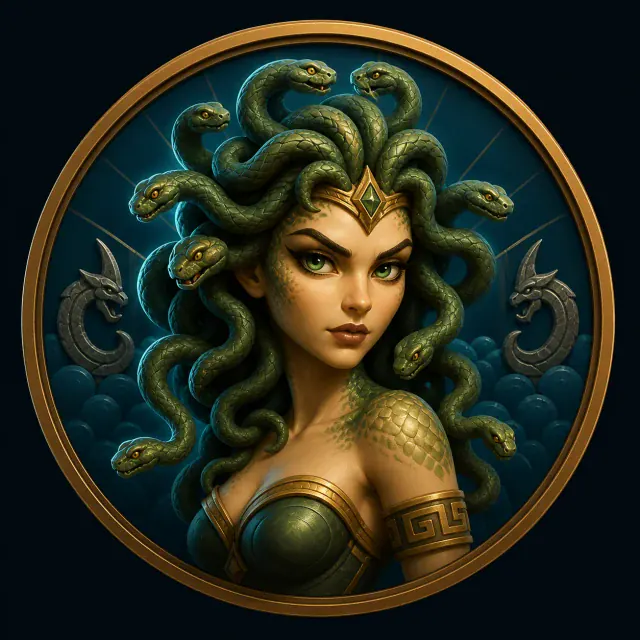
Illustrated portrait of Medusa

Portrait from the MythBranch atlas
Interpretive illustration, not an ancient likeness

Greek mythology research profile · cited sources

Medusa

Medusa · Mortal Gorgon, protective image, and contested survivor

Medusa is the one mortal Gorgon, daughter of the sea powers Phorcys and Ceto, killed by Perseus while her immortal sisters survive. Her head petrifies even after death and becomes the gorgoneion on Athena's aegis and countless protective objects. Ovid's story of sexual violence and transformation reshaped later reception; modern writers increasingly give Medusa the voice that ancient victory narratives deny.

Names · attributes · ancient evidence

Medusa: identity and historical contexts.

Archaic gorgoneia face the viewer directly with staring eyes, tusks, tongue, and sometimes beard. The frontal gaze breaks the usual profile conventions of Greek narrative art and turns the object itself into an encounter. Over centuries Medusa's face becomes more beautiful, sorrowful, female, and psychologically legible. That visual change cannot be explained by one text alone; apotropaic function, aesthetics, gender, and the Perseus story develop together.

Hesiod says Medusa alone was mortal and that Poseidon lay with her in a meadow; he does not narrate Athena transforming a beautiful maiden. Ovid later tells that Neptune violated Medusa in Minerva's temple and that the goddess changed her hair. Modern retellings rightly engage the violence but should identify the Roman source and distinguish it from earlier Gorgon genealogy. No single ‘original Medusa’ resolves all versions.

01Gorgō · Terrible one02Medousa · Guardian / ruler03Mortal Gorgon04Gorgoneion · Gorgon face05Horse-mother through Pegasus
01

The apotropaic function of the gorgoneion

On shields, temples, cups, coins, and tombs, the frontal gorgoneion serves an apotropaic function independent of a full Perseus narrative. Its direct gaze confronts the viewer and allows the image to operate protectively even when Medusa's body and decapitation are absent.

02

Beauty is a historical change, not her true recovered face

Classical and later artists soften animal features and produce the ‘beautiful Medusa.’ Renaissance and Baroque works explore horror, pathos, virtuosity, and decapitation. Modern fashion can turn the head into a luxury logo. Each transformation claims a different relation to threat and power; none should be treated as neutral illustration.

Texts · chronology · variant traditions

Selected ancient narratives involving Medusa.

Her page follows the figure beyond the instant Perseus wins, because the severed image has a larger cultural life than the living character receives in early narrative.

01

Hesiod · Theogony

The mortal sister among Gorgons

Phorcys and Ceto produce the Graeae and Gorgons; Stheno and Euryale are immortal, while Medusa is mortal. Poseidon lies with Medusa in a soft meadow. When Perseus cuts her head, Chrysaor and Pegasus spring from her body.

Hesiodic tradition: Theogony ↗
03

Metamorphoses · Book 4

Ovid gives Medusa a before

Perseus tells that Medusa was once famous for beauty, especially her hair. Neptune violated her in Minerva's temple; Minerva transformed the hair into snakes so onlookers would be terrified. The story embeds sexual violence and punitive transformation inside Perseus's banquet narration.

Ovid: Metamorphoses, Book 4 ↗

Genealogical records and atlas relationships

Genealogical evidence and variant traditions.

The atlas connects Medusa to Perseus through encounter rather than parentage. It does not draw Phorcys, Ceto, Stheno, Euryale, Pegasus, or Chrysaor, so the profile restores her actual family outside the hero's branch.

Parents drawn in this atlas

00

No line of this type is drawn in the current atlas.

Chart-based siblings

00

No line of this type is drawn in the current atlas.

Unions drawn in this atlas

00

No line of this type is drawn in the current atlas.

Children drawn in this atlas

00

No line of this type is drawn in the current atlas.

Genealogy note

Medusa is daughter of Phorcys and Ceto and sister of immortal Gorgons Stheno and Euryale in Hesiod. Pegasus and Chrysaor emerge at her death after the union with Poseidon.

Open the interactive branch ↗

Text · stage · screen · scholarship

Selected works concerning Medusa in later reception.

Each selected work treats this figure as its subject, title presence, principal voice, or central dramatic agent. Incidental appearances are excluded. The bibliography also avoids assigning the same representative title to multiple profiles except where a shared primary text is indispensable.

  1. 2022Stone BlindNovel
  2. 2021MedusaIllustrated novella
  3. 2023 editionMedusa: The Girl Behind the MythYoung reader retelling
01

Selected bibliography

Modern novels

03 works

When modern book covers or publicity images are shown, they appear at small scale for identification and criticism; copyright remains with the named rights holders. Public-domain context images are explicitly labeled.

Sources and documentation

Primary texts, scholarship, and catalogue records.

Dates follow conventional scholarly ranges. Cover thumbnails identify modern editions; they do not represent the original material form of an ancient text. Links lead to university archives, publishers, and museum catalogues.

Ancient source

3
  1. 01TheogonyHesiodic tradition
    Verified text or catalogue record
    Theogony↗

    Hesiodic tradition · late 8th–7th c. BCE

    Gorgon family, Medusa's mortality, Poseidon, death, Pegasus, and Chrysaor.
    Edition or recordGreek text and translation · Perseus Digital Library
  2. 02Library of Greek MythologyPseudo-Apollodorus
    Verified text or catalogue record
    Library of Greek Mythology↗

    Pseudo-Apollodorus · 1st–2nd c. CE

    Perseus's equipment, killing, escape, and later use of the head.
    Edition or recordGreek text and translation · Perseus Digital Library
  3. 03Metamorphoses, Book 4Ovid
    Verified text or catalogue record
    Metamorphoses, Book 4↗

    Ovid · c. 8 CE

    The influential Roman account of beauty, sexual violence, transformation, and Perseus's narration.
    Edition or recordLatin text and English translation · Perseus

Museum research

2
  1. 01Hydria with Perseus and MedusaThe British Museum
    Verified text or catalogue record
    Hydria with Perseus and Medusa↗

    The British Museum · c. 460 BCE

    Detailed ancient object record for the immediate aftermath of decapitation.
    Edition or recordBritish Museum object 1873,0820.352
  2. 02Medusa collection authorityThe British Museum
    Verified text or catalogue record
    Medusa collection authority↗

    The British Museum · Collection research

    Broad material record for gorgoneion, narrative scenes, and later reception.
    Edition or recordBritish Museum Collection Online

Family questions

Questions about Medusa's family.

Who are Medusa's parents?

Hesiod makes Medusa a daughter of the old sea powers Phorcys and Ceto.

Was Medusa born a monster?

Hesiod presents her within the Gorgon family. Ovid's later Roman account says she was transformed after Neptune violated her in Minerva's temple.

Why does Medusa's head remain powerful?

The severed head preserves the petrifying gaze and becomes an apotropaic image used by Perseus, Athena, and countless ancient objects.