MONSTER · 29
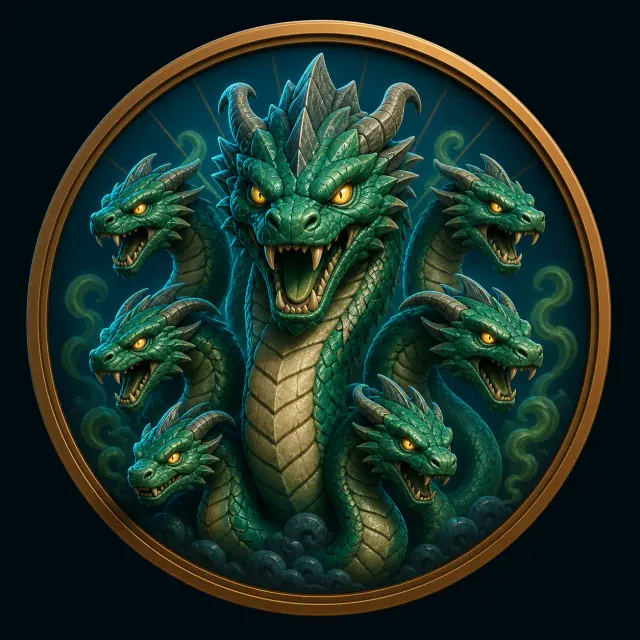
Illustrated portrait of Lernaean Hydra

Portrait from the MythBranch atlas
Interpretive illustration, not an ancient likeness

Greek mythology research profile · cited sources

Lernaean Hydra

Hydra · Multiplying danger and the problem of shared labor

The Lernaean Hydra is the many-headed serpent of the marsh at Lerna, child of Typhon and Echidna and opponent in Heracles' second labor. Cutting one head produces more; one may be immortal; breath and blood are poisonous. The monster turns straightforward force into a problem of method. Heracles needs Iolaus to cauterize each wound, then uses the Hydra's venom on arrows that carry the labor's harm into later stories.

Names · attributes · ancient evidence

Lernaean Hydra: identity and historical contexts.

Hydra means water snake, and the Lernaean name locates the monster in a wet Argive landscape associated with springs and underworld depth. Ancient sources give different numbers of heads; the variation emphasizes regenerative multiplicity rather than a fixed anatomy. Vase painters devised bodies that remain legible while Heracles and Iolaus attack at different points. Some later images add claws and produce a more generally draconic form.

The modern word hydra describes any problem that grows when attacked, a metaphor already available in political and literary reception. Biological Hydra received its scientific name from regenerative powers that seem mythically apt. Those later uses are meaningful but distinct from the offspring of Typhon and Echidna. The page also avoids treating the mythical venom as a realistic zoological substance.

01Lernaia · Of Lerna02Polykephalos · Many-headed03Hydra · Water serpent04Iobolos · Venomous05Typhonid offspring
01

Iolaus changes the meaning of the labor

Heracles cannot solve regeneration by cutting faster. Iolaus burns the necks while the hero attacks. Eurystheus later refuses to count the labor because of this help. The judgment exposes a contradiction in heroic credit: cooperation is necessary, yet the institution evaluating excellence demands isolated achievement.

02

The venom outlives the monster

Heracles dips arrows in Hydra blood or bile. Those weapons kill Nessus and contribute indirectly to Heracles' own death through the poisoned garment; one also wounds the immortal Chiron in other traditions. Victory therefore converts the monster into portable technology whose consequences continue long after Lerna.

Texts · chronology · variant traditions

Selected ancient narratives involving Lernaean Hydra.

The Hydra's story is not over when the final head is buried, because its blood moves into the rest of the Heracles cycle.

02

Second Labor

Cutting makes the danger larger

Heracles covers his face against poisonous breath and attacks with club or sword, but new heads grow when one is removed. A giant crab sent by Hera bites him; he crushes it. The ordinary logic of decapitation fails because the Hydra converts injury into multiplication.

Pseudo-Apollodorus: Library of Greek Mythology ↗
03

Second Labor

Iolaus cauterizes the necks

Heracles calls his nephew Iolaus, who uses burning brands to sear each exposed neck and prevent regrowth. The immortal head is cut and buried under a heavy rock. Eurystheus rejects the labor from the official count because Heracles received help.

Pseudo-Apollodorus: Library of Greek Mythology ↗

Genealogical records and atlas relationships

Genealogical evidence and variant traditions.

The atlas places the Hydra among heroic-age monsters and links it narratively to Heracles. Its parents and siblings lie outside the selected graph.

Parents drawn in this atlas

00

No line of this type is drawn in the current atlas.

Chart-based siblings

00

No line of this type is drawn in the current atlas.

Unions drawn in this atlas

00

No line of this type is drawn in the current atlas.

Children drawn in this atlas

00

No line of this type is drawn in the current atlas.

Genealogy note

Typhon and Echidna are the Hydra's parents in Hesiod. Cerberus, Orthrus, and Chimera belong to the same broad family, though ancient genealogical details and intermediate parentage can vary.

Open the interactive branch ↗

Text · stage · screen · scholarship

Selected works concerning Lernaean Hydra in later reception.

Each selected work treats this figure as its subject, title presence, principal voice, or central dramatic agent. Incidental appearances are excluded. The bibliography also avoids assigning the same representative title to multiple profiles except where a shared primary text is indispensable.

  1. 1875–76Hercules and the Lernaean HydraSymbolist painting
  2. 1st–2nd c. CELibrary: The Second LaborMythographic narrative
  3. Modern scienceHydra: A Model for RegenerationScientific model-organism research
01

Selected bibliography

Painting & symbolism

01 works
02

Selected bibliography

Ancient mythography

01 works
03

Selected bibliography

Science & naming

01 works

When modern book covers or publicity images are shown, they appear at small scale for identification and criticism; copyright remains with the named rights holders. Public-domain context images are explicitly labeled.

Sources and documentation

Primary texts, scholarship, and catalogue records.

Dates follow conventional scholarly ranges. Cover thumbnails identify modern editions; they do not represent the original material form of an ancient text. Links lead to university archives, publishers, and museum catalogues.

Ancient source

3
  1. 01TheogonyHesiodic tradition
    Verified text or catalogue record
    Theogony↗

    Hesiodic tradition · late 8th–7th c. BCE

    Hydra's parentage in the Typhon–Echidna monster family.
    Edition or recordGreek text and translation · Perseus Digital Library
  2. 02Library of Greek MythologyPseudo-Apollodorus
    Verified text or catalogue record
    Library of Greek Mythology↗

    Pseudo-Apollodorus · 1st–2nd c. CE

    The full compact second-labor account and later use of venom.
    Edition or recordGreek text and translation · Perseus Digital Library
  3. 03Women of TrachisSophocles
    Verified text or catalogue record
    Women of Trachis↗

    Sophocles · 5th c. BCE

    The poisonous chain from Hydra through Nessus to Heracles' death.
    Edition or recordGreek text and translation research · Perseus

Museum research

2
  1. 01Hercules and the Lernaean HydraArt Institute of Chicago
    Verified text or catalogue record
    Hercules and the Lernaean Hydra↗

    Art Institute of Chicago · 1875–76

    Authoritative object, provenance, and Symbolist interpretation.
    Edition or recordArt Institute object 1927.504
  2. 02Hydra collection authorityThe British Museum
    Verified text or catalogue record
    Hydra collection authority↗

    The British Museum · Collection research

    Museum biography and object corpus for ancient and later Hydra imagery.
    Edition or recordBritish Museum Collection Online

Family questions

Questions about Lernaean Hydra's family.

Who are the Hydra's parents?

The Lernaean Hydra is a child of Typhon and Echidna in Hesiod's genealogy.

How did Heracles kill the Hydra?

He cut the heads while Iolaus cauterized the necks to stop regrowth, then buried the immortal head beneath a rock.

Why did the Hydra matter after its death?

Heracles poisoned his arrows with its venom, which caused later deaths and ultimately contributed to his own mortal end.