MONSTER · 28
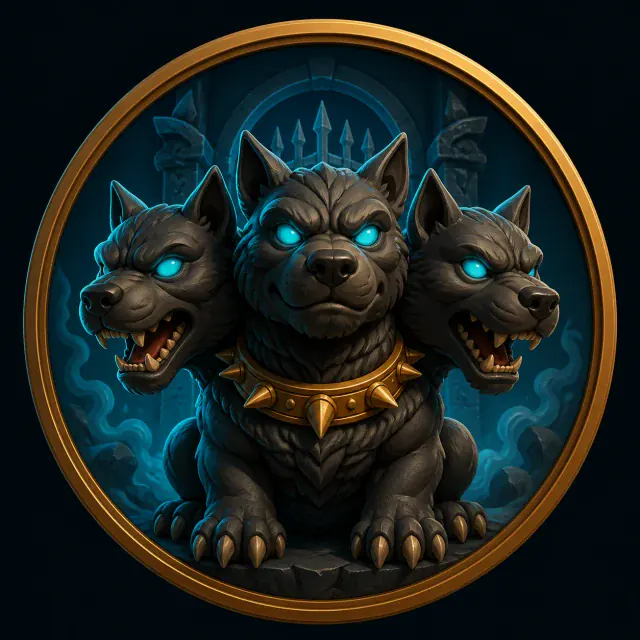
Illustrated portrait of Cerberus

Portrait from the MythBranch atlas
Interpretive illustration, not an ancient likeness

Greek mythology research profile · cited sources

Cerberus

Cerberus · The hound who keeps the dead within

Cerberus is the monstrous hound of Hades, child of Typhon and Echidna, stationed at the underworld entrance. Ancient descriptions vary from fifty heads to three, often adding a serpent tail and snake-grown body. His function is more stable than his anatomy: he admits the dead and prevents unauthorized return. Heracles' final labor makes him visible above ground without permanently defeating or killing him.

Names · attributes · ancient evidence

Cerberus: identity and historical contexts.

The three-headed dog is now standard, but Hesiod gives Cerberus fifty heads and emphasizes an irresistible, flesh-eating voice. Art often simplifies multiplicity for visual clarity and adds serpentine elements that connect him to his parents and siblings. Unlike monsters defined by occupying a route heroes must clear forever, Cerberus retains his office after encounter. The underworld still needs a guardian when the labor ends.

Cerberus is not Hades' evil pet in the modern sense and does not torture every dead soul. Roman poets give him drugged honey cakes or describe the Sibyl passing him; Orpheus can charm him; Psyche prepares offerings; Heracles uses force under conditions. These variations test different means—food, song, ritual knowledge, strength—of crossing a guarded boundary.

01Kerberos · Cerberus02Kynē Haidou · Hound of Hades03Trikephalos · Three-headed04Chalkophonōs · Brazen-voiced05Ameilichos · Implacable
01

Anatomy changes because function survives

A poet can multiply heads to express excess; a painter needs a composition a viewer can read. Three became the durable compromise, perhaps reinforced by tripartite underworld symbolism in later interpretation. The variations do not require one source to be wrong—they show different media solving monstrosity differently.

02

The final labor is a temporary removal

Heracles does not kill Cerberus. He brings the guardian to Eurystheus and returns him below. That distinction matters: the hero proves he can cross and master the boundary under exceptional terms, while the underworld's ordinary rule remains intact for everyone else.

Texts · chronology · variant traditions

Selected ancient narratives involving Cerberus.

Cerberus's encounters are variations on whether a living traveler may pass without dissolving the structure of death.

01

Hesiod · Theogony

Typhon and Echidna produce the hound

Among the offspring of Typhon and Echidna, Hesiod names Cerberus as the bronze-voiced, fifty-headed, shameless and powerful dog of Hades. The genealogy links him to Orthrus, the Hydra, Chimera, and other boundary monsters before later art settles on three heads.

Hesiodic tradition: Theogony ↗
02

Twelfth Labor

Heracles wrestles the guardian

Heracles descends, is initiated or guided in differing accounts, and obtains Hades' permission to take Cerberus if he can master him without ordinary weapons. Protected by lion skin, he grips the hound despite biting serpent tail, carries him to Eurystheus, and returns him.

Pseudo-Apollodorus: Library of Greek Mythology ↗
03

Virgil · Aeneid 6

The Sibyl uses a honeyed cake

As Aeneas and the Sibyl enter the underworld, Cerberus makes the region resound. The Sibyl throws a cake medicated with honey and soporific herbs; he devours it and falls across the cave. Their passage depends on ritual preparation rather than combat.

Virgil: Aeneid, Book 6 ↗
04

Poetic and visual reception

Orpheus makes the hound listen

In versions of Orpheus's descent, music pacifies Cerberus along with other underworld powers. Later art loves the image because it lets song suspend animal vigilance without blood. The reprieve lasts only as long as the exceptional performance and agreement.

Ovid: Metamorphoses ↗

Genealogical records and atlas relationships

Genealogical evidence and variant traditions.

The atlas displays Cerberus among heroic-age monsters but does not draw Typhon, Echidna, Orthrus, or most siblings. Encounter lines connect him to Heracles without making the hero a relative.

Parents drawn in this atlas

00

No line of this type is drawn in the current atlas.

Chart-based siblings

00

No line of this type is drawn in the current atlas.

Unions drawn in this atlas

00

No line of this type is drawn in the current atlas.

Children drawn in this atlas

00

No line of this type is drawn in the current atlas.

Genealogy note

Typhon and Echidna are Cerberus's parents in Hesiod. The Hydra, Orthrus, and Chimera belong to the same broad monstrous family in traditions whose exact intermediate parentage can vary.

Open the interactive branch ↗

Text · stage · screen · scholarship

Selected works concerning Cerberus in later reception.

Each selected work treats this figure as its subject, title presence, principal voice, or central dramatic agent. Incidental appearances are excluded. The bibliography also avoids assigning the same representative title to multiple profiles except where a shared primary text is indispensable.

  1. 1st c. BCEAeneid, Book 6: Cerberus at the GateRoman epic
  2. early 14th centuryInferno, Canto VIEpic canto
  3. 1st–2nd c. CELibrary: The Capture of CerberusMythographic narrative
01

Selected bibliography

Ancient underworld

02 works
02

Selected bibliography

Later literature

01 works

When modern book covers or publicity images are shown, they appear at small scale for identification and criticism; copyright remains with the named rights holders. Public-domain context images are explicitly labeled.

Sources and documentation

Primary texts, scholarship, and catalogue records.

Dates follow conventional scholarly ranges. Cover thumbnails identify modern editions; they do not represent the original material form of an ancient text. Links lead to university archives, publishers, and museum catalogues.

Ancient source

4
  1. 01TheogonyHesiodic tradition
    Verified text or catalogue record
    Theogony↗

    Hesiodic tradition · late 8th–7th c. BCE

    Parentage, siblings, voice, and the early fifty-headed description.
    Edition or recordGreek text and translation · Perseus Digital Library
  2. 02Library of Greek MythologyPseudo-Apollodorus
    Verified text or catalogue record
    Library of Greek Mythology↗

    Pseudo-Apollodorus · 1st–2nd c. CE

    Heracles' descent, conditions, capture, and return of Cerberus.
    Edition or recordGreek text and translation · Perseus Digital Library
  3. 03Aeneid, Book 6Virgil
    Verified text or catalogue record
    Aeneid, Book 6↗

    Virgil · 1st c. BCE

    The three-throated guardian and the Sibyl's honeyed drugged cake.
    Edition or recordLatin text and English translation · Perseus
  4. 04MetamorphosesOvid
    Verified text or catalogue record
    Metamorphoses↗

    Ovid · c. 8 CE

    Roman underworld and Orphic reception relevant to the hound.
    Edition or recordLatin text and English translation · Perseus

Museum research

1
  1. 01Cerberus collection researchThe British Museum
    Verified text or catalogue record
    Cerberus collection research↗

    The British Museum · Collection research

    Object corpus for head count, serpent anatomy, Heracles, and later reception.
    Edition or recordBritish Museum Collection Online

Family questions

Questions about Cerberus's family.

Who are Cerberus's parents?

Cerberus is a child of Typhon and Echidna in Hesiod's monster genealogy.

How many heads does Cerberus have?

Three is the standard later image, but Hesiod gives him fifty and other ancient sources vary.

Did Heracles kill Cerberus?

No. Heracles captured and displayed him under specific conditions, then returned him to the underworld.