HERO · 02
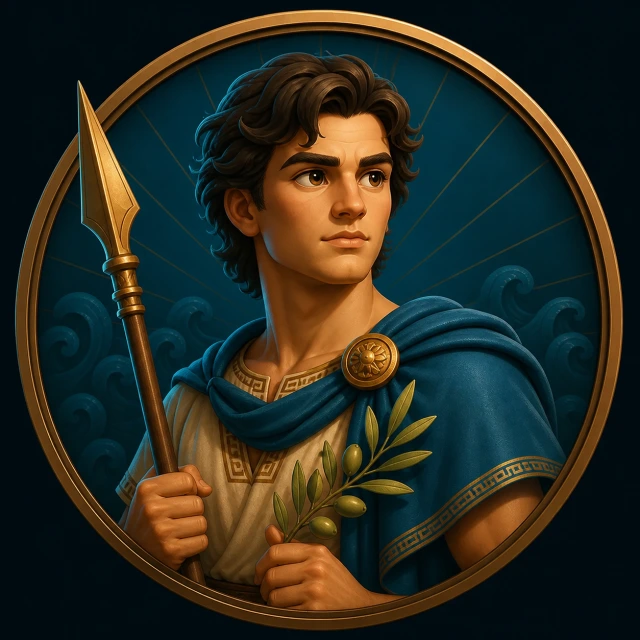
Illustrated portrait of Telemachus

Portrait from the MythBranch atlas
Interpretive illustration, not an ancient likeness

Greek hero research profile · cited sources

Telemachus

Telemachus · Son of Odysseus, heir of Ithaca

Telemachus is the son of Odysseus and Penelope and the young heir of Ithaca. The first four books of the Odyssey follow his search for news of the father he cannot remember; the later books turn that search into recognition, joint action, and an unsettled transfer between generations. His family tree is simple in Homer and radically expanded by later traditions.

Names · attributes · ancient evidence

Telemachus: identity and historical contexts.

Telemachus begins the Odyssey trapped in a household that is legally, politically, and emotionally suspended. The suitors consume his estate while insisting that Odysseus is dead; Penelope delays remarriage; and Telemachus has neither the authority nor the allies to remove them. Athena's intervention gives him a public voice and a route outward. His journey to Pylos and Sparta does not find Odysseus, but it teaches him how other households remember Troy, how sons inherit damaged stories, and how a young prince can act before certainty arrives.

Homer does not name a wife or child for Telemachus. The lost cyclic Telegony, known chiefly through Proclus' summary, ends with Telemachus marrying Circe after Telegonus accidentally kills Odysseus. Other late traditions pair him with Nausicaa or with Cassiphone, a daughter attributed to Odysseus and Circe. Those endings are later alternatives, not events in Homer's Odyssey.

01Odysseides · Son of Odysseus02Pepeithēmenos · Discerning / persuaded03Ithakesios · Of Ithaca04Philos huios · Dear son05Young heir of the house
01

The ‘Telemachy’ is a modern critical label

Books 1–4 are often called the Telemachy because they center Telemachus, but the Odyssey itself does not divide or title its opening movement that way. The label is useful if it does not turn the son's plot into a detachable preface.


02

Kinship is also a political claim

Being Odysseus's son gives Telemachus a place in the household but does not automatically give him control of Ithaca. The poem repeatedly tests whether resemblance, testimony, public speech, and coordinated action can make inherited identity socially effective.

03

Later spouses belong to different textual layers

Circe is the spouse named in Proclus' summary of the Telegony. Nausicaa and Cassiphone occur in other, later strands. A responsible family tree labels these alternatives instead of combining them into one continuous biography.

Texts · chronology · variant traditions

Selected ancient narratives involving Telemachus.

Telemachus spends the poem learning how to act before the famous hero returns. His path includes travel, diplomatic encounters, failed public institutions, recognition, violence, and the difficult work of becoming a son to a father he first knows through other people's stories.

01

Odyssey · Book 1

Athena enters the occupied house

Athena arrives in disguise while the suitors feast in Odysseus's halls. She urges Telemachus to call an assembly, seek news at Pylos and Sparta, and imagine a future in which he can act rather than merely endure.

Homeric tradition: Odyssey, Book 1
02

Odyssey · Book 2

The assembly fails—but public speech begins

Telemachus denounces the suitors before the Ithacan assembly, weeps, and demands redress. No collective force removes them, yet he names the household's crisis publicly before departing in a ship Athena helps secure.

Homeric tradition: Odyssey, Books 2–4
03

Odyssey · Book 3

Nestor teaches through other sons

At Pylos, Nestor receives Telemachus with sacrifice and hospitality, recounts the divided Greek returns, and compares Orestes' response to Agamemnon's murder with Telemachus's situation. He cannot reveal Odysseus's location, but he supplies a model of memory, household continuity, and action.

Homeric tradition: Odyssey, Books 2–4
04

Odyssey · Book 4

Helen and Menelaus remember different Odysseuses

At Sparta, Helen and Menelaus tell stories about Odysseus at Troy and Menelaus reports that Proteus saw him detained on Calypso's island. Telemachus finally receives credible evidence that his father was recently alive while the suitors plan an ambush for his return.

Homeric tradition: Odyssey, Books 2–4
05

Odyssey · Books 15–16

Father and son recognize one another

Telemachus evades the ambush, returns to Eumaeus's hut, and meets a disguised stranger. Athena restores Odysseus's appearance; after fear and disbelief, Telemachus accepts the recognition and the two begin planning against the suitors.

Homeric tradition: Odyssey, Books 15–16
06

Odyssey · Books 21–24

The heir fights—and nearly surpasses the bow test

Telemachus almost strings Odysseus's bow before his father signals him to stop. He then fights beside Odysseus, Eumaeus, and Philoetius, rebukes his own mistake when weapons reach the suitors, and remains present as Athena ends the threat of wider feud.

Homeric tradition: Odyssey, Books 21–24

Genealogical records and atlas relationships

Genealogical evidence and variant traditions.

In the Odyssey, Telemachus is the son of Odysseus and Penelope, grandson of Laertes and Anticleia through his father, and heir to the Ithacan household. Later poems and mythographers extend the line beyond Homer's ending, but they do not agree with one another.

Parents in the Odyssey

02
OdysseusUlysses

PenelopeMother and queen of Ithaca

Paternal grandparents

02

LaertesGrandfather

AnticleiaGrandmother

Guides and household allies

04
AthenaMinerva

EumaeusLoyal household ally

NestorHost and elder adviser

MenelausHost and witness to Odysseus

Variant later spouses

03

CirceSpouse in the Telegony summary

NausicaaSpouse in a later variant

CassiphoneSpouse in a late, separate tradition

Genealogy note

The solid atlas line connects Odysseus to Telemachus. Penelope, Laertes, and Anticleia are documented here even though the compact atlas does not yet draw them as nodes. Homer names no spouse for Telemachus. The Telegony's Circe marriage and later Nausicaa or Cassiphone variants are kept in a separate group so users do not mistake reception history for one canonical family.

Open the interactive branch

Text · stage · screen · scholarship

Selected works concerning Telemachus in later reception.

Later works repeatedly use Telemachus to ask what the child of a famous, absent, or damaged father can inherit. Some make him a political pupil, some an ordinary young man, and some restore the parallel father-and-son structure to large-scale screen storytelling.

  1. c. 700 BCEOdysseyThe son's search opens and anchors the return.
  2. 6th c. BCE?TelegonyA lost cyclic sequel supplies a radically different later marriage.
  3. 1699The Adventures of TelemachusFénelon turns the heir into a pupil of ethical kingship.
  4. 1922UlyssesJoyce names the opening episode ‘Telemachus.’
  5. 2026The OdysseyChristopher Nolan restores the son's journey beside the father's return.
01

Selected bibliography

Epic and cyclic afterlives

01 works
02

Selected bibliography

Literary and educational afterlives

02 works
03

Selected bibliography

Modern adaptation

02 works

When modern book covers or publicity images are shown, they appear at small scale for identification and criticism; copyright remains with the named rights holders. Public-domain context images are explicitly labeled.

Sources and documentation

Primary texts, scholarship, and catalogue records.

Dates follow conventional scholarly ranges. Cover thumbnails identify modern editions; they do not represent the original material form of an ancient text. Links lead to university archives, publishers, and museum catalogues.

Ancient source

5
  1. 01Odyssey, Book 1Homeric tradition
    Verified text or catalogue record
    Odyssey, Book 1

    Homeric tradition · late 8th–early 7th c. BCE

    Athena's visit, the occupied household, and Telemachus's first decision to seek news.
    Edition or recordGreek and English text · Perseus Digital Library
  2. 02Odyssey, Books 2–4Homeric tradition
    Verified text or catalogue record
    Odyssey, Books 2–4

    Homeric tradition · late 8th–early 7th c. BCE

    The Ithacan assembly and the journeys to Nestor at Pylos and Menelaus and Helen at Sparta.
    Edition or recordGreek and English text · Perseus Digital Library
  3. 03Odyssey, Books 15–16Homeric tradition
    Verified text or catalogue record
    Odyssey, Books 15–16

    Homeric tradition · late 8th–early 7th c. BCE

    Telemachus's return, the evasion of the ambush, and recognition between father and son.
    Edition or recordGreek and English text · Perseus Digital Library
  4. 04Odyssey, Books 21–24Homeric tradition
    Verified text or catalogue record
    Odyssey, Books 21–24

    Homeric tradition · late 8th–early 7th c. BCE

    The bow contest, the joint battle in the hall, recognition, and the prevention of continuing feud.
    Edition or recordGreek and English text · Perseus Digital Library
  5. 05Telegony: Proclus' summary and fragmentsEpic Cycle tradition
    Verified text or catalogue record
    Telegony: Proclus' summary and fragments

    Epic Cycle tradition · probably 6th c. BCE; later summary

    The principal surviving outline of the lost sequel, including Telegonus, Odysseus's death, and the paired marriages of Telegonus with Penelope and Telemachus with Circe.
    Edition or recordH. G. Evelyn-White translation · Livius transmission page

Academic study

1
  1. 01TelegonyChristos Tsagalis
    Verified text or catalogue record
    Telegony

    Christos Tsagalis · 2015

    A specialist account of the poem's fragments, Proclus' summary, date, structure, and relation to the rest of the Epic Cycle.
    Edition or recordThe Greek Epic Cycle and its Ancient Reception · Cambridge University Press