PRIMORDIAL · 05
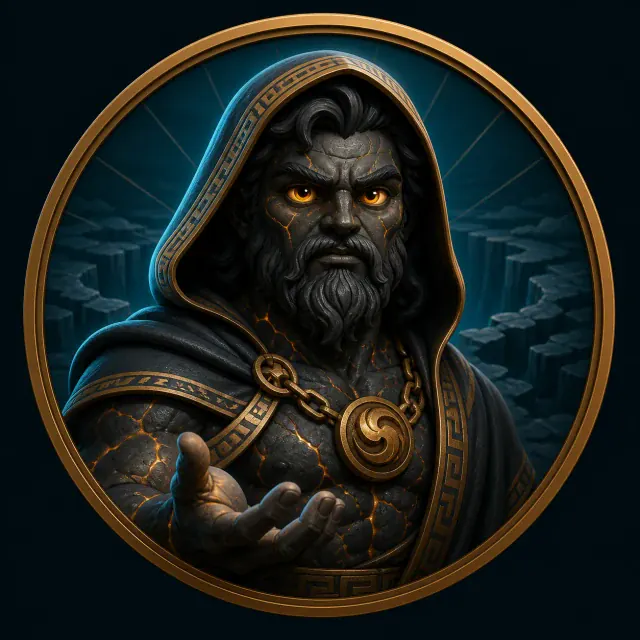
Illustrated portrait of Tartarus

Portrait from the MythBranch atlas
Interpretive illustration, not an ancient likeness

Greek mythology research profile · cited sources

Tartarus

Tartarus · The deepest cosmic prison and primordial reality

Tartarus is both a primordial reality named near the beginning of Hesiod's cosmos and the deepest region beneath the earth, later famous as the prison of defeated Titans and a place of exemplary punishment. Treating it only as the Greek equivalent of Christian hell erases its earlier cosmic scale, its guarded architecture, and the difference between a personified place and Hades' broader realm of the dead.

Names · attributes · ancient evidence

Tartarus: identity and historical contexts.

Hesiod places Tartarus as far below earth as heaven is above it and imagines a bronze anvil falling nine days to reach the tenth. Bronze walls and gates, roots of earth and sea, and the Hundred-Handers as guards turn abstract depth into architecture. Tartarus also appears among the first realities after Chaos, so its later role as prison does not exhaust its identity.

Later authors increasingly emphasize individual punishments—Titans, giants, Tantalus, Sisyphus, Ixion, and others—while Roman epic folds Tartarus into moral and imperial visions of the underworld. Modern fantasy often standardizes it as a single infernal dungeon. Ancient sources, however, vary in who is confined, how the region relates to Hades, and whether Tartarus is named as a being, a location, or both.

01Tartaros · Deep abyss02Ēeroeis · Misty03Bathys · Deep04Chalkopyle · Bronze-gated05Ametron chasma · Measureless gap
01

Cosmic map before moral prison

The Theogony's long description belongs to cosmology as much as punishment. Tartarus anchors the lower limit of the universe, near the roots and sources of earth, sea, sky, and night. Only after the Titanomachy does the poem dwell on it as a secured prison. Sequence matters: the place is older than the prisoners.

02

Underworld art needs careful labels

A painting of Aeneas, Orpheus, or Christ in hell is not automatically an image of primordial Tartarus. Later works may use the name while combining Virgilian, Dantean, and Christian structures. This page includes those works as reception of an abyss and clearly separates them from ancient evidence about a divine personification.

Texts · chronology · variant traditions

Selected ancient narratives involving Tartarus.

Tartarus moves from primordial coordinate to war prison and, in later imagination, a moral theatre of consequences.

01

Hesiod · Theogony 116–122

Tartarus appears near the beginning

After Chaos, broad Gaia and dim Tartarus are named among the first realities, along with Eros. Tartarus lies in the depth of wide-pathed earth. The poem does not narrate a birth, childhood, or conquest of the abyss; it establishes a permanent lower dimension required before later divine generations can be located.

Hesiodic tradition: Theogony ↗
02

After the Titanomachy

The Titans are shut behind bronze gates

Zeus and his allies defeat the Titans. They are confined beneath earth in misty Tartarus, behind bronze walls and gates, with the Hundred-Handers established as guards. The victory reorganizes kinship into political geography: an earlier generation remains present but immobilized at the universe's lower boundary.

Hesiodic tradition: Theogony ↗Pseudo-Apollodorus: Library of Greek Mythology ↗
03

Aeneid · Book 6, 1st c. BCE

Virgil's punitive Tartarus

The Sibyl guides Aeneas through the underworld and describes a walled Tartarus where Rhadamanthus judges, Tisiphone guards, and notorious offenders suffer. The Roman epic intensifies moral classification and places the terrible region inside a journey concerned with Rome's future and the discipline of memory.

Virgil: Aeneid, Book 6 ↗

Genealogical records and atlas relationships

Genealogical evidence and variant traditions.

The atlas places Tartarus among the origin generation. It does not draw every tradition in which Tartarus fathers monstrous children with Gaia or functions only as a location.

Parents drawn in this atlas

00

No line of this type is drawn in the current atlas.

Chart-based siblings

00

No line of this type is drawn in the current atlas.

Unions drawn in this atlas

00

No line of this type is drawn in the current atlas.

Children drawn in this atlas

00

No line of this type is drawn in the current atlas.

Genealogy note

Hesiod names Tartarus among the first realities without parents. Later genealogical summaries can pair Tartarus with Gaia as parent of Typhon or other beings, but the traditions are not uniform.

Open the interactive branch ↗

Text · stage · screen · scholarship

Selected works concerning Tartarus in later reception.

Each selected work treats this figure as its subject, title presence, principal voice, or central dramatic agent. Incidental appearances are excluded. The bibliography also avoids assigning the same representative title to multiple profiles except where a shared primary text is indispensable.

  1. late 8th–7th c. BCETheogony: The House of Night and TartarusCosmogonic poem
  2. 1st c. BCEAeneid, Book 6Roman epic
  3. 1667Paradise Lost: Tartarean LanguageEnglish epic
01

Selected bibliography

Ancient underworld

02 works
02

Selected bibliography

Later literature

01 works

When modern book covers or publicity images are shown, they appear at small scale for identification and criticism; copyright remains with the named rights holders. Public-domain context images are explicitly labeled.

Sources and documentation

Primary texts, scholarship, and catalogue records.

Dates follow conventional scholarly ranges. Cover thumbnails identify modern editions; they do not represent the original material form of an ancient text. Links lead to university archives, publishers, and museum catalogues.

Ancient source

3
  1. 01TheogonyHesiodic tradition
    Verified text or catalogue record
    Theogony↗

    Hesiodic tradition · late 8th–7th c. BCE

    Primordial status, cosmic dimensions, and imprisonment of the Titans.
    Edition or recordGreek text and translation · Perseus Digital Library
  2. 02Library of Greek MythologyPseudo-Apollodorus
    Verified text or catalogue record
    Library of Greek Mythology↗

    Pseudo-Apollodorus · 1st–2nd c. CE

    Mythographic synthesis of Titan defeat and confinement.
    Edition or recordGreek text and translation · Perseus Digital Library
  3. 03Aeneid, Book 6Virgil
    Verified text or catalogue record
    Aeneid, Book 6↗

    Virgil · 1st c. BCE

    Roman development of Tartarus as a place of judgment and exemplary punishment.
    Edition or recordLatin text and English translation · Perseus

Academic study

1
  1. 01Tartarus across Greek and Roman epicClassical scholarship trail
    Verified text or catalogue record
    Tartarus across Greek and Roman epic↗

    Classical scholarship trail · Modern research

    Research pathway for the changing geography and moralization of the abyss.
    Edition or recordJSTOR indexed scholarship

Family questions

Questions about Tartarus's family.

Is Tartarus a god or a place?

Both descriptions occur. Hesiod names Tartarus as a primordial reality and also gives a long spatial account of the abyss beneath earth.

Who is imprisoned in Tartarus?

The defeated Titans are its most famous prisoners in Hesiod. Later sources add various giants, monsters, and punished offenders.

Is Tartarus the same as Hades?

No. Hades can mean the wider realm of the dead and its ruler; Tartarus is a deeper, more restricted region with a distinct cosmogonic history.