PRIMORDIAL · 03
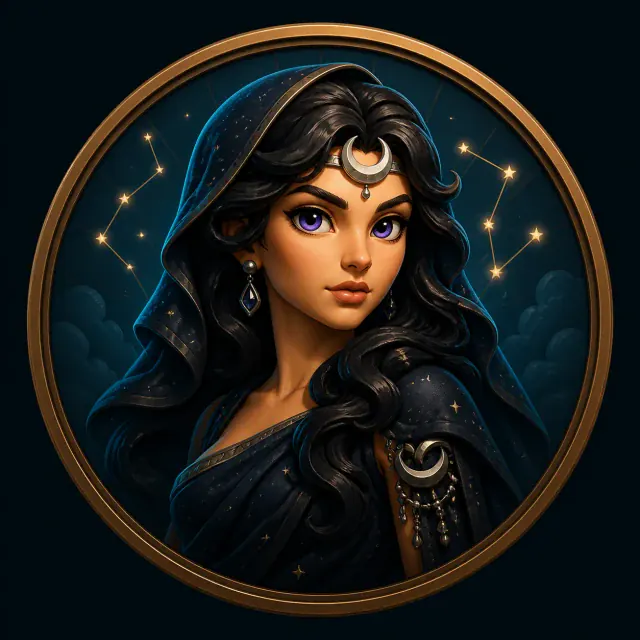
Illustrated portrait of Nyx

Portrait from the MythBranch atlas
Interpretive illustration, not an ancient likeness

Greek mythology research profile · cited sources

Nyx

Nox · Night as an older divine power

Nyx is Night personified, a primordial goddess whose power predates Olympus. Hesiod makes her a daughter of Chaos and mother—alone or with Erebus—of Day, Aether, Sleep, Death, the Fates, Strife, and other conditions that shape mortal life. She seldom drives a long adventure; her scale is cosmic, appearing in genealogy, daily transition, and moments when even Zeus respects an older limit.

Names · attributes · ancient evidence

Nyx: identity and historical contexts.

Nyx is both the visible arrival of night and a divine ancestor. Early art can show her as a winged woman or charioteer moving at the cosmic edge with Helios and Eos. In the Theogony, Night and Day pass one another at a remote house but never occupy it together. That architecture makes temporal alternation spatial. Her many children personify experiences that come under darkness or escape ordinary control: sleep, dreams, death, blame, deception, age, and fate.

Popular fantasy often turns Nyx into a hidden supreme queen, while astronomical naming and modern fiction borrow her name for darkness. Ancient evidence supports formidable antiquity but not a single standardized personality. In Iliad 14, Hypnos says Zeus once pursued him until he reached Nyx, whom Zeus feared to offend. The episode indicates respect for primordial status without creating a complete ranking system above Olympus.

01Nyx · Night02Melaina · Black03Euphronē · Kindly night04Pteroeissa · Winged05Ambrosiē · Immortal night
01

A family of human limits

Nyx's descendants are unusually abstract: Doom, Death, Sleep, Dreams, Blame, Misery, Deceit, Friendship, Old Age, and Strife. Genealogy makes these forces relatives rather than random events. Different passages and later authors adjust the list, so a modern chart should show the main line without implying that Hesiod supplied a fixed encyclopedic roster.

02

Night within a moving sequence

The Met's lekythos names Nyx and Eos around the chariot of Helios. Rather than isolating Night as a portrait, the vase places her within a sequence of movement. The adjacent inscriptions and figures document an ancient visual scheme for the passage of time.

Texts · chronology · variant traditions

Selected ancient narratives involving Nyx.

Nyx's most revealing appearances occur where poems explain beginnings, the daily cosmos, and boundaries Zeus chooses not to cross.

01

Hesiod · Theogony 123–125

Night and Darkness produce Day

Chaos produces Erebus and black Nyx. Nyx joins with Erebus and bears Aether and Hemera, bright upper air and Day. The surprising movement from darkness toward brightness makes opposition genealogical: light is not an unrelated enemy arriving from outside but an outcome of the first dark pair.

Hesiodic tradition: Theogony ↗
02

Hesiod · Theogony 744–766

The house where Night meets Day

Near the realm of Atlas, Night and Day approach a threshold, greet one another, and alternate their journeys over the earth. One enters as the other leaves. Sleep and Death also live nearby, while Tartarus lies beneath. Hesiod turns time, geography, and genealogy into one monumental imagined structure.

Hesiodic tradition: Theogony ↗
03

Iliad · Book 14

Zeus stops at Nyx

Hypnos recalls helping Hera deceive Zeus on an earlier occasion. Zeus hurled gods about while searching for Sleep, but Hypnos escaped into the protection of Nyx. Zeus halted because he was reluctant to displease swift Night. The recollection makes Hera's new plan dangerous and establishes the older goddess as a boundary even divine anger recognizes.

Homeric tradition: Iliad, Book 14 ↗

Genealogical records and atlas relationships

Genealogical evidence and variant traditions.

Hesiod gives Nyx one of the largest families of personified conditions. The atlas shows only the core branch from Chaos and the union with Erebus, not the full catalogue of children generated by Night alone.

Parents drawn in this atlas

00

No line of this type is drawn in the current atlas.

Chart-based siblings

00

No line of this type is drawn in the current atlas.

Unions drawn in this atlas

00

No line of this type is drawn in the current atlas.

Children drawn in this atlas

00

No line of this type is drawn in the current atlas.

Genealogy note

Aether and Hemera are born from Nyx and Erebus. Many darker or morally ambiguous powers are Nyx's children without a named partner; sources vary in how they assign parentage.

Open the interactive branch ↗

Text · stage · screen · scholarship

Selected works concerning Nyx in later reception.

Each selected work treats this figure as its subject, title presence, principal voice, or central dramatic agent. Incidental appearances are excluded. The bibliography also avoids assigning the same representative title to multiple profiles except where a shared primary text is indispensable.

  1. Imperial-era collectionOrphic Hymn to NightRitual hymn
  2. 414 BCEBirds: The Egg of NightComedy
  3. Named 2006Nyx on PlutoAstronomical name
01

Selected bibliography

Ancient poetry

02 works
02

Selected bibliography

Modern naming

01 works

When modern book covers or publicity images are shown, they appear at small scale for identification and criticism; copyright remains with the named rights holders. Public-domain context images are explicitly labeled.

Sources and documentation

Primary texts, scholarship, and catalogue records.

Dates follow conventional scholarly ranges. Cover thumbnails identify modern editions; they do not represent the original material form of an ancient text. Links lead to university archives, publishers, and museum catalogues.

Ancient source

2
  1. 01TheogonyHesiodic tradition
    Verified text or catalogue record
    Theogony↗

    Hesiodic tradition · late 8th–7th c. BCE

    Nyx's parentage, children, dwelling, and daily relation with Day.
    Edition or recordGreek text and translation · Perseus Digital Library
  2. 02Iliad, Book 14Homeric tradition
    Verified text or catalogue record
    Iliad, Book 14↗

    Homeric tradition · late 8th–early 7th c. BCE

    Hypnos's account of seeking Nyx's protection from Zeus.
    Edition or recordOpen translation · Harvard Center for Hellenic Studies

Academic study

1
  1. 01Night in Ancient Greek Religion and ArtMuseum and classical scholarship trail
    Verified text or catalogue record
    Night in Ancient Greek Religion and Art↗

    Museum and classical scholarship trail · Modern research

    Research trail for distinctions among poetic genealogy, ritual address, and visual personification.
    Edition or recordJSTOR indexed scholarship

Museum research

1
  1. 01Lekythos attributed to the Sappho PainterThe Metropolitan Museum of Art
    Verified text or catalogue record
    Lekythos attributed to the Sappho Painter↗

    The Metropolitan Museum of Art · c. 500 BCE

    Object record and public-domain image for the named charioteer Nyx.
    Edition or recordMet Collection · object 41.162.29

Family questions

Questions about Nyx's family.

Who are Nyx's parents?

Hesiod says Nyx came from Chaos. Other cosmogonies can give primordial Night a different position.

Who are Nyx's children?

With Erebus she bears Aether and Day; alone in Hesiod she generates many powers including Sleep, Death, the Fates, Nemesis, and Strife.

Is Nyx more powerful than Zeus?

Iliad 14 says Zeus avoided offending Nyx when Sleep sought her protection. That shows exceptional respect, not a complete ancient ranking that simply places Nyx above Zeus in every context.