HERO · 26
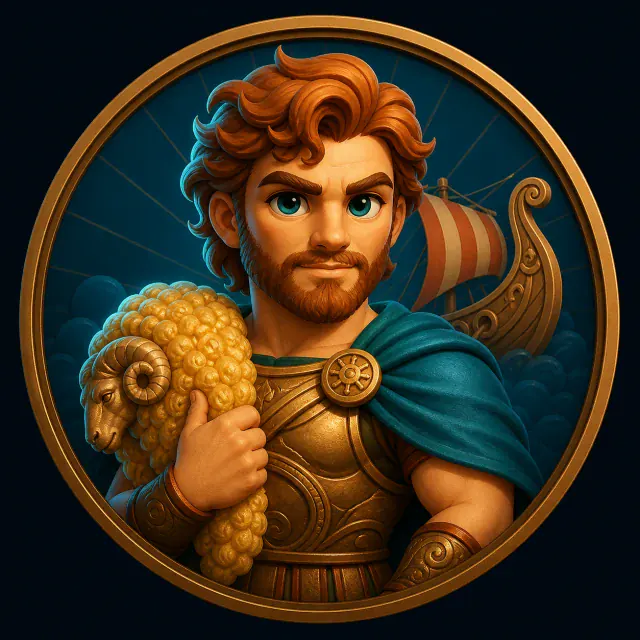
Illustrated portrait of Jason

Portrait from the MythBranch atlas
Interpretive illustration, not an ancient likeness

Greek mythology research profile · cited sources

Jason

Jason · Expedition leader whose victory cannot secure return

Jason is the displaced heir who gathers the Argonauts, sails the Argo for the Golden Fleece, survives impossible tasks through Medea's knowledge, and returns only to destroy the bond that made success possible. His story is an expedition epic and a tragedy of leadership, reciprocity, marriage, exile, and memory. Ancient works disagree about his heroism because the voyage and its aftermath ask different questions.

Names · attributes · ancient evidence

Jason: identity and historical contexts.

Jason arrives before Pelias missing one sandal, fulfilling an oracle. His name is related to healing, and he is often said to have been educated by Chiron. Unlike Heracles, he rarely solves obstacles by personal force; unlike Odysseus, he is not the sole intelligence of his crew. Hera protects him, Athena helps the ship, Argus builds it, Orpheus sings, and Medea supplies decisive strategy. Leadership consists in assembling exceptional capacities—and becomes ethically empty when those debts are denied.

Apollonius's Argonautica gives the fullest surviving account of the voyage and develops Medea's conflicted desire under divine pressure. Euripides begins after the expedition and sets Jason's rhetoric against Medea's account of rescue and oath. Later films often treat Medea as a magical helper who disappears from the heroic ending. Jason's profile therefore includes the Corinthian aftermath alongside the acquisition of the fleece.

01Iasōn · Jason02Aisonidēs · Son of Aeson03Argonautēs · Argonaut04Monosandalos · One-sandaled05Fleece-bearer
01

The Argo is a collective technology

The ship is built, advised, crewed, and sometimes given a speaking timber from Dodona. Catalogues of Argonauts vary because cities and families attach their heroes to the first great voyage. Jason's fame therefore rests on an expandable network whose membership is itself a history of reception.

02

Medea is not equipment

Jason cannot yoke the fire-breathing bulls, defeat the earthborn warriors, or secure the fleece without Medea. She betrays family and homeland, carries knowledge, and extracts promises. Treating her as one more magic item reproduces Jason's later failure to recognize the person whose agency made his triumph possible.

Texts · chronology · variant traditions

Selected ancient narratives involving Jason.

Jason's major episodes are connected by promises—royal, divine, marital, and political—that remain dangerous after each task is complete.

02

Outward voyage

The Argo gathers a heroic world

Jason recruits a shifting company including Orpheus, Castor and Polydeuces, Peleus, Telamon, Argus, and often Heracles. The voyage passes Lemnos, Cyzicus, the Bebrycians, Phineus, the Clashing Rocks, and other encounters. Success repeatedly depends on a specialist rather than the captain alone.

Apollonius of Rhodes: Argonautica ↗
03

Colchis

Medea makes the impossible tasks possible

Aeetes requires Jason to yoke fire-breathing bulls, sow dragon teeth, and overcome armed men born from the earth. Medea gives protective drugs and strategy, then helps secure the fleece from its serpent guardian. Divine desire, personal choice, family conflict, and oath bind the pair.

Apollonius of Rhodes: Argonautica ↗
04

Flight and Iolcus

The return carries violence home

Accounts of Apsyrtus's death differ, but escape from Colchis is marked by kin killing and purification. Back in Iolcus, Medea engineers Pelias's death through his daughters. Jason and Medea are driven into exile, showing that retrieval of the fleece does not automatically restore a legitimate kingdom.

Apollonius of Rhodes: Argonautica ↗Pseudo-Apollodorus: Library of Greek Mythology ↗
05

Euripides · Medea

Jason abandons Medea in Corinth

Jason plans to marry Creon's daughter and argues that the new alliance will benefit everyone. Medea recalls saving him and the oaths he swore. She destroys the new marriage and kills their children before escaping, leaving Jason alive with the complete collapse of household, lineage, and heroic future.

Euripides: Medea ↗

Genealogical records and atlas relationships

Genealogical evidence and variant traditions.

The atlas gives Jason an independent heroic node but cannot draw Aeson, Alcimede, Pelias, Medea, children, or the enormous Argonaut network. The page distinguishes dynasty from crew and marriage.

Parents drawn in this atlas

00

No line of this type is drawn in the current atlas.

Chart-based siblings

00

No line of this type is drawn in the current atlas.

Unions drawn in this atlas

00

No line of this type is drawn in the current atlas.

Children drawn in this atlas

00

No line of this type is drawn in the current atlas.

Genealogy note

Aeson is Jason's father; his mother is named Alcimede, Polymede, or otherwise in different sources. Jason and Medea have children whose names and number vary, and his later unions depend on the narrative tradition.

Open the interactive branch ↗

Text · stage · screen · scholarship

Selected works concerning Jason in later reception.

Each selected work treats this figure as its subject, title presence, principal voice, or central dramatic agent. Incidental appearances are excluded. The bibliography also avoids assigning the same representative title to multiple profiles except where a shared primary text is indispensable.

  1. 3rd c. BCEArgonauticaHellenistic epic
  2. 431 BCEMedeaTragedy
  3. 1944The Golden FleeceMyth-historical novel
01

Selected bibliography

Ancient epic & drama

02 works
02

Selected bibliography

Modern novels

01 works

When modern book covers or publicity images are shown, they appear at small scale for identification and criticism; copyright remains with the named rights holders. Public-domain context images are explicitly labeled.

Sources and documentation

Primary texts, scholarship, and catalogue records.

Dates follow conventional scholarly ranges. Cover thumbnails identify modern editions; they do not represent the original material form of an ancient text. Links lead to university archives, publishers, and museum catalogues.

Ancient source

3
  1. 01ArgonauticaApollonius of Rhodes
    Verified text or catalogue record
    Argonautica↗

    Apollonius of Rhodes · 3rd c. BCE

    The principal surviving complete voyage narrative and most sustained ancient characterization of Jason and Medea.
    Edition or recordGreek text and translation research · Perseus
  2. 02MedeaEuripides
    Verified text or catalogue record
    Medea↗

    Euripides · 431 BCE

    Corinthian aftermath, broken oath, Jason's rhetoric, and the destruction of the household.
    Edition or recordGreek text and translation research · Perseus
  3. 03Library of Greek MythologyPseudo-Apollodorus
    Verified text or catalogue record
    Library of Greek Mythology↗

    Pseudo-Apollodorus · 1st–2nd c. CE

    Compact synthesis of parentage, voyage, Colchis, return, and later fate.
    Edition or recordGreek text and translation · Perseus Digital Library

Museum research

1
  1. 01Jason with the Golden FleeceThorvaldsens Museum
    Verified text or catalogue record
    Jason with the Golden Fleece↗

    Thorvaldsens Museum · 1803 / 1828

    Authoritative record for the neoclassical sculpture and its place in Thorvaldsen's career.
    Edition or recordThorvaldsens Museum collection A822

Family questions

Questions about Jason's family.

Who are Jason's parents?

Aeson is his father; ancient sources give his mother several names, including Alcimede and Polymede.

How did Jason obtain the Golden Fleece?

Medea supplied protective drugs and strategy for Aeetes' tasks and helped him overcome the fleece's guardian after the Argonaut voyage reached Colchis.

Was Jason a great hero?

He leads an extraordinary expedition, but ancient tragedy and epic emphasize dependence, broken oaths, political failure, and the cost borne by Medea and others.