PRIMORDIAL · 04
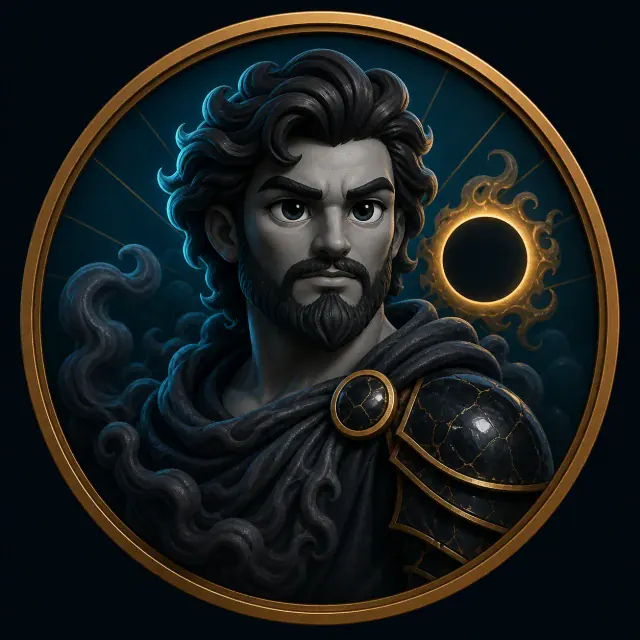
Illustrated portrait of Erebus

Portrait from the MythBranch atlas
Interpretive illustration, not an ancient likeness

Greek mythology research profile · cited sources

Erebus

Erebus · Darkness as being and underworld region

Erebus is primordial Darkness and also a word for the gloomy region through which the dead pass. Hesiod makes him a child of Chaos and partner of Nyx; together they produce Aether and Day. Because the same name can indicate a being, a substance, or an underworld zone, Erebus resists the modern expectation that every atlas node should behave like a human-shaped character with a sequence of adventures.

Names · attributes · ancient evidence

Erebus: identity and historical contexts.

Erebos names deep obscurity, especially the dark below the bright world. In the Theogony the word participates in genealogy, but in Homer it often functions geographically: gods or souls may be sent down to Erebus. The distinction between person and region is not a defect in the evidence. Greek myth repeatedly personifies physical and moral conditions without removing their ordinary spatial meaning.

Roman poets translate or pair Erebus with terms for darkness and the underworld. Later European literature uses the classical name as a grand synonym for hell, night, or death, sometimes detached from Nyx and early cosmogony. Since secure independent cult and iconography are scarce, this page emphasizes textual function and refuses to label generic images of Hades as portraits of Erebus.

01Erebos · Deep darkness02Zophos · Gloom03Skotos · Darkness04Tenebrae · Roman darkness05Aides domos · House below
01

Personification does not cancel geography

When Hesiod gives Erebus parentage and a union, the darkness behaves genealogically. When epic sends a shade ‘to Erebus,’ the word behaves like a destination. Ancient readers could tolerate both. A responsible page therefore explains grammatical context instead of choosing one modern ontology and forcing every occurrence into it.

02

Limits of the visual evidence

Museum databases contain many underworld scenes, but most represent Hades, Persephone, Heracles, Orpheus, or unnamed dead. They do not automatically depict Erebus as a separate figure. This profile therefore records only works whose titles or catalogue histories explicitly identify Erebus.

Texts · chronology · variant traditions

Selected ancient narratives involving Erebus.

Erebus acts less like an epic hero than a conceptual hinge between cosmogony and the geography of death.

01

Hesiod · Theogony 123–125

Erebus emerges from Chaos

Chaos produces Erebus and black Nyx. Their union then produces Aether and Hemera. The compact passage sets lower darkness and night beside upper brightness and day, using ancestry to explain a structured cosmos rather than a battle between moral good and evil.

Hesiodic tradition: Theogony ↗
02

Homeric epic

The dead travel into Erebus

In epic diction Erebus is repeatedly the dark destination below: shades descend there, and underworld beings can emerge from it. These passages do not pause to stage a god named Erebus speaking. The ancient name retains mythic weight while functioning as part of the world's vertical geography.

Homeric tradition: Odyssey ↗
03

Aristophanes · Birds

Night's egg rests in Erebus

The comic cosmogony imagines Night laying a wind-egg in the boundless depths of Erebus. Eros hatches and helps generate the visible order. Erebus becomes a containing depth in which an alternative creation can incubate, a role different from Hesiod's reproductive pair.

Aristophanes: Birds ↗

Genealogical records and atlas relationships

Genealogical evidence and variant traditions.

The atlas follows Hesiod by drawing Erebus and Nyx from Chaos and linking the pair. Aether and Day are central children in that poem even though they are outside the current selected network.

Parents drawn in this atlas

00

No line of this type is drawn in the current atlas.

Chart-based siblings

00

No line of this type is drawn in the current atlas.

Unions drawn in this atlas

00

No line of this type is drawn in the current atlas.

Children drawn in this atlas

00

No line of this type is drawn in the current atlas.

Genealogy note

The union is cosmogonic rather than a developed marriage narrative. Later lists assign additional children to Night and Darkness, but they often reflect different literary systems.

Open the interactive branch ↗

Text · stage · screen · scholarship

Selected works concerning Erebus in later reception.

Each selected work treats this figure as its subject, title presence, principal voice, or central dramatic agent. Incidental appearances are excluded. The bibliography also avoids assigning the same representative title to multiple profiles except where a shared primary text is indispensable.

  1. late 8th–7th c. BCETheogony: Erebus and NightCosmogonic poem
  2. 414 BCEBirds: The Depths of ErebusComedy
  3. 1667Paradise Lost: Erebus as Classical DepthEpic poem
01

Selected bibliography

Ancient poetry

02 works
02

Selected bibliography

Later literature

01 works

When modern book covers or publicity images are shown, they appear at small scale for identification and criticism; copyright remains with the named rights holders. Public-domain context images are explicitly labeled.

Sources and documentation

Primary texts, scholarship, and catalogue records.

Dates follow conventional scholarly ranges. Cover thumbnails identify modern editions; they do not represent the original material form of an ancient text. Links lead to university archives, publishers, and museum catalogues.

Ancient source

3
  1. 01TheogonyHesiodic tradition
    Verified text or catalogue record
    Theogony↗

    Hesiodic tradition · late 8th–7th c. BCE

    Erebus's emergence from Chaos and union with Nyx.
    Edition or recordGreek text and translation · Perseus Digital Library
  2. 02OdysseyHomeric tradition
    Verified text or catalogue record
    Odyssey↗

    Homeric tradition · late 8th–early 7th c. BCE

    Epic uses of Erebus as the dark region associated with the dead.
    Edition or recordOpen translation · Harvard Center for Hellenic Studies
  3. 03BirdsAristophanes
    Verified text or catalogue record
    Birds↗

    Aristophanes · 414 BCE

    Alternative cosmic-egg account locating generation in Erebus.
    Edition or recordPerseus Digital Library research record

Academic study

1
  1. 01Erebus in Greek and Roman textsPerseus Digital Library
    Verified text or catalogue record
    Erebus in Greek and Roman texts↗

    Perseus Digital Library · Textual research

    A corpus trail that allows readers to distinguish a named being from spatial and poetic usage.
    Edition or recordTufts University digital corpus

Family questions

Questions about Erebus's family.

Who are Erebus's parents?

Hesiod says Erebus came from Chaos, alongside Nyx.

Who are Erebus's children?

With Nyx, Erebus produces Aether and Hemera, upper brightness and Day, in Hesiod's Theogony.

Is Erebus the same as Hades?

No. Erebus can name primordial darkness or a dark underworld region; Hades is the ruler of the dead and also a name used for his realm.