PRIMORDIAL · 01
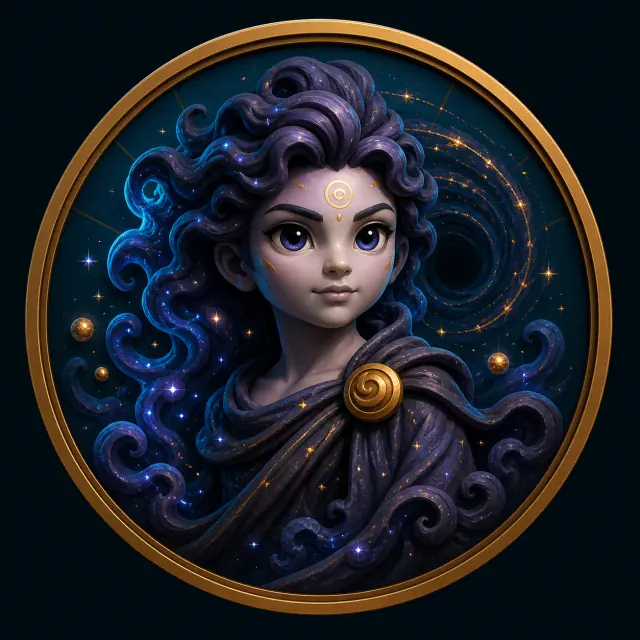
Illustrated portrait of Chaos

Portrait from the MythBranch atlas
Interpretive illustration, not an ancient likeness

Greek mythology research profile · cited sources

Chaos

Chaos · The first gap before an ordered cosmos

Chaos is the first named reality in Hesiod's Theogony: not a noisy disorderly personality, but a yawning gap from which Night and Darkness emerge. Later Greek and Roman writers changed the idea, and modern English inherited ‘chaos’ as confusion. Reading the figure well therefore requires separating Hesiod's opening space, later elemental mixture, and the ordinary modern word.

Names · attributes · ancient evidence

Chaos: identity and historical contexts.

The Greek noun khaos is related to opening or gaping. In Hesiod it appears before Gaia, Tartarus, and Eros, then generates Erebus and Nyx. Chaos has almost no biography, cult, consistent gender, or human-shaped iconography. Its importance lies in sequence and structure: it marks a condition before the differentiated relationships that make a genealogy possible. Calling Chaos ‘the god of disorder’ can be convenient, but it imports later meanings into an early poem whose language is spatial and cosmogonic.

Ovid begins the Metamorphoses with chaos as a rough, unorganized mass in which the elements have not yet been separated. That enormously influential Roman description helped produce the modern idea of chaotic confusion. Aristophanes' Birds offers a playful alternative cosmogony involving Chaos, Night, Erebus, Tartarus, an egg, and Eros. These accounts are evidence of several ancient ways to imagine beginnings, not pieces of one perfectly synchronized timeline.

01Khaos · Gap02Prōtiston · First03Chasma · Opening04Caligo · Roman mist05Rudis indigestaque moles · Unshaped mass
01

A genealogy begins where genealogy almost fails

The atlas gives Chaos a node because Hesiod names it at the start and makes Erebus and Nyx emerge from it. Yet ‘parent’ is already an approximation: the poem states succession and generation without supplying a household, partner, pregnancy, or divine childhood. The branch should therefore be read as a map of poetic emergence rather than a literal family photograph.

02

Absence of a secure portrait type

Ancient art offers no stable, securely identified portrait type for Chaos comparable to Zeus's thunderbolt or Athena's aegis. Later artists usually visualize a turbulent void, elemental cloud, or the moment of creation. Those works are classified here as reception; modern fantasy figures are not presented as authenticated ancient likenesses.

Texts · chronology · variant traditions

Selected ancient narratives involving Chaos.

Chaos rarely acts inside a plot. Its major ‘stories’ are competing accounts of how order, difference, and generation become thinkable.

01

Hesiod · Theogony 116–125

Chaos comes first

The Muses answer a question about what first came to be. Chaos appears first, followed by broad-breasted Gaia, deep Tartarus, and Eros. From Chaos come Erebus and black Night; Night and Erebus then produce Aether and Day. The sequence builds a cosmos through contrasting spaces and conditions rather than through a creator issuing commands.

Hesiodic tradition: Theogony ↗
02

Aristophanes · Birds, 414 BCE

Night lays the cosmic egg

The chorus of birds parodies learned cosmogony: at first there are Chaos, Night, Erebus, and Tartarus. Black-winged Night lays an egg in Erebus, and from it hatches golden-winged Eros, who helps generate birds and the visible world. Comedy borrows the authority of sacred beginnings while redirecting it toward an outrageous claim that birds are older than Olympian gods.

Aristophanes: Birds ↗
03

Ovid · Metamorphoses, c. 8 CE

Ovid's unshaped mass

Ovid calls Chaos a rude and unorganized heap in which earth, sea, and air are mingled without stable form. A god or ‘better nature’ separates the elements, assigns places, and produces an ordered world. The account is Roman poetry in dialogue with philosophical cosmology and earlier myth, not a translation of Hesiod's first lines.

Ovid: Metamorphoses, Book 1 ↗

Genealogical records and atlas relationships

Genealogical evidence and variant traditions.

The chart connects Chaos to Erebus and Nyx because that sequence is explicit in Hesiod. Other ancient cosmogonies begin differently, and even Hesiod does not describe a conventional couple or household at the origin.

Parents drawn in this atlas

00

No line of this type is drawn in the current atlas.

Chart-based siblings

00

No line of this type is drawn in the current atlas.

Unions drawn in this atlas

00

No line of this type is drawn in the current atlas.

Children drawn in this atlas

00

No line of this type is drawn in the current atlas.

Genealogy note

Treat the line from Chaos as ‘comes forth from’ rather than a claim that every Greek author imagined biological parenthood. Gaia, Tartarus, and Eros follow Chaos in Hesiod but are not called its children in that passage.

Open the interactive branch ↗

Text · stage · screen · scholarship

Selected works concerning Chaos in later reception.

Each selected work treats this figure as its subject, title presence, principal voice, or central dramatic agent. Incidental appearances are excluded. The bibliography also avoids assigning the same representative title to multiple profiles except where a shared primary text is indispensable.

  1. late 8th–7th c. BCETheogonyHexameter poem
  2. 414 BCEBirdsComedy
  3. 1798The Creation: Representation of ChaosOratorio introduction
01

Selected bibliography

Ancient cosmogony

02 works
02

Selected bibliography

Music & later reception

01 works

When modern book covers or publicity images are shown, they appear at small scale for identification and criticism; copyright remains with the named rights holders. Public-domain context images are explicitly labeled.

Sources and documentation

Primary texts, scholarship, and catalogue records.

Dates follow conventional scholarly ranges. Cover thumbnails identify modern editions; they do not represent the original material form of an ancient text. Links lead to university archives, publishers, and museum catalogues.

Ancient source

3
  1. 01TheogonyHesiodic tradition
    Verified text or catalogue record
    Theogony↗

    Hesiodic tradition · late 8th–7th c. BCE

    The principal genealogy in which Chaos comes first and produces Erebus and Night.
    Edition or recordGreek text and English translation · Perseus Digital Library
  2. 02BirdsAristophanes
    Verified text or catalogue record
    Birds↗

    Aristophanes · 414 BCE

    Comic preservation and transformation of a cosmic-egg tradition.
    Edition or recordGreek text and translation search · Perseus Digital Library
  3. 03Metamorphoses, Book 1Ovid
    Verified text or catalogue record
    Metamorphoses, Book 1↗

    Ovid · c. 8 CE

    The influential Roman description of Chaos as unorganized elemental matter.
    Edition or recordLatin text and English translation · Perseus Digital Library

Academic study

1
  1. 01The Early Greek Concept of ChaosClassical scholarship trail
    Verified text or catalogue record
    The Early Greek Concept of Chaos↗

    Classical scholarship trail · Modern research

    A research trail for philological debates about the term rather than a single simplified definition.
    Edition or recordJSTOR indexed scholarship

Family questions

Questions about Chaos's family.

Is Chaos a god or a place?

Ancient poetry can treat primordial realities as both conditions and personified beings. In Hesiod, Chaos is best approached as the first gap or opening; it has genealogy but almost no human-like biography.

Who are the children of Chaos?

Hesiod says Erebus and Nyx came from Chaos. Later sources expand or rearrange primordial genealogies.

Does Greek Chaos mean disorder?

Not primarily in Hesiod. The familiar meaning of disorder owes much to later philosophical and Roman reinterpretation, especially Ovid's elemental mixture.